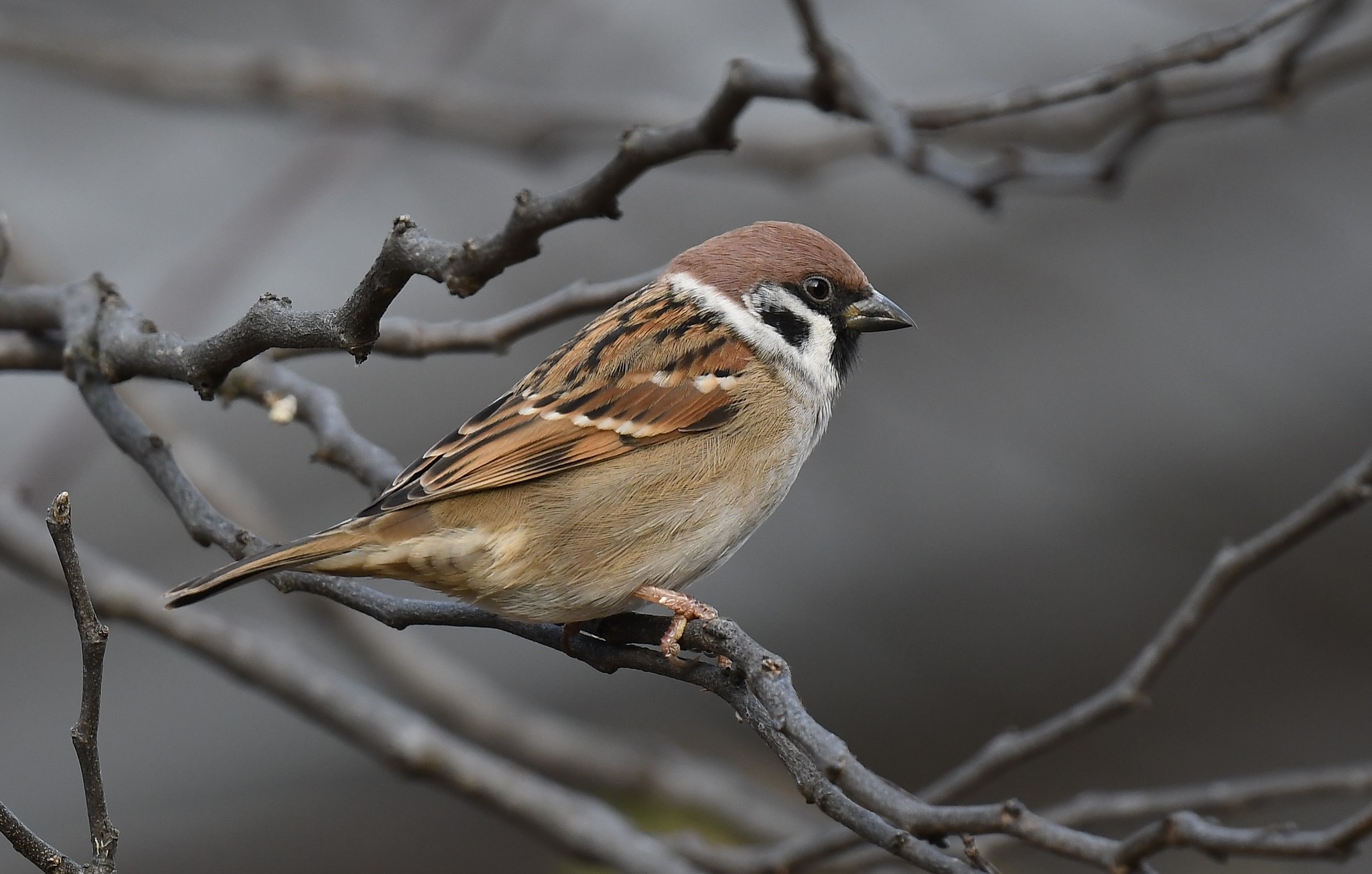
Passer montanus
Identity and names
Eurasian Tree Sparrow, Passer montanus, is Moineau friquet in French and belongs to Passeridae within the order Passeriformes. It is approximately 14 cm long and usually weighs around 20–24 g. Its name does not confine it to closed forest: trees with cavities, fields and villages may together provide its requirements. It is unrelated at genus level to the American Tree Sparrow, and a sparrow perched in a tree is not necessarily this species.
Identification
Look for a fully chestnut crown and an isolated black spot on each white cheek, combined with a small black throat patch and an incomplete white collar. The brown back is streaked and the wings have pale bars. Males and females look alike, unlike the strongly different sexes of House Sparrow. Juveniles have a less contrasting face. Male Spanish Sparrows also have chestnut crowns, but lack the isolated cheek spot and show heavier black markings below.
Habitat, food and behaviour
Farmland edges, orchards and open woodland provide food, shelter and potential nest cavities. Adults eat seeds and grain and also collect insects and other invertebrates, particularly for their chicks. Its relationship with settlements varies geographically: a predominantly rural bird in much of Europe, it readily occupies towns in eastern Asia. Outside breeding, birds may join mixed flocks. Checking individuals rather than labelling an entire flock as ordinary sparrows is therefore a useful identification habit.
Range and Arab occurrence
Although widespread across Eurasia, its Arab occurrence is limited. The specialist Iraqi checklist describes a rare winter visitor to northern and central Iraq. Lebanon’s 2026 guide treats it as a vagrant, with an uncertain old Litani Valley record and two birds recorded at Qaa in November 2018. The published Oman list classifies it as a vagrant with one record. These situations are not regular residence or breeding and cannot be extended to the Gulf or Maghreb generally.
Breeding and development
Nests occupy cavities in trees or buildings; suitable nest boxes may also be used. Plant material and feathers line the nest. BTO reports a usual clutch of 5–6 eggs, incubation by both sexes lasting 12–13 days, and young leaving after roughly 15–18 days. These are approximate development periods, not an Arab breeding calendar. A bird standing beside a hole does not establish nesting, and departure from the nest does not necessarily mean immediate independence from parental care.
November and responsible observation
A possible November observation in Iraq or the Levant deserves careful documentation. Record country, site, date and numbers, seeking a side view of the cheek and a view of the crown without moving after the bird. Shade can conceal the cheek spot, so an uncertain identification is preferable to certainty based on a chestnut crown alone. Allow feeding flocks to continue undisturbed and avoid flushing them towards traffic or repeatedly interrupting access to shelter.
Conservation
Its global IUCN category is Least Concern, but local declines remain important: Britain experienced a severe historical decrease whose effects persist. Retaining winter seed, insects and nesting cavities in farmland helps meet different seasonal needs. Reducing pesticide pressure and keeping suitable old trees can protect these resources. Where this sparrow is rare, a photograph of a living bird is more valuable than capturing or killing one to establish identity. Local wildlife laws apply regardless of global category.
References
AviList Core Team — AviList v2026; British Trust for Ornithology — BirdFacts: Tree Sparrow; RSPB — Tree Sparrow; UNDP / ABCL / Ministry of Environment — Birds of Lebanon, 2026, p. 387; Salim et al. — An annotated checklist of the birds of Iraq, Sandgrouse 34, 2012; Oman Birds Records Committee — Official Oman Birdlist.
Photo: Chrissy McClarren and Andy Reago