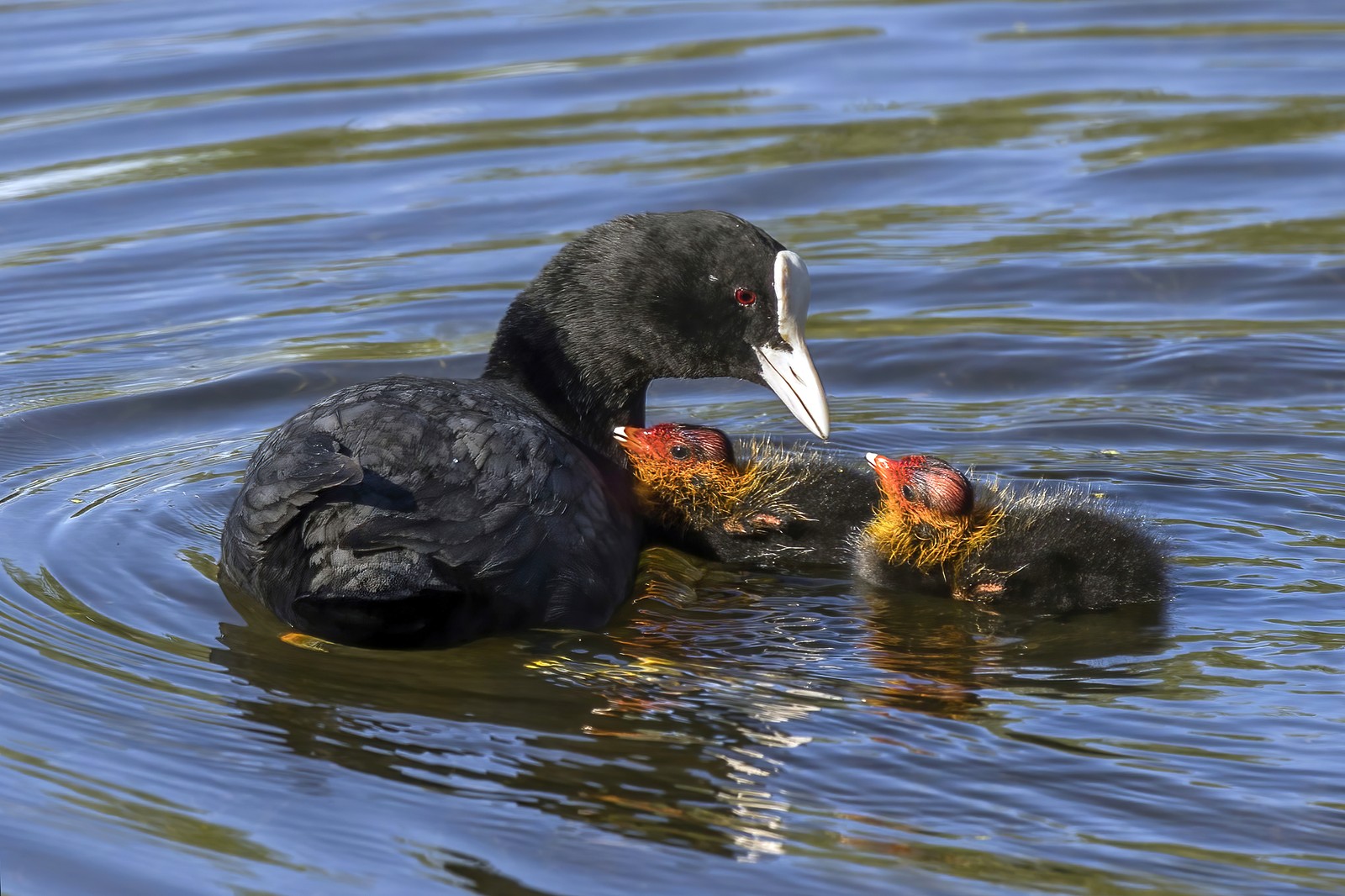
From a distance it looks like an unassuming dark waterbird. Closer views reveal two prominent features: a white bill and a white shield on the forehead. The Eurasian Coot combines diving skills with life in winter flocks. Yet not every coot seen in October is a new arrival: at some Arab wetlands, resident breeding birds meet visitors from colder regions.
Identification card
- Arabic name: الغرّة الأوراسية; the Saudi bird reference uses غراء أوراسية.
- English: Eurasian Coot; French: Foulque macroule.
- Scientific name: Fulica atra, family Rallidae, order Gruiformes. Despite sharing the water with ducks, it is not a duck.
- Global conservation status: Least Concern (LC), which does not mean every local population is stable.
The scientific name follows AviList v2026; regional references document differing patterns of occurrence between countries. [1] [2] [7]
Why watch it in autumn?
European ringing data show autumn movements beginning in late August and strengthening from mid-September, with returns to distant wintering sites during October. They also document connections between south-western Europe and North Africa. These are observed migration patterns, not a common arrival calendar for all Arab coots: the species includes both resident and migratory populations. [11]
An Arab map of residence, passage and wintering
Lebanon’s 2020 checklist describes the coot as a resident breeder at inland wetlands, and very common on passage and in winter, mainly from September to late May. Seeing a bird in autumn therefore does not establish that it is a migrant; nor does a winter flock show that all its members breed at that site. [3]
In Morocco, a study of Daya Takaddoum in the Bouregreg valley documented breeding in 2018 and 2019, and increasing numbers with the arrival of winter visitors. This is local field evidence, not a current nationwide count. Tunisian winter surveys conducted in 2020–2021 and published in 2024 also recorded the species, underlining the seasonal importance of wetlands. [4] [6]
Saudi Arabia’s bird reference classifies it as a rare breeding resident and an uncommon winter visitor, occurring in winter from October to March. The Emirates Bird Records Committee checklist, updated in February 2026, calls it a locally common migrant and winter visitor, with resident breeding populations at particular sites, including Al Warsan Lakes and Al Wathba Wetland Reserve. Such differences rule out treating one country’s status as that of the entire Gulf. [2] [5]
In Egypt, the Lake Burullus Key Biodiversity Area account, whose latest listed assessment is from 2016, includes coots among wintering waterbirds. This is reference evidence of the site’s winter importance, not a recent count. [12]
In Iraq’s Central Marsh, a study published in 2017 recorded coots as winter visitors from November to March during surveys conducted from October 2013 to June 2014. It did not record them in the breeding season within the study area; this does not establish an absence of breeding throughout Iraq. [13]
Recognising age and distinguishing similar species
Adult coots have charcoal-grey bodies, blacker heads and white bills and frontal shields. Their long toes carry separate skin lobes that aid swimming, unlike the continuous webbing familiar in ducks. To take off, they run across the water before gaining height. [8]
The sexes look similar: black plumage alone does not identify an individual’s sex. Juveniles are paler, with greyish white on the face, fore-neck and breast, and a frontal shield that is not yet fully developed. The Red-knobbed Coot Fulica cristata is particularly similar. Red knobs above the shield help identify breeding adults, but their apparent absence in a distant photograph is not enough to exclude that species. [9]
Adult Common Moorhens Gallinula chloropus, by contrast, have a red frontal shield. Combine head, bill and body shape rather than calling every dark waterbird a coot. [8]
Food, habitat and behaviour
Coots use lakes, ponds and slow-flowing waterways, including urban waters. They eat aquatic plants and seeds, as well as molluscs, insects and larvae, diving for food or grazing close to the bank. Their presence in a treatment pond does not make its water drinkable, and bird abundance alone is not a water-quality test. [10]
Life cycle: from nest to flock
Both partners build a nest of plant material near aquatic cover, share incubation and care for the young, and defend the surrounding territory. Breeding-season disputes between neighbours can be fierce, unlike the winter gatherings that bring many individuals together. [2] [8]
BTO data give a typical clutch of 5–7 eggs, incubation of about 21–24 days and flight capability at roughly 55–60 days. The downy young can move early but remain dependent on parental care. These are reference values, not fixed numbers or durations for every Arab nest; a European nesting calendar cannot simply be transferred to a different climate. [7]
Its value, and what needs protecting
Following coots helps reveal how a lake is used throughout the year: where flocks feed, and where vegetation suitable for nesting remains. The Daya Takaddoum study highlights wetland habitat change under urban pressure. Protecting the place, not just the bird, preserves opportunities to feed, breed and rest. [4]
Watch from the bank without repeatedly forcing birds to flee, and do not approach nests or chicks for a better photograph. Record the date, site, count and behaviour, distinguishing a sighting from breeding evidence. Global Least Concern status neither automatically permits hunting nor replaces local regulations.
References
- AviList v2026 — Global Avian Checklist
- The Birds of Saudi Arabia, volume 2, p. 72
- Ramadan-Jaradi et al. (2020) — Lebanon checklist, p. 195
- Hilmi et al. (2020) — Daya Takaddoum, Morocco
- Emirates Bird Records Committee — 19 February 2026 checklist, p. 19
- Hamza et al. (2024) — wintering waterbirds in Tunisia
- BTO BirdFacts — Coot breeding and conservation status
- RSPB — Coot identification and behaviour
- MEEDDAT–MNHN — Coot species account
- LPO — Coot habitat and diet
- EURING/CMS — Coot migration atlas
- Key Biodiversity Areas — Lake Burullus, 2016 assessment
- Fazaa et al. (2017) — birds of Iraq’s Central Marsh; 2013–2014 surveys
Photo: © Charles J. Sharp, via Wikimedia Commons, CC BY-SA 4.0. Photographed at Trujillo, Spain on 2022-04-14; resized and compressed for the website without changing its content.