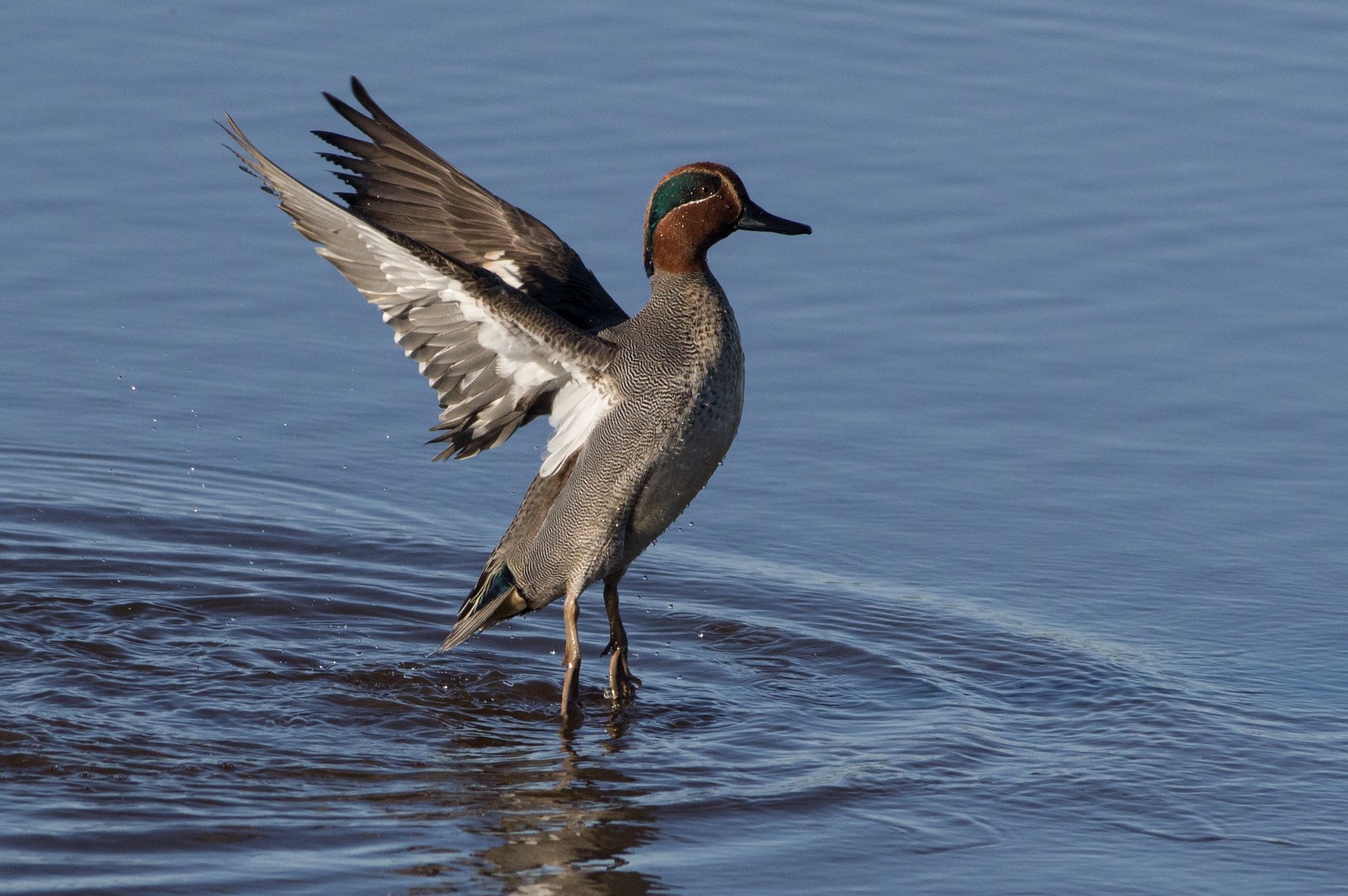
At the edge of shallow water, a teal can look like a small duck among larger flocks. A male’s chestnut head and green face patch reveal a bird connecting northern breeding grounds with Arab winter wetlands. October highlights the value of quiet pools and stopovers, but migration, residence and breeding must remain distinct.
Identity and taxonomic scope
Arabic name: الحذفة الشتوية, documented in The Birds of Saudi Arabia. The species is Anas crecca, family Anatidae, order Anseriformes. AviList v2026 calls the broader species Green-winged Teal and includes the American carolinensis as a subspecies. This account centres on the Eurasian form Anas crecca crecca, also called Eurasian or Common Teal; its French name is Sarcelle d’hiver. Different English names therefore do not denote two separate species in this treatment. [1] [2] [8]
Recognition
A brightly plumaged male has a chestnut head with a broad green eye patch, spotted breast, grey flanks and a yellow rear patch bordered by dark markings. Females are mottled brown; both sexes show a green wing speculum. Brown plumage alone cannot identify a female among similar ducks. [6]
Age, sex and lookalikes
The Eurasian form measures about 34–38 cm. Outside bright plumage, males may resemble females. Accurate ageing uses wing and tail feather details and wear, not body size alone. Small size and the speculum pattern help distinguish females from other brown ducks, but distant photographs or concealed wings may prevent reliable identification. Criteria developed for birds handled during ringing cannot simply be applied to a fleeting photograph. [7]
Garganey Spatula querquedula warrants comparison: it is slightly larger, and its brightly plumaged male has a broad white eyebrow rather than the teal’s green face patch. [13]
October, migration and Arab distribution
Saudi references describe common passage in February–March and September–October, common winter presence in November–February, irregular summer occurrence and no breeding in the book’s account. The UAE’s 2026 checklist lists the Eurasian form as a common to very common migrant and winter visitor. These are national status descriptions, not counts for autumn 2026. [2] [4]
Lebanon’s 2020 checklist treats it as a former breeder, with passage in March–early May and mid-August–late November, and winter presence chiefly in Beqaa wetlands during December–March. Pairs seen in May in earlier years were not accepted as evidence of renewed breeding. Tunisian surveys in December 2020–January 2021 documented winter occurrence; the study appeared in 2024 and is not a new count. [3] [5]
Farther west, Danish ringing recoveries document birds reaching Morocco in winter. Egypt’s historical Ramsar information sheet for Lake Burullus also records wintering teal. These examples span the Maghreb, Egypt, the Levant and the Gulf; they are neither an exhaustive country list nor grounds for assigning every Arab population to one route. [9] [10]
In Egypt, a BirdLife report published in February 2025 identifies Lake Nasser as a teal stopover and wintering site. In Iraq’s Central Marsh, the October 2013–June 2014 survey recorded teal in December–March, not among observed breeders; this is not a current census. [11] [12]
Habitat, food and behaviour
It uses shallow, vegetation-rich wetlands, including small pools, lakes and saline lagoons. Plant material and invertebrates are taken at the surface or by dipping and upending. The Saudi account describes much feeding at night, with daytime activity too: a resting daytime flock does not mean that a wetland has little feeding value. [2]
Life cycle and reproduction
BTO gives a typical single brood, 8–11 eggs and female incubation lasting about 21–23 days. Chicks hatch downy and mobile. These are reference biological values, not a uniform Arab nesting calendar. Breeding is followed by movements towards post-breeding and winter sites; ringing shows that some birds stop for weeks while others move on quickly. A duck remaining in summer is not proof of a nest or successful hatching. [8] [9]
Ecological importance and conservation
The need to feed and rest at several sites makes a connected wetland network more valuable than protection of one pool alone. The Tunisian study describes habitat pressures including pollution, urban expansion and illegal hunting. Such general pressures cannot be converted into a species-specific loss estimate without relevant data. [5]
BTO reports Least Concern, LC, for Eurasian Teal; this reference is not a new assessment of the species under its expanded taxonomic scope in AviList 2026. A taxonomic change is not, by itself, evidence of a population increase or decline. [1] [8]
Responsible observation
Watch from a stationary position at a distance that does not flush the flock, and record date, location and plumage. Reliable identification takes priority over naming every bird: where diagnostic features are hidden, an unresolved small-duck record is preferable to a false species record. This account does not authorise hunting; legal status is separate from abundance and conservation category.
Scientific references
- [1] AviList v2026
- [2] The Birds of Saudi Arabia, Volume 2
- [3] Updated checklist of the birds of Lebanon (2020)
- [4] Emirates Bird Records Committee: checklist, 19 February 2026
- [5] Hamza et al. (2024), winter waterbirds of Tunisia
- [6] RSPB: Teal identification
- [7] Blasco-Zumeta & Heinze: Eurasian Teal identification, ageing and sexing
- [8] BTO BirdFacts: Teal
- [9] Danish Bird Migration Atlas: Eurasian Teal
- [10] Ramsar: Lake Burullus, historical information sheet (1993)
- [11] BirdLife / Nature Conservation Egypt (2025), Lake Nasser
- [12] Fazaa, Dunn & Whittingham (2017), Iraq’s Central Marsh
- [13] RSPB: Garganey identification
Photo: Hobbyfotowiki, via Wikimedia Commons, CC0 1.0. Photographed at Le Teich bird reserve, France on 2020-02-06; resized and compressed for the website without changing its content.