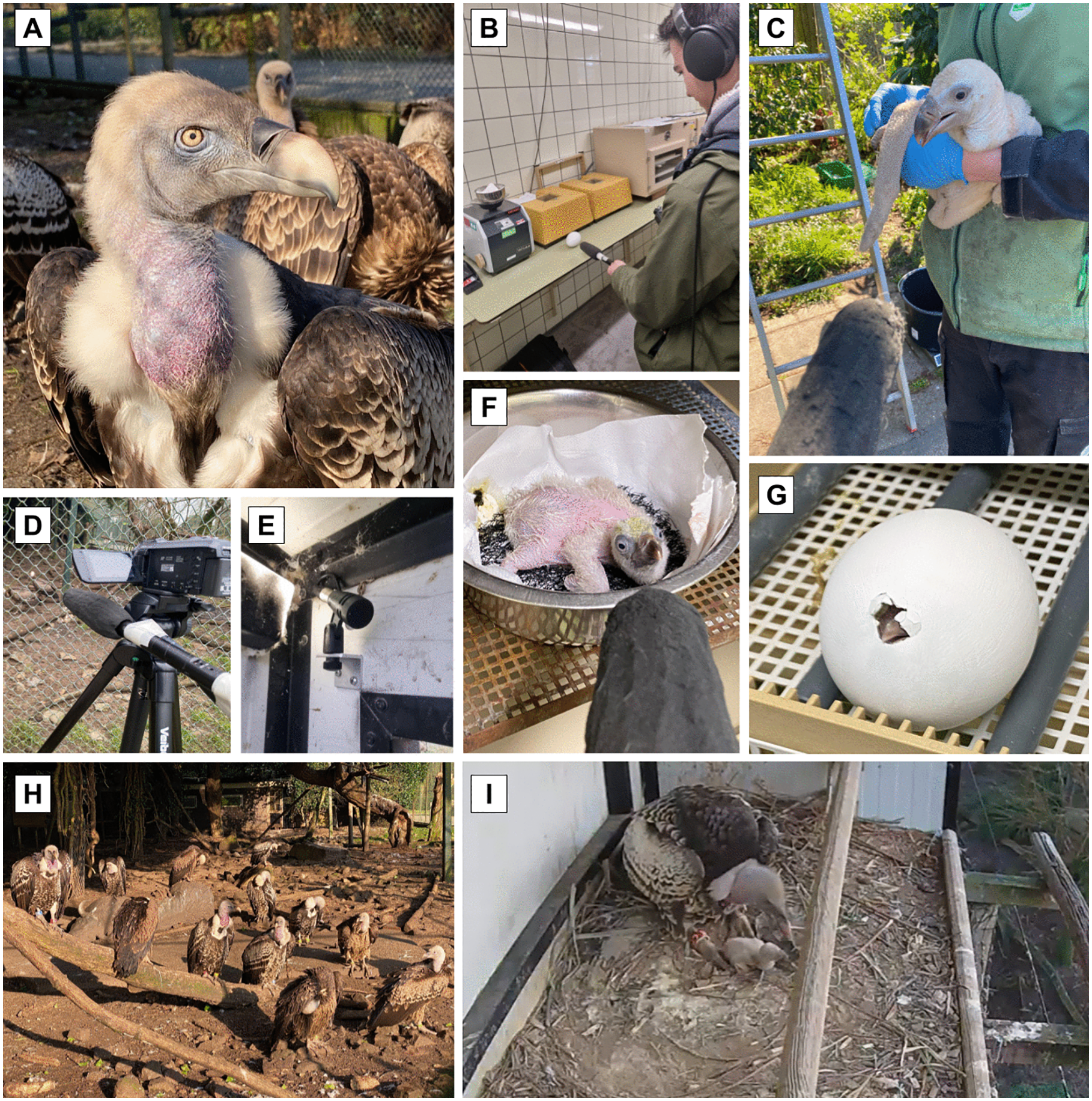
Soft calls from inside the egg reveal the beginnings of a rich vocal world in Rüppell’s vultures—and could open a new avenue for conservation.
The sound comes first, from inside the egg; the chick’s arrival follows. That is how the story begins for Rüppell’s vultures, whose vocal lives appear far richer than their supposedly silent image suggests.
Researchers documented soft calls produced before hatching in a study published in PLOS One on 21 October 2026. According to Utrecht University, the chicks begin making these sounds about two days before they emerge.
Original recording of a Rüppell’s vulture egg before hatching
Video S2 from the study’s supplementary material, approximately 18 seconds. Increase the volume or use headphones for this quiet recording.
A single call from inside the egg
Audio S1 is a very short sample of one call from inside the egg, lasting approximately 0.22 seconds.
A voice before emergence
The study describes soft, tonal calls beginning after the chick breaks into the egg’s air chamber and starts breathing with its lungs. The calls continue through hatching and appear to develop into the chick’s post-hatching sounds, becoming more variable.
Artificial incubation at Rotterdam’s Diergaarde Blijdorp offered an opportunity to record this stage. Whether parents answer their chick’s calls while it is still inside the egg could not be determined by the study.
A society with calls of its own
The team, led by Connor Proudfoot, studied two groups of Rüppell’s vultures in the Netherlands, comprising 35 birds, and analysed 2,500 calls. Recordings collected between September 2024 and May 2025 covered feeding, competition, reproduction and care of young.
The researchers distinguished 16 call types: some clearly differentiated, others graded and overlapping. This vocal world includes food-begging calls, calls associated with resource defence or receiving aggression, and sounds accompanying the feeding of chicks. Its diversity offers a window into the social life of a bird often described as quiet.
Could sound help conserve the species?
Rüppell’s vulture, Gyps rueppelli, is critically endangered. The significance of the research therefore extends beyond the surprising sound inside an egg to a practical question: could hearing these calls help parents prepare for their chick’s arrival?
In artificial-incubation programmes, a model may replace the real egg, and chicks return to the nest only several days after hatching. The researchers propose testing the role of pre-hatching calls and their potential future use in improving chick acceptance and breeding success. This remains a proposed research step; the study has not tested that effect.
The beginning of a fuller picture
The study provides a quantitative description of the species’ vocal repertoire, rather than the final word on it. The work took place in captivity: wild populations may use calls or encounter contexts not represented in the recordings, including interactions during soaring flight. Behind the silent bird of popular imagination is a world worth listening to.
Photographs: Connor Proudfoot; recordings: Proudfoot et al. © 2026 Proudfoot et al. Source: The complex, graded vocal repertoire of the social Rüppell’s vulture, PLOS One; Figure 1 and supplementary audio/video file S1. Originals unchanged. CC BY 4.0
https://doi.org/10.1371/journal.pone.0360246.g001
https://doi.org/10.1371/journal.pone.0360246.s001
https://creativecommons.org/licenses/by/4.0/
Sources: Original study: Proudfoot et al., PLOS One, 21 October 2026؛ Utrecht University research release, 21 October 2026