Aythya fuligula — a diving duck on passage and wintering waters
Identity and names
The Tufted Duck is a diving waterbird in the family Anatidae and order Anseriformes, scientifically named Aythya fuligula. Arabic references use “Batta Qanbaraa”; Saudi and Libyan sources also record “Abu Khusla”, while the Kuwait checklist uses “al-Hadhaf al-Muqanza”. These are documented names for the same species, not separate species. Calling it a diving duck describes its feeding method; it does not place it in the grebe family.
Recognising males, females and young
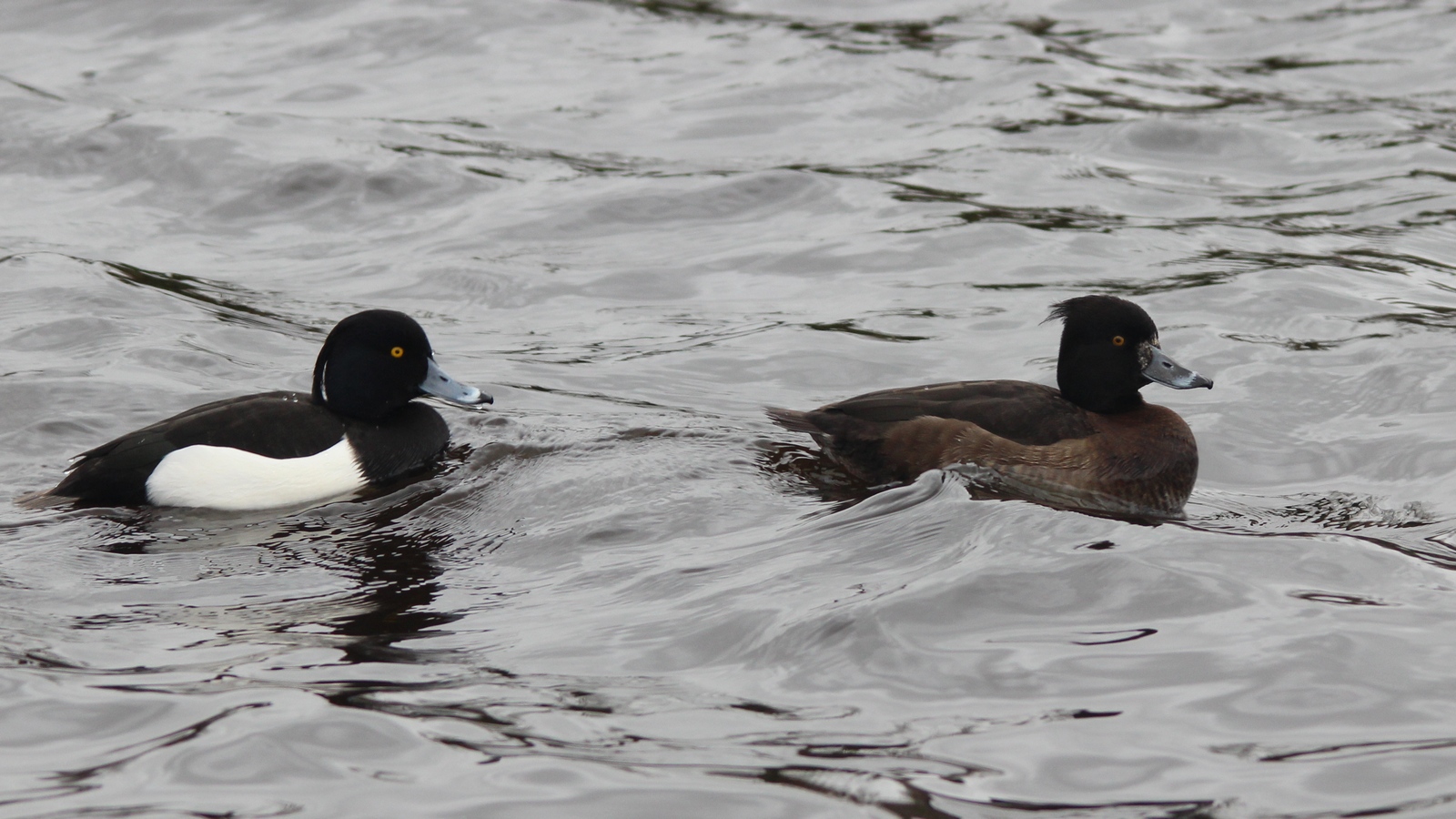
An adult male contrasts black head, breast and back with white flanks. A tuft hangs behind the head, which can show a purple sheen depending on the light. The eye is yellow and the bill blue-grey with a broad black tip. Females are predominantly dark brown, with paler flanks and a much shorter tuft; a variable white patch may surround the bill base. The face pattern alone therefore cannot establish identification.
Young birds appear duller and may retain narrow, brown juvenile wing feathers into their first winter, unlike adult feathers; ageing at a distance is not always reliable. Males also become less contrasting in post-breeding eclipse plumage. Both sexes show a conspicuous white wing bar in flight. Male Greater Scaup Aythya marila have grey rather than black backs. Females require comparison of tuft, head shape, back colour and bill pattern together, rather than expecting an obvious tuft on every bird.
Habitat, diet and behaviour
It uses lakes, ponds and reservoirs, including artificial waterbodies, and sometimes sheltered coastal waters. Open swimming water matters, but does not remove its need for suitable margins for resting or nesting. It dives for molluscs and aquatic invertebrates and also eats seeds and plant material: it is neither exclusively carnivorous nor exclusively vegetarian.
It may join other ducks and spend long periods resting or sleeping on the water. A quiet flock does not mean a site is unused for feeding: a brief visit cannot reveal its full activity cycle. Recording numbers, behaviour and water conditions is more informative than recording the species name alone.
Distribution and Arab-country occurrence
It breeds across large parts of Eurasia, and migrant populations winter south of their northern breeding range. Movements are not identical everywhere: parts of Britain have resident birds whose numbers increase with winter arrivals, illustrating why one country’s status should not be transferred to another.
In Saudi Arabia it is primarily a winter visitor during October–February and a rare passage migrant; the Saudi reference does not report breeding in the kingdom. Some individuals may remain through summer without proving nesting. Kuwait’s official list classifies it as a rare passage migrant and winter visitor. The Oman field guide lists it as a winter visitor, while UAE reports document winter occurrence, particularly on certain lakes.
In Lebanon it is an uncommon passage migrant in Beqaa wetlands from mid-September to late November, with a few remaining in winter. Libya’s wintering-waterbird atlas documented limited occurrence during its 2005–2010 surveys; these represent a defined study period, not a current census. AEWA also records occurrence in Morocco, Algeria, Tunisia, Egypt and Iraq, but national listing alone does not establish abundance or the season at every site.
Breeding and life cycle
The nest is made of vegetation near water, sometimes on an island or among grasses. A female typically lays 8–11 eggs and incubates for about 25 days. Chicks hatch downy and mobile and usually become capable of flight at around 45–50 days. These are typical durations rather than a fixed schedule for every nest. They should not be presented as an Arab breeding calendar: the regional occurrence described here is predominantly passage and winter presence.
Late October and conservation
Late October overlaps autumn passage in Lebanon and the winter occurrence window reported for Saudi Arabia. It is therefore a useful moment to learn the species, without claiming simultaneous arrival throughout the Arab world. Its global category in the 2025 assessment is Least Concern (LC), with an overall decreasing population trend; the category does not mean an absence of pressures. Risks include wetland degradation, pollution, disturbance and hunting. Practical protection depends on suitable water and quiet resting areas. Watch from a distance that does not cause escape, and never chase birds to reveal their tuft or wing bar.
References
BirdLife International, 2025 assessment; BTO BirdFacts; RSPB; Cornell Lab of Ornithology; Blasco-Zumeta and Heinze identification guide; AEWA; The Birds of Saudi Arabia via Saudi Nature; Official Kuwait Bird List; Field Guide to the Birds of Oman; UAE bird reports; Updated checklist of the birds of Lebanon; Atlas of wintering waterbirds of Libya, 2005–2010. Information reviewed: 26 October 2026.
Photo: Terry Hughes — CC0 1.0.