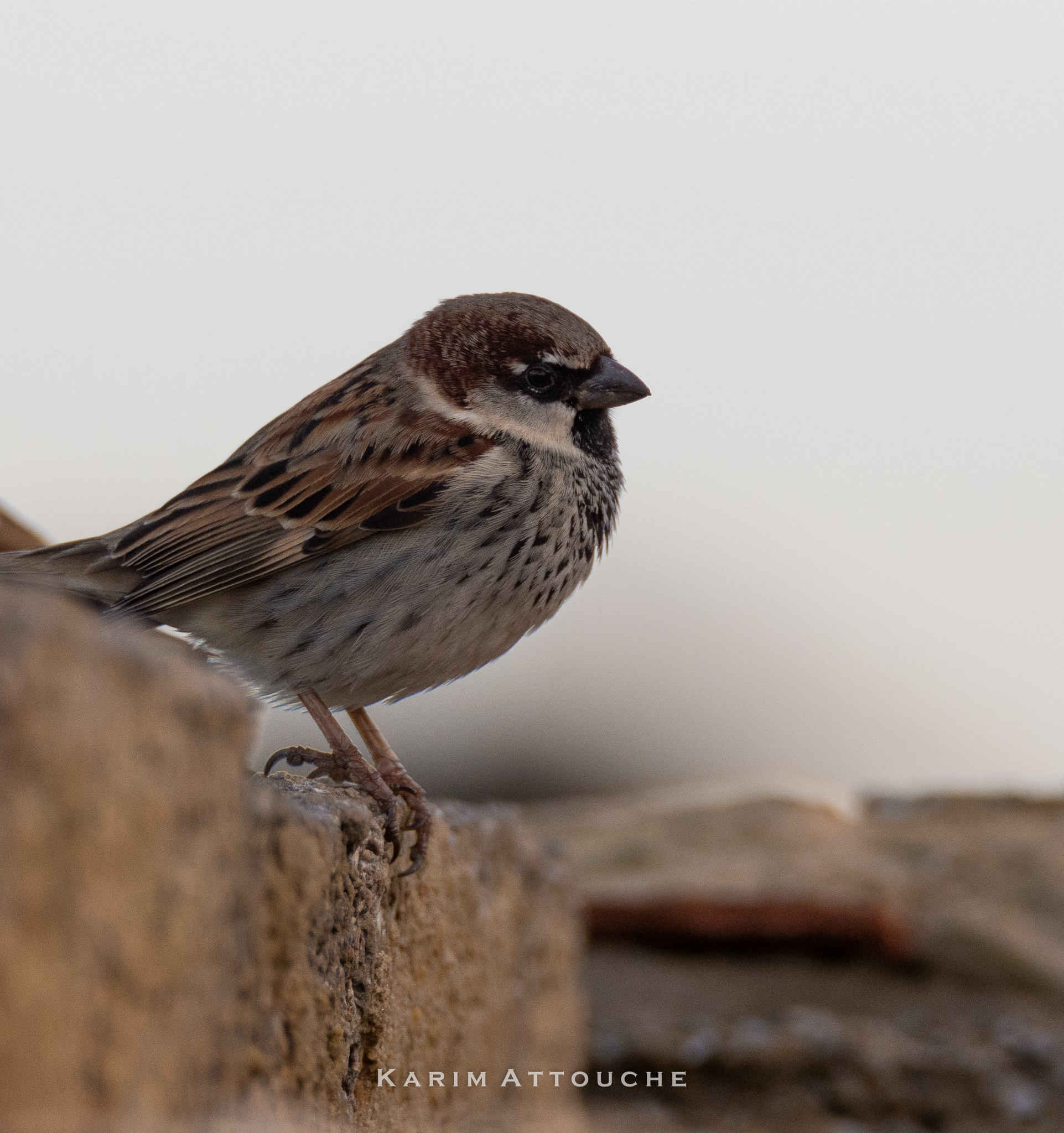
Passer hispaniolensis
Identity and names
Spanish Sparrow, Passer hispaniolensis, is Moineau espagnol in French; Arabic usage includes both “Spanish” and “Andalusian” sparrow. It belongs to Passeridae within Passeriformes, measures approximately 15–16 cm and has a wingspan of 23–26 cm. Its name does not restrict it to Spain: Mediterranean and Asian populations include both residents and migrants. Separating it from House Sparrow requires more than judging size or noting proximity to people.
Identification
Adult males have chestnut crowns and napes, white cheeks and extensive black on the throat and breast, continuing as bold flank streaks. The strongly patterned back and substantial bill add useful clues. Winter males look less sharply marked. Females and juveniles are much harder to distinguish from House Sparrows; a pale eyebrow or one mark cannot settle every identification. Hybridisation in North Africa adds further difficulty, making “unidentified sparrow” preferable to forcing an uncertain bird into a species.
Habitat, food and behaviour
Farmland, fields, shrubs and scattered trees are important habitats, including sites close to water. Seeds and grain dominate the diet, with invertebrates especially important to growing chicks. It is sociable when feeding, roosting and breeding, sometimes gathering in large numbers. A count over a field alone does not measure crop damage: the crop, its growth stage and the birds’ behaviour must also be considered, distinguishing birds collecting fallen grain from those feeding directly on a standing crop.
Range and Arab occurrence
Its range includes North Africa, the Levant and parts of Central Asia. Morocco recognises it among agricultural birds, while Algerian studies document breeding and hybridisation with House Sparrow. Lebanon’s 2026 guide describes an uncommon summer breeder, common passage migrant and scarce winter visitor. Kuwait supports resident breeders and winter visitors, with colonies recorded at farms and reserves. Oman’s published list describes uncommon passage and winter occurrence. A single seasonal label therefore cannot represent all these countries.
Breeding and development
Breeding often occurs in colonies. Bulky nests made from grass and other plant material occupy trees or bushes, sometimes beside larger birds’ nests. Clutches commonly contain several eggs, with approximately 3–6 reported and local variation. Incubation lasts roughly 11–14 days and young leave after about 12–15 days. Both parents contribute care, and more than one brood may follow when conditions allow. These intervals are not fixed local dates, and a communal roost is not necessarily a nesting colony.
November and responsible observation
November offers opportunities to compare field flocks and changing numbers, particularly where winter visitors join residents. One Lebanese flock does not make the species a nationally common winter bird. Record approximate numbers and identifiable males, photographing cheeks and flanks from a fixed distance. Do not use weak streaking on a small or distant bird to prove it is a female House Sparrow. Light and feather edges may obscure markings that appear clearer in another season.
Conservation
Its global category is Least Concern, while habitat deterioration, pesticides and illegal hunting remain local pressures. Retaining diverse field margins, shrubs and insect food supports birds through different stages of their lives. Where agricultural conflict occurs, assess actual damage and seek lawful, selective solutions that consider other species rather than targeting unidentified mixed flocks. Watching from outside a breeding colony or roost avoids disturbing hundreds of birds for a single close photograph.
References
AviList Core Team — AviList v2026; Oiseaux.net — Moineau espagnol; Oiseaux-Birds — Moineau espagnol; UNDP / ABCL / Ministry of Environment — Birds of Lebanon, 2026, p. 386; KuwaitBirds — Spanish Sparrow; Oman Birds Records Committee — Official Oman Birdlist; ONSSA — Moineaux; Päckert et al. — North African hybrid sparrows, Ecology and Evolution, 2016; Birds of Saudi Arabia — Spanish Sparrow.
Photo: karim Attouche