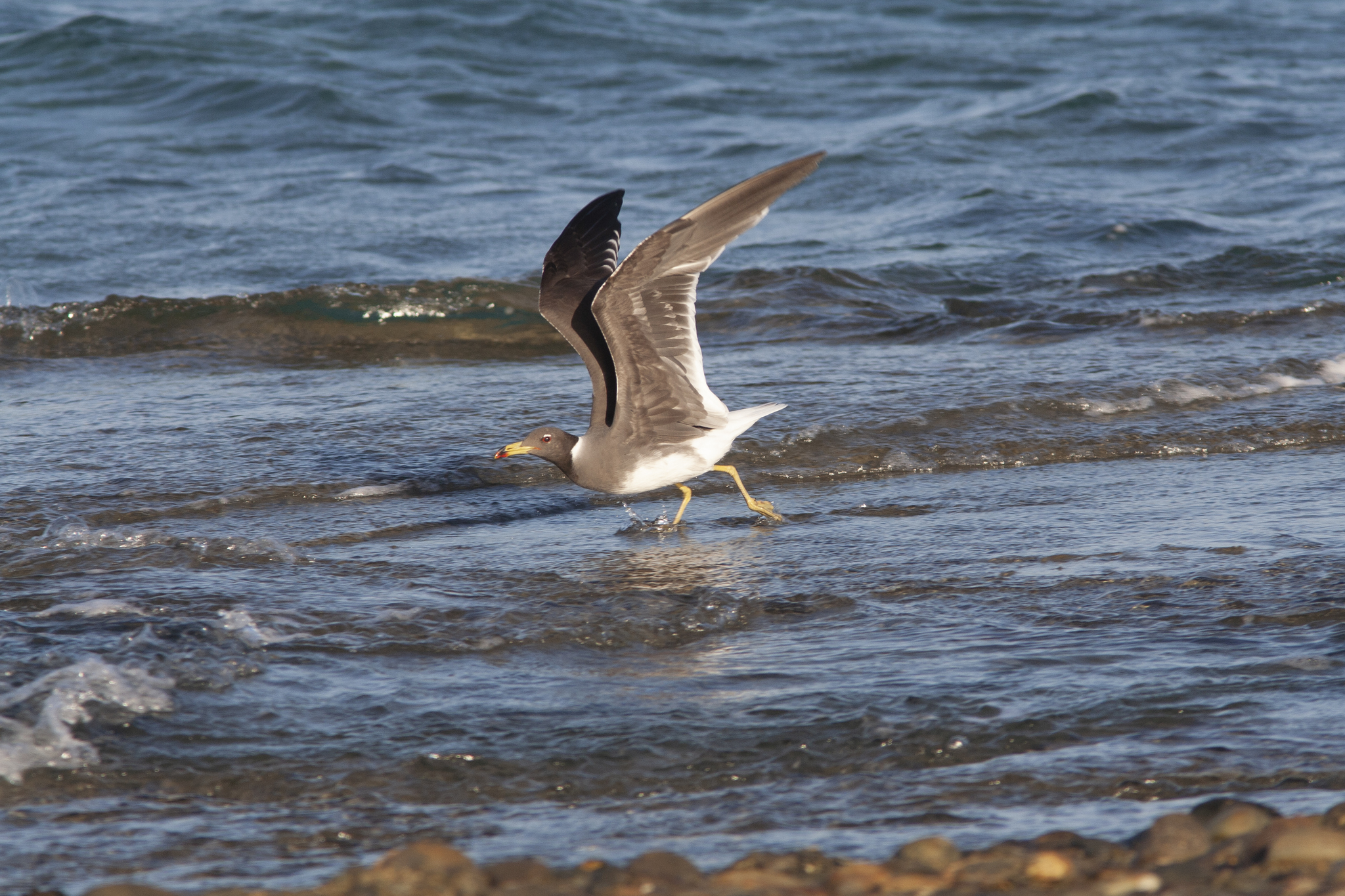
Ichthyaetus hemprichii
A dark gull of the region’s seas
The Sooty Gull, Ichthyaetus hemprichii, is one of the birds that give the Red Sea and Arabian Sea coasts their distinctive character. Arabic names include al-asḥam, al-askham and al-fāḥim; older references place it in the genus Larus as Larus hemprichii. These names refer to the same species, not to different birds. A member of the gull family, Laridae, it measures about 43–48 cm long, with a wingspan of approximately 105–118 cm. It is a medium-sized coastal gull, rather than one of the large white gulls that arrive conspicuously in winter.
The adult has a dark brown head, neck and upper breast, separated from the back by a narrow white collar most evident at the sides of the neck. Its back and wings are dark, while the belly and tail are white. The long, strong bill has a pale base and a red area towards the tip, with dark markings; the feet appear olive. The sexes have similar plumage, so colour alone does not establish whether a bird is male or female. The hood becomes less dark outside the breeding season without turning the bird into a white-headed gull.
Recognising different ages
White-eyed Gull is the main confusion species in the Red Sea. Identification should therefore combine several features. Sooty Gull is relatively robust, with a clearer contrast between the pale bill base and its coloured tip. Adult White-eyed Gull has a darker bill and more conspicuous white markings around the eye. Sunlight and shade alter the apparent brown of a Sooty Gull’s head, while backlighting can make it look almost black and conceal useful distinctions. A side-by-side comparison, or a photograph showing the head, bill and wing, is more reliable than the overall impression.
Juveniles are paler, browner and more patterned. Pale edges to the back and wing feathers create a scaled appearance. The tail carries a dark band, while the adult’s white collar and red bill tip are less evident. This appearance changes gradually through feather replacement, and immature birds may combine features from different stages. Adults and juveniles can occur together in November. Their differences do not necessarily indicate a second species, and a distant photograph is not enough to assign every bird an exact age.
Coastal habitat, food and behaviour
The Sooty Gull’s life connects breeding islands with shores that provide food. It uses sandy and rocky coasts, reef margins and harbours, resting alongside other gulls in safe places. A bird may forage alone before joining a group where food becomes plentiful. Its presence beside a fishing boat or fish market does not make it wholly dependent on people. Such a place is one part of a wider network of shores, islands and nearby waters.
It eats small fish, shrimps, fish remains and carrion, and may steal food from other seabirds or take their eggs and chicks, as well as turtle hatchlings. This is natural dietary diversity, not a reason to treat the gull as a pest to be eliminated. Human disturbance can increase the damage at other birds’ nests: when parents leave eggs exposed, a gull gains an opportunity that did not exist before people approached. Protecting the colony from disturbance addresses that problem more effectively than blaming only the predator that took advantage of it.
From nesting to independence
The pair nests on the ground on a quiet island, in a shallow scrape sometimes surrounded by a few sticks or fragments of vegetation. The site may be sheltered by a bush or rock, or lie in the open. Birds breed as spaced pairs or in small, loose groups, rather than necessarily forming the dense crowds associated with some terns. The Saudi bird reference gives a usual clutch of two or three eggs and an incubation period of about 25 days, shared by both parents, which also care for the chicks.
Chicks leave the nest site shortly after hatching but still need parental food and protection. Walking does not mean independence. The regional references used here do not provide a reliable fixed age at first flight that can be applied throughout the species. Breeding dates also vary. The PERSGA regional report records egg laying in April and May in the northern Saudi Red Sea, later in June and July farther south, and Egyptian nests between July and September. These are recorded patterns, not a timetable binding every island in every year.
Arab-world distribution: resident here, passing elsewhere
The Red Sea and Gulf of Aden lie at the heart of the species’ range; its presence there is not simply a winter arrival from Europe. References document breeding in Saudi Arabia, Egypt, Sudan, Yemen, Djibouti and Somalia. The 2003 PERSGA report brings together evidence from these countries, while Saudi surveys published in 2014 and 2024 confirm the continuing importance of islands for the species. Estimates in older reports must be treated as information from their own period, not converted into a count of populations alive today.
In Saudi Arabia it is a breeding resident on Red Sea islands, with birds also appearing in the southern waters of the Arabian Gulf. The United Arab Emirates has direct nesting evidence, including a 2019 study of nest materials on Sir Bu Nair Island. Qatar’s local checklist instead describes it as a scarce passage migrant, not a breeding resident. Oman’s coast also falls within its known range. These differences matter: neighbouring countries cannot automatically be assigned the same breeding status or abundance.
What does a November sighting mean?
The range covers the northwestern Indian Ocean, extending east towards southern Pakistan and south along East Africa. Some birds stay near their usual areas, while others disperse after breeding; non-breeding movements reach the Tanzanian coast. Its annual life therefore cannot be reduced to a single north-to-south migration. A November sighting on a suitable Arab coast may involve a local or a dispersing bird. Month and colour alone cannot establish the individual’s origin.
Autumn offers opportunities to compare ages, feeding behaviour, and the use of harbours and resting places. Observations become more valuable when counts are repeated from the same point and accompanied by notes on sea conditions, tides and observation effort. Absence on one visit does not prove disappearance from that coast. A larger gathering around fishery waste does not demonstrate growth of the breeding population either. Keeping these interpretations separate turns an enjoyable sighting into information that can be compared over time.
Conservation and responsible observation
AviList 2026 lists Sooty Gull as globally Least Concern, but a favourable global status does not guarantee the safety of an individual colony. Threats include coastal oil pollution, changes to islands and shoreline habitats, egg collection and disturbance. The Sir Bu Nair study documented human-made debris in nest materials. Plastic in a nest shows contact between the island and human activity; by itself, it does not measure pollution throughout the surrounding sea.
The best observation is from shore or a boat at a distance that does not cause birds to leave their positions. Visitors should not approach nests, chase juveniles for photographs or offer food to attract a gathering. Precise locations of active nests are better shared with responsible authorities than publicised in ways that increase pressure. The Sooty Gull belongs to a coastal system involving predation, scavenging and the movement of food. Its protection begins with safeguarding that system, rather than merely keeping an attractive photograph.
Photo: Tero Linjama / iNaturalist (CC0 1.0)