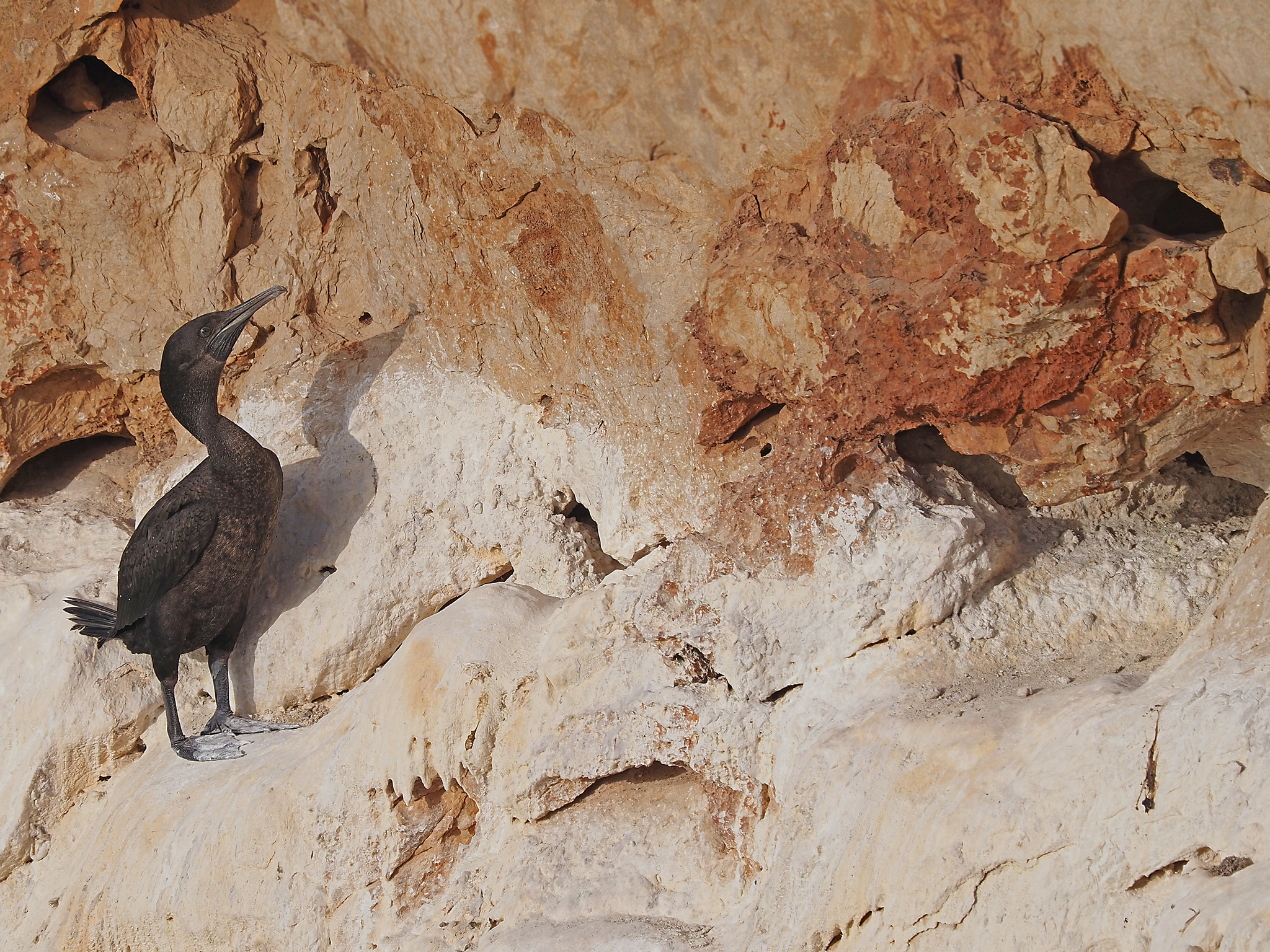
Phalacrocorax nigrogularis
A regional seabird beyond the island in its name
The Socotra Cormorant, Phalacrocorax nigrogularis, is a marine member of the cormorant family, approximately 80 centimetres long. Its core range surrounds the Arabian Gulf, Gulf of Oman and southern Arabian Peninsula. Its name does not mean that it is confined to Socotra Island, nor is it simply a dark-plumaged Great Cormorant. Its breeding sites, seasonal movements and threats deserve attention in their own right.
Dense flocks can create an impression of limitless abundance, yet concentrating thousands of birds on relatively few islands makes those islands more important, not less vulnerable. Siniya Island in Umm Al Quwain is a significant breeding site among other regional colonies. Numbers on an individual island may change because birds have moved from a neighbouring site, rather than because the overall population has grown.
Recognising adults and young birds
Adults are sooty dark, with a slimmer head and neck and a finer bill than Great Cormorant. They lack the same extensive white face and chin patch. Breeding plumage gains a greenish or purplish gloss and may include fine white filoplumes around the head and neck. Both sexes share the dark appearance, so blackness or sheen alone cannot establish sex.
Immatures are grey-brown above, with pale feather edges on the wings, and lighter below with brown spotting. They can be confused with immature Great Cormorants, Phalacrocorax carbo, which visit some of the same coasts. Combine the slender head and neck and bill shape with face and breast pattern. A pale belly or a large flock is insufficient to identify the species, and a place name cannot establish a bird’s identity.
Group fishing below the surface
The species feeds mainly on small fish pursued by diving from the surface. A tracking study of birds breeding at Siniya documented overlapping feeding areas and large gatherings at sea. Its results suggest that aggregation helps birds locate and exploit fish schools. They do not establish that a flock follows one leader or divides tasks in the manner of a human team.
A dietary study at Siniya during the 2011–2012 and 2012–2013 breeding seasons found that dominant prey shifted from flying fish and sardines to anchovies. The most frequent prey had limited overlap with the local commercial catch. This is a finding from one place and two seasons, not a rule for every sea and year, but it shows why flock size alone cannot demonstrate damage to fisheries.
From colony to egg
Socotra Cormorants breed in dense island colonies, using shallow ground scrapes rather than nests suspended in trees. Clutches usually contain two or three eggs. The ground around nests also needs protection: an adult leaving as a visitor approaches may expose eggs to heat or predators even when nobody touches the nest.
A study published in 2017 followed breeding at Siniya during 2011–2015. It recorded the start of laying between 13 September and 6 October and estimated incubation at 24–27 days. These dates and durations describe a studied population, not a universal timetable for every island. Variation within a colony also means that nests can be at different stages during the same visit.
Chicks and gatherings after hatching
Chicks begin life dependent on their parents for food, then grow and leave the immediate nest site to join gatherings of young birds. This transition does not mean that every chick can fly or feed independently. An apparently mobile group can contain birds at different stages of parental dependence, so protection does not become unnecessary once eggs are no longer visible.
Research at Siniya shows that hatching success and chick survival are affected by colony conditions. Predation studies also demonstrate that terrestrial predators can place additional pressure on birds and eggs. Addressing that pressure requires site-specific scientific assessment, not improvised intervention by visitors. Protecting the breeding cycle involves nesting ground, routes towards the sea and the waters from which parents bring food.
Arab range and the November scene
The Arab range includes the coasts of Saudi Arabia, Bahrain, Qatar, the United Arab Emirates, Oman and Yemen; the Convention on Migratory Species also lists Kuwait and Somalia. Country presence does not imply breeding or equal abundance in every country. The Qatar Bird Observation Group describes it as a resident breeder, whereas the Kuwaiti checklist distinguishes occurrence from breeding and lists it as a non-breeder there.
In the northern Emirates, autumn is associated with conspicuous breeding activity. A scientific review describes a season generally extending from August to December, sometimes longer after delays or disruption. The studies it assembles indicate that some Siniya birds begin moving towards Abu Dhabi waters in December. November may therefore involve chick provisioning and colony activity rather than merely passage migration, with the situation differing among sites.
Vulnerable despite impressive flocks
The global Red List category is Vulnerable, VU, also confirmed by the Convention on Migratory Species and BirdLife. Threats include development of coasts and islands, disturbance at breeding sites, marine pollution and entanglement in fishing gear. Losing one colony matters when breeding is concentrated in a limited set of places; a large flock elsewhere does not necessarily compensate for that loss.
The best observations leave birds where they are: use binoculars at a suitable distance, avoid landing in colonies and never drive a boat through feeding flocks. Do not collect eggs or chicks or feed birds to attract them to a camera. Repeated, coordinated counts across sites help explain movements. One photograph cannot establish either recovery or decline throughout the region.
Further reading: United Arab Emirates University studies of breeding and feeding at Siniya; Ecology and Evolution; Oryx; Convention on Migratory Species; Qatar Bird Observation Group; Kuwait Birds checklist; Environment Agency – Abu Dhabi; BirdLife International; The Birds of Saudi Arabia.
Photo: James Eaton / iNaturalist (CC0 1.0), Hadramawt, Yemen, 20 March 2022.