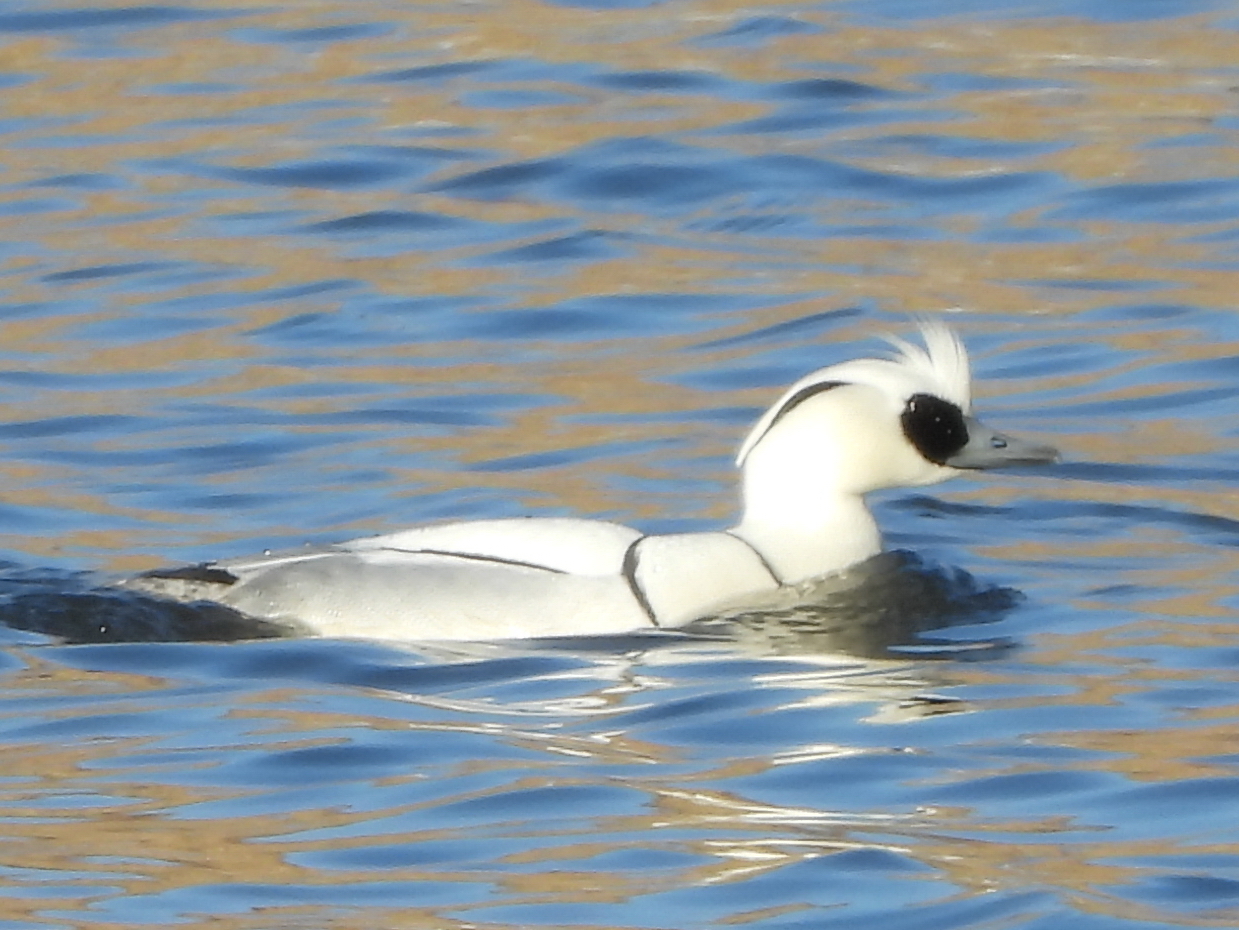
Mergellus albellus
Identity and changing appearance
Smew, Mergellus albellus, is a small northern diving duck, about 38–44 cm long. The adult male's white plumage is crossed by sharply contrasting black markings around the eye, on the head, back and breast. Its compact body and short, fine bill distinguish it from the larger, long-billed mergansers. At a distance the male may appear almost entirely white, so closer views are needed to appreciate the dark pattern and greyish flanks.
Females have a chestnut-brown crown and nape, white cheeks and throat, and a grey body. Juveniles broadly resemble females, which is why the field term “redhead” does not necessarily identify a female. In the Naturalis description, juveniles have less dark in front of the eye and a duller wing patch. Males in eclipse also lose the striking winter contrast. Sex and age should therefore be recorded only as precisely as the view permits.
A female Goldeneye is more robust and has a brown head without the Smew's broad white lower face. Female larger mergansers have longer bills and necks. In flight the Smew shows a conspicuous black-and-white wing pattern, with a smaller white patch in females. Size comparisons are most useful when the birds are at the same distance; a lone duck viewed across a wide reservoir can be misleading.
Feeding and seasonal habitats
On its breeding grounds, Smew combines two habitats that may seem unrelated: wooded country providing nest cavities, and freshwater providing food. Lakes, quiet rivers, pools and flooded woodland margins can all be used. In winter it often occupies lakes and reservoirs, and also sheltered coastal or brackish waters. Unlike a duck that merely requires an open nesting bank, it depends on the relationship between trees and water during reproduction.
The bird feeds mainly by diving. Small fish dominate in winter and early spring, while aquatic insects and other invertebrates are more important in the breeding season. Prey may be brought to the surface before swallowing. The short bill is well suited to its small prey and should not be mistaken for the broad filtering bill of a dabbling duck. Feeding birds alternate submergence with short surface intervals, making patient, repeated observation more effective than a quick scan.
Tree-hole breeding and young
Smew nests in a tree cavity, often using an old woodpecker hole, including those made by Black Woodpeckers. It can also accept artificial nest boxes. The cavity is a protected chamber above ground, not an excuse to neglect the surrounding lake: the female and young need accessible, productive water after hatching. Old trees and safe feeding shallows thus form complementary parts of the breeding habitat.
BTO gives a typical clutch of 7–9 eggs, with the female incubating for 26–28 days. The young are downy and precocial, meaning relatively well developed and mobile on hatching rather than helpless in a nest. Egg laying, incubation and brood rearing are distinct stages, and nesting dates vary across the broad northern range. A nest-box programme is appropriate only within a suitable breeding setting; installing a box at a southern wintering pond does not by itself create a breeding population.
Eurasian range and winter movements
The main breeding range lies in northern Europe and Asia. Birds leave northern breeding waters for more temperate wintering areas, with movements also occurring within winter when freezing closes feeding sites. Some winter movements are therefore responses to weather rather than a single fixed journey between two points. In western Europe, cold spells can bring birds farther west, while mild winters leave more open water closer to the breeding range.
A study by Pavón-Jordán and colleagues, published in 2015, analysed counts from 16 European countries during 1990–2011. It documented a northeastward redistribution of wintering Smew associated with warmer conditions. This is a European finding, not a direct measurement of Arab populations, but it helps explain why fewer birds at one southern site need not indicate an equal decline throughout the range.
Arab occurrence: national distinctions
In Iraq, Salim and colleagues' checklist describes Smew as an uncommon winter visitor in the north and uncommon in the southern marshes. It also reports more than a thousand in the south in 1979, without a comparable subsequent occurrence in the evidence available to that publication. That exceptional historical count should not be presented as today's normal winter population.
In Syria, Murdoch and Betton's 2008 checklist documents winter records from the Euphrates and Khabur reservoirs, including the first accepted observations in February 2004 and further records in 2006–2007. The authors suggested that it might winter regularly in the north, where observation coverage was poor. The records establish winter occurrence; the proposed regularity remains the authors' assessment, not a demonstrated annual census.
Morocco's rare-bird committee classifies Smew as a Palearctic accidental visitor. Egypt's 2019 national checklist accepts it in category A, which establishes wild occurrence since 1950 but does not itself specify frequency or season. These different labels matter: a northern Iraqi winter visitor, a Syrian winter record and a Moroccan rarity should not be merged into a claim of widespread regular Arab wintering.
Conservation and unobtrusive watching
BTO reports global Least Concern status. Conservation nevertheless requires both cavity-bearing woodland in the breeding range and undisturbed open water in winter. The European redistribution study found that protected areas helped accommodate changing winter distribution, while identifying gaps in protection. Southern refuges can remain valuable during harsh winters even when used less often in mild ones.
From a hide or distant bank, document the head pattern, bill shape, accompanying ducks and behaviour. Avoid approaching repeatedly between dives, which can interrupt feeding. For unusual national records, photographs and a dated locality are more valuable than an unsupported age or sex assignment. Protecting mature waterside trees and maintaining quiet feeding water addresses the two very different habitats on which this small duck depends.
BTO — Smew BirdFacts · Naturalis — Smew · BirdLife International — Smew factsheet · Pavón-Jordán et al. — Climate and winter distribution · Salim et al. — Annotated checklist of the birds of Iraq · Murdoch & Betton — A checklist of the birds of Syria · Commission d’Homologation Marocaine — Report 27 · Egyptian Ornithological Rarities Committee — Checklist 2019
Photo: Лариса Артемьева