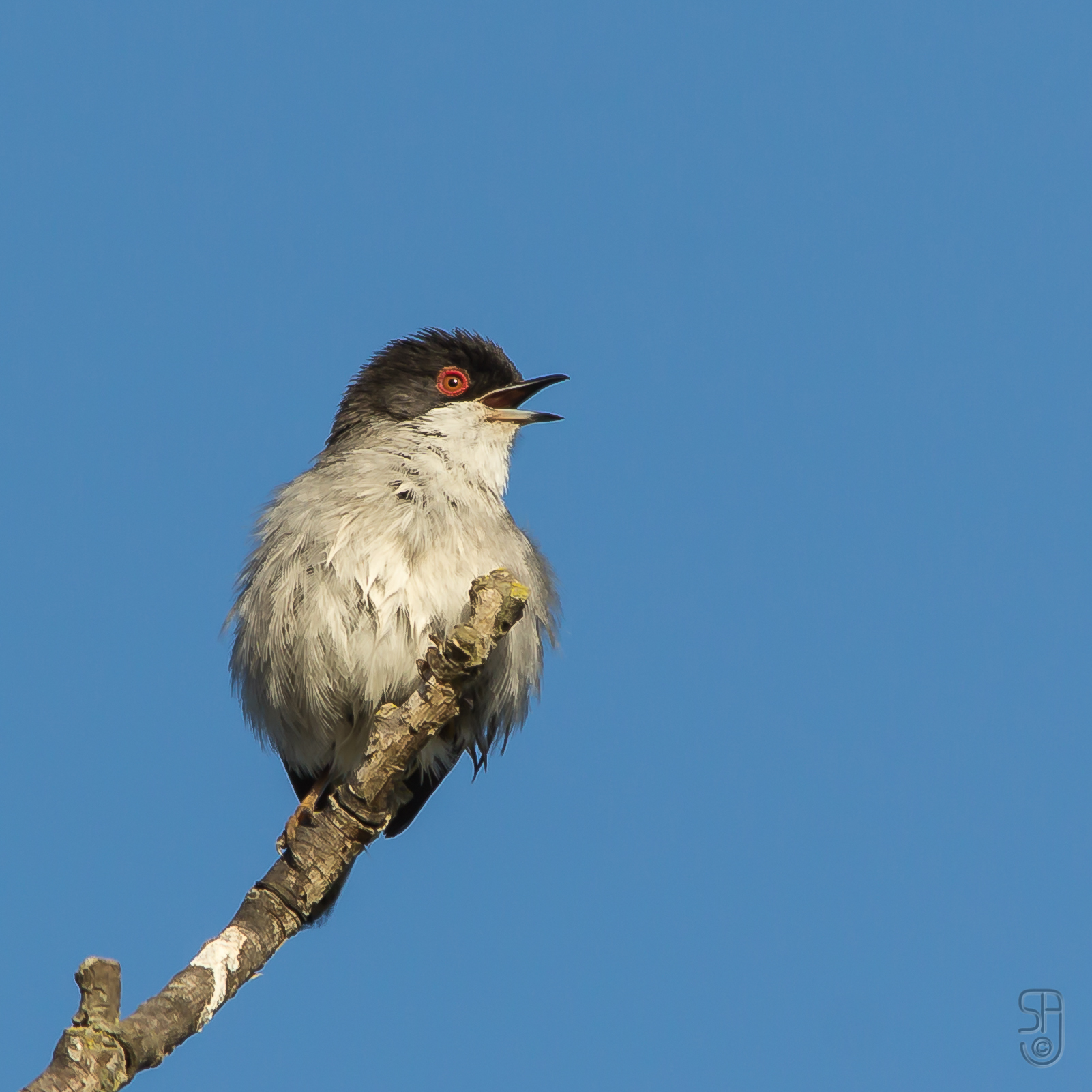
Curruca melanocephala — Identification, habitats, breeding and occurrence in the Arab region
Identity and recognition
The Sardinian Warbler, Curruca melanocephala, is a small member of the family Sylviidae. Older literature uses Sylvia melanocephala for the same species. At about 13–14 cm long, it has a relatively long dark tail with white outer tips and a red eye-ring. Its English name does not confine it to Sardinia: its range includes Mediterranean habitats and adjoining Arab regions.
Age, sex and similar species
An adult male has an extensive black hood surrounding the eye, a white throat, grey back and grey flanks. The female has a greyer head, browner back and pale underparts with buff-toned flanks. Juveniles are less contrasting; absence of a black hood alone does not establish a female. Blackcaps have a cap rather than this extensive hood and lack the characteristic red eye-ring. Cyprus Warblers may show dark throat spotting, while Spectacled Warblers have a chestnut wing panel. Females and young birds require several features to be checked together, not identification from a single head colour.
Habitat, diet and behaviour
Mediterranean scrub, open woodland with dense undergrowth and orchard edges provide habitat. Birds move within cover and flick their tails; a repeated harsh call may reveal them before a clear view is possible. They collect insects and other small invertebrates from foliage and twigs and also eat fruit. This varied diet allows exploitation of seasonally different resources. Concealment should not be confused with absence. Combining visual and acoustic observations improves detection, while repeated playback can unnecessarily disturb birds occupying a territory.
Breeding and life cycle
A cup nest is built low inside a shrub, and both members of the pair participate in incubation and caring for young. Clutch size and breeding dates vary geographically. Lebanon’s updated checklist records breeding from late March to late July. Dense shrubs supply nesting and concealment sites, so cutting an occupied bush can destroy the family rather than simply remove cover. Evidence such as an occupied nest or dependent young is needed to confirm breeding: a summer sighting alone is insufficient.
Arab-region distribution and seasonality
Lebanon’s 2020 checklist describes a very common resident breeder, reaching approximately 1,600 m in the north, as well as common passage and winter birds from mid-September to late April. October can therefore bring residents and arrivals together. It is listed as resident in Libya, while its broader range includes parts of North Africa, the Levant and Sinai. The AlUla bird guide records winter occurrence in western Arabia, including Harrat Uwayrid, AlGharameel and Wadi Nakhlah. In Oman, the regional reference documents vagrancy, contrasting with winter occurrence in western Arabia.
Ecology and conservation
The global IUCN assessment conducted in 2018 classified the species as Least Concern, with an increasing global trend. Invertebrate and fruit consumption places it within scrubland food webs. Removing vegetation or changing its structure can affect suitable sites. Cyprus sources also list it among birds harmed by illegal trapping. Maintaining connected patches of structurally varied scrub, woodland and gardens supports both residents and seasonal visitors.
References
BirdLife International — IUCN Red List assessment of Curruca melanocephala (2018)
Royal Commission for AlUla — Birds of AlUla, English and Arabic editions
Naturalis — Birds of Europe: Sylvia melanocephala
Ramadan-Jaradi and colleagues — Updated checklist of the birds of Lebanon, Sandgrouse 42 (2020)
OSME — Region List, version 8.1, Passerines (2022)
Libyan Wildlife — Sylvia melanocephala species account
BirdLife Cyprus — identification guidance and species affected by trapping
Photo: Stein Arne Jensen — CC0.