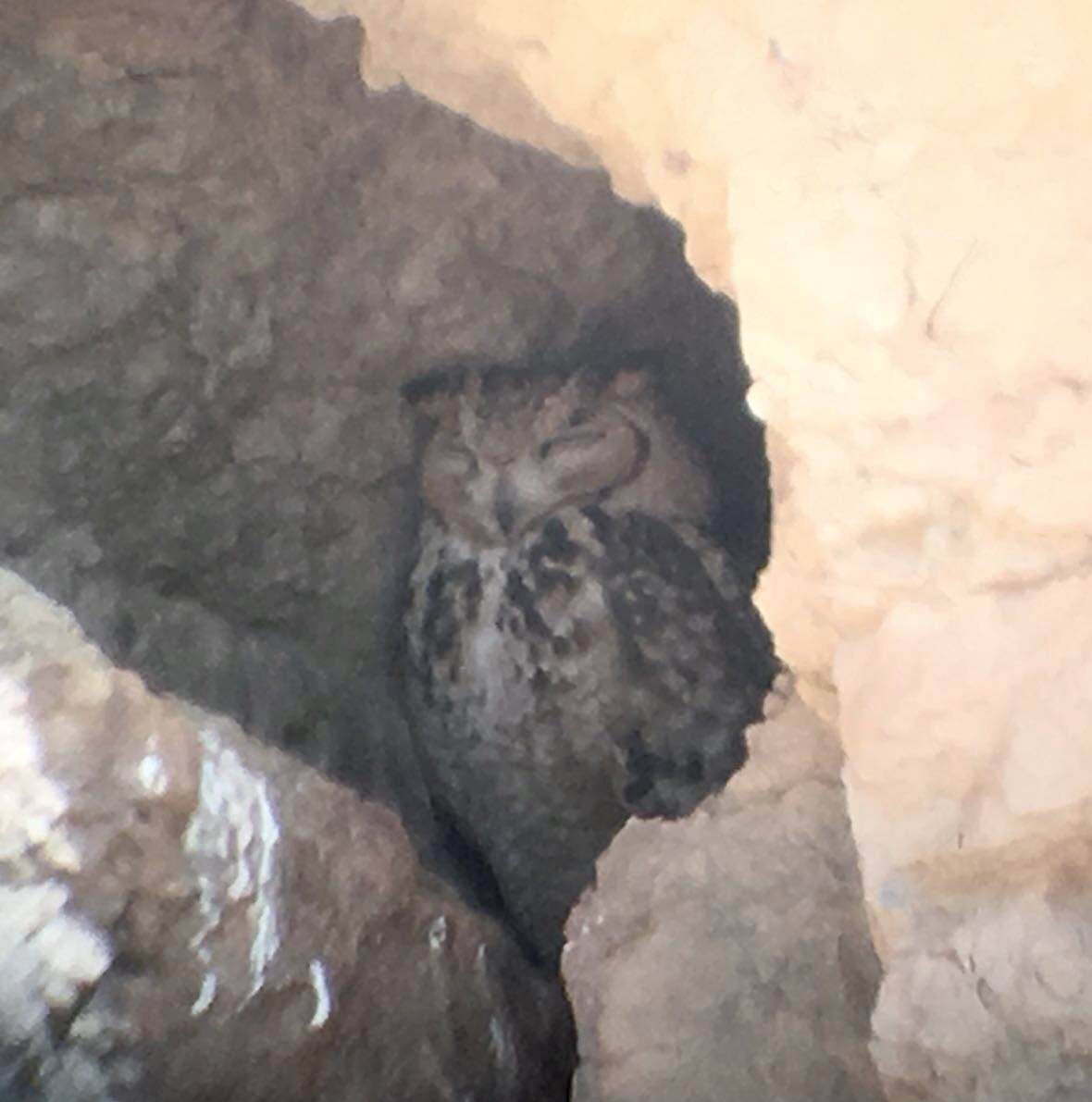
Bubo ascalaphus
Identity and identification
Pharaoh Eagle-Owl Bubo ascalaphus belongs to Strigidae. A large desert owl, it has sandy mottled plumage, orange-yellow eyes and head feather tufts. It differs from larger Eurasian Eagle-Owl, but dark photographs alone cannot reliably separate owls. The tufts are feathers, not external ears. It is placed in the order Strigiformes. The IUCN category carried in AviList 2026 is Least Concern (LC).
Habitat, food and behaviour
Cliffs, wadis and rocky desert provide habitat. Nocturnal hunting takes rodents, birds, reptiles and other locally available prey. Specialised wings permit quiet approaches. A bird resting near a cavity by day is not necessarily ill.
Breeding and parental care
It nests on cliffs and in sheltered cavities, sometimes using old raven nests, according to Abu Dhabi’s Environment Agency. Young depend on adult prey deliveries and site protection. Quiet habitat and food determine success; cavities must not be illuminated to count eggs or chicks.
Range and Arab occurrence
It is resident in parts of North Africa and Arabia, with occurrence and monitoring documented in Abu Dhabi. Suitable desert distribution does not mean equal presence in all Arab countries. New records require face, eye and structure comparisons alongside location.
Seasonality and observation
Residents can be observed in November. Listening at a distance is preferable to approach or repeated call playback. Exact cavity locations should not be publicised if they would attract disturbance to a sensitive breeding site.
Ecological role and conservation
It consumes desert rodents and other prey and faces poisoning, hunting and cliff destruction. Rodenticides can poison predators through prey. Protecting cavities, reducing toxicants and respecting nocturnal activity help; repeated flash or deliberate luring should be avoided.
References
Environment Agency–Abu Dhabi — Pharaoh Eagle Owl.
AviList Core Team — AviList: The Global Avian Checklist, v2026 (20 October 2026).
Photo: Jean-Paul Boerekamps — CC0 1.0.