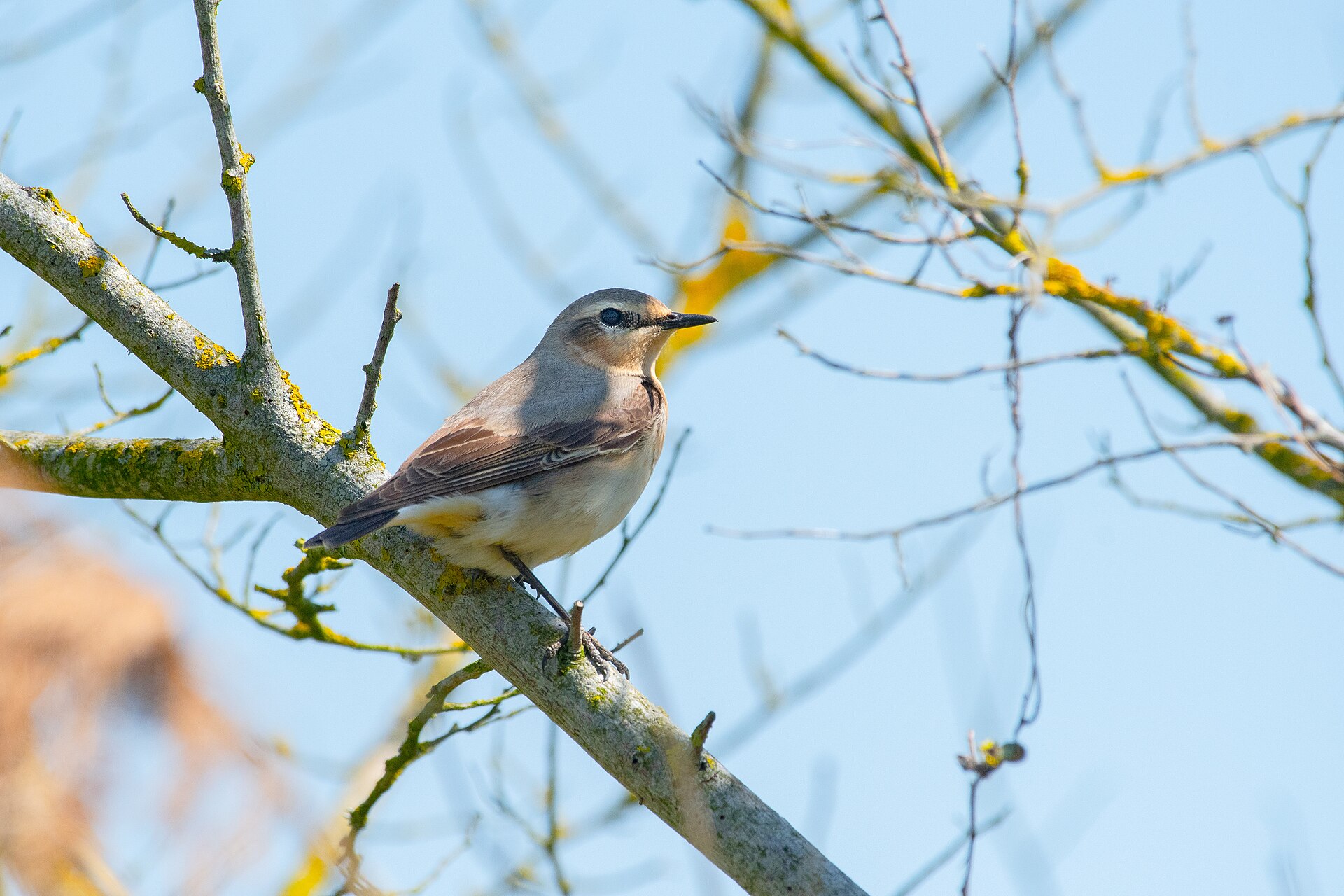
A small bird pauses on a stone, drops to the ground for prey and returns to a lookout. When it flies, white flashes across the rump and tail. This is a familiar Northern Wheatear scene during migration, when open ground across the Arab world becomes a stop along a much longer journey between breeding and wintering areas.
Identification card
- Arabic name: الأبلق الشمالي
- English name: Northern Wheatear
- French name: Traquet motteux
- Scientific name: Oenanthe oenanthe
- Family: Muscicapidae
- Length: approximately 14–16 cm
- Habitat: bare ground, short grass, stony plains and sparsely vegetated slopes
- Arab-world occurrence: widespread passage migrant; breeds in parts of the Levant, with limited winter occurrence in some areas
- Global conservation status: Least Concern (LC)
From the Maghreb to Arabia
Ringing data in the Eurasian-African Migration Atlas connect April and September–October encounters in Morocco, Algeria and Tunisia with several European breeding regions. A passing wheatear cannot therefore simply be described as a bird from one particular country. A recovered ring establishes a connection between documented locations, rather than necessarily revealing every part of the journey.
In the Levant, passage overlaps with local breeding. Lebanon's checklist documents summer breeding, especially at 1,500–2,500 metres, autumn passage from early August to late November, and smaller numbers in winter. In Saudi Arabia, Saudipedia describes a common passage migrant that does not breed in the country. The comparison matters: occurrence in an Arab country does not itself establish residency or wintering status.
Most populations travel to wintering areas south of the Sahara. Tracking research on North American breeders has shown that even populations very far from Africa reach that continent by different routes. This does not make every wheatear seen in the Levant an Alaskan bird. An individual's origin needs its own evidence.
Why autumn brings it into view
Southward movement reaches North Africa from August and becomes conspicuous in September, while the last birds leave Europe during October. Local observations from Dhahran in eastern Saudi Arabia include September and October, as well as spring passage. These are regional seasonal windows, not fixed arrival dates for every country and year.
A bird may pause in a short-grass field, on stony ground or beside a farm. A few days' presence does not show that its journey has ended. Recording the length of a stay, behaviour and observation date is more useful: passage, wintering and breeding are different situations that one photograph cannot establish.
Recognising more than the spring male
A breeding male usually has a grey back, black mask and dark wings. The female is browner and less contrasting, without the same bold black mask. In autumn, sandy or warm tones soften the appearance of many individuals, unlike the sharply patterned spring males familiar from illustrations.
Assess the upright stance, legs, face and wing pattern, then the black-and-white tail when it becomes visible naturally. A white rump alone is insufficient because other wheatears share it. Nor does an overall brown colour in a distant photograph reliably establish sex or age. Document several features and leave uncertain identifications open.
Small prey and a sheltered nest
Its diet consists mainly of insects and other small invertebrates, with some berries. Sparse vegetation leaves room to locate and reach prey. Near a stone or low perch, the pauses and short movements to the ground can be watched without attracting the bird with food.
In breeding areas, the nest is concealed in a cavity or rock crevice. BTO data give five to six eggs as a typical clutch; a British nesting calendar should not be transferred directly to Arab mountain habitats. A bird standing on a rock in October is not evidence of a nest beneath it.
Conservation and responsible observation
Least Concern describes global extinction risk and does not rule out local declines. European monitoring shows that a wide geographical range does not remove the need for habitat protection and continued surveys. The category also does not determine hunting law, which must be checked with the relevant national authority.
Stay far enough away for the bird to keep feeding. Do not flush it to reveal the tail or follow it towards a nesting cavity. Record date, habitat, elevation and behaviour. Leaving a stopover undisturbed helps protect the journey briefly made visible by this small traveller.
References
- EURING/CMS — Northern Wheatear migration atlas
- Cornell Lab — Northern Wheatear identification
- BTO — Wheatear biology and conservation
- Saudipedia — Northern Wheatear in Saudi Arabia
- Updated checklist of the birds of Lebanon (2020)
- Bairlein et al. — Cross-hemisphere migration of a 25 g songbird
- Birds of Saudi Arabia — Dhahran field observations
- RSPB — Wheatear identification
Photo credit: TRinaud — Wikimedia Commons — CC BY 4.0.

_2025.jpg)