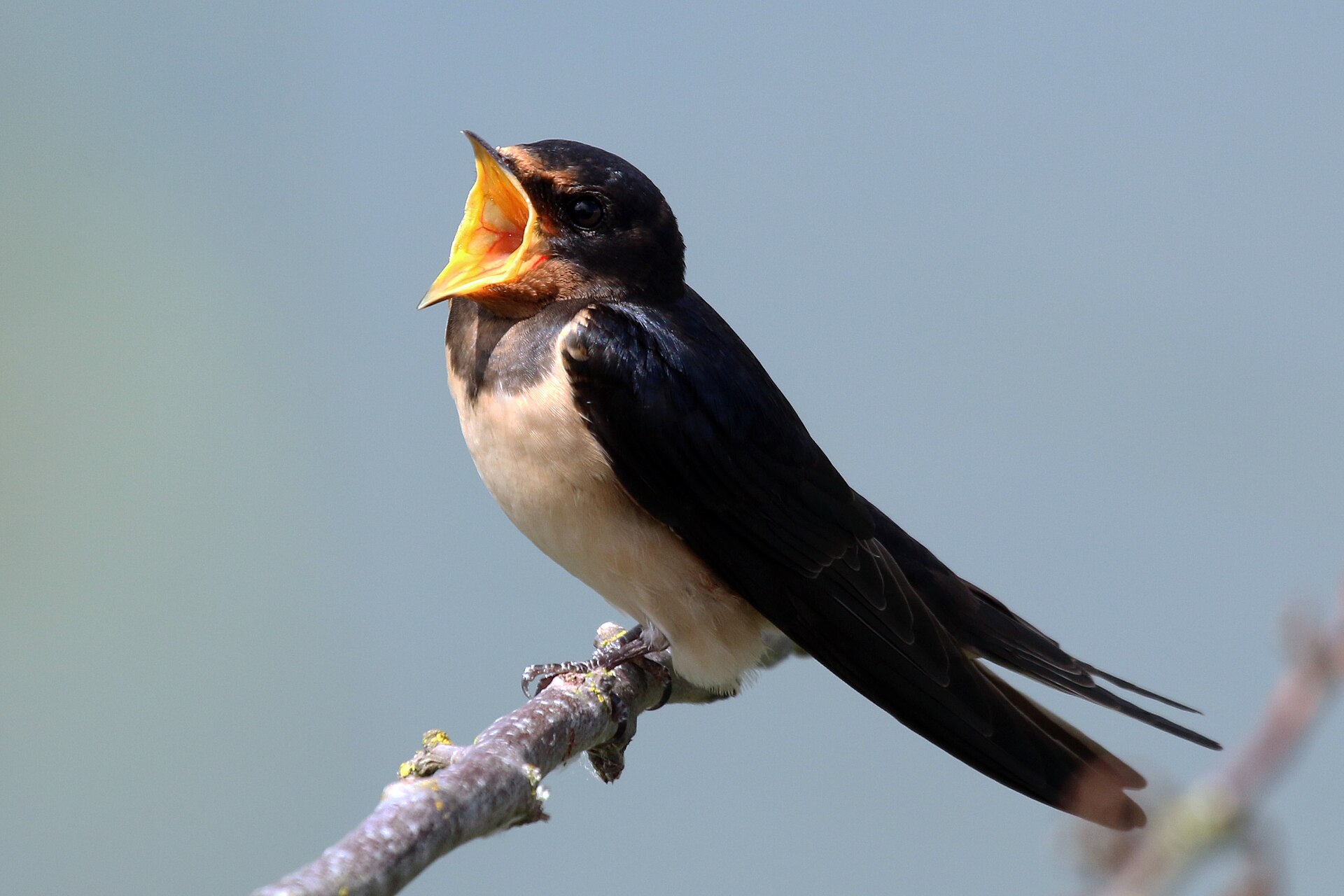
Birds skim a field, turn sharply above a pond and rise towards a wire where others are gathering. In autumn, Barn Swallows seem to draw a line between villages, water and distant skies. Yet the scene does not mean that every swallow in the Arab world is passing through: the species includes local breeders, passage migrants, winter visitors and resident populations.
Identification card
- Arabic names: السنونو الشائع; خطاف الحظائر
- English name: Barn Swallow
- French name: Hirondelle rustique
- Scientific name: Hirundo rustica
- Family: Hirundinidae
- Length: approximately 17–19 cm, with variation in the outer tail streamers
- Habitat: fields, pasture and open country near water and buildings
- Arab-world occurrence: breeding, passage and winter occurrence vary; Egypt has a resident population
- Global conservation status: Least Concern (LC)
One species, different seasonal lives
Across the Maghreb, swallows pass through open landscapes and wetlands, and breed locally in parts of the region. Research on Morocco's Ma'amora bird community documents Barn Swallow as both a breeding summer visitor and passage migrant. An agricultural landscape can be more than a stopover: it may also be where birds begin life before joining a later journey.
In the Levant, Lebanon's checklist records breeding, widespread passage and less frequent winter occurrence. The OSME regional list identifies breeding populations of the subspecies transitiva in the Levant and the resident Egyptian savignii. A winter swallow in Egypt should therefore not automatically be described as a European bird that migrated late.
In Arabia, seasonal passage is prominent, with documented winter occurrence in Oman and rare breeding recorded at some Arabian sites. Saudi observations identify September–October and March–May as clear passage periods. These situations differ between countries and sites: scarce nesting in one area does not mean that the species breeds nowhere in the Arab world.
Autumn has more than one timetable
The Eurasian-African Migration Atlas describes Middle Eastern autumn passage from late August to early November, peaking in early October. This summarises studied populations rather than setting a timetable for every village flock. African winter destinations also differ with breeding origin: not all birds follow the same route or finish in the same place.
Birds may gather on wires or at roosts before dispersing above fields and water. Recording group size, observation time, direction and feeding behaviour is more useful than assuming that every flock is a new migration wave. European roost studies show that these gatherings also form part of the period when birds build energy reserves before travelling.
Reading a bird in flight
Long pointed wings, a forked tail, glossy dark-blue upperparts in suitable light, and a rusty forehead and throat are helpful features. The rump stays dark, useful when comparing it with white-rumped martins. But light and distance change the impression: throat and back colours can disappear, leaving an apparently dark bird.
Juveniles are less glossy, with paler throats and shorter outer tail feathers. Females tend to have shorter streamers than males, but overlap prevents confident sexing from every photograph. A short tail alone is insufficient for identification or ageing: consider wing shape, face, rump and tail together.
Underpart colour also varies geographically, from pale to warm or rusty, with reddish tones prominent in some eastern Mediterranean and Egyptian populations. Belly colour alone should not establish sex, and a photograph from another continent should not be treated as a template for every regional bird.
Insects in the air, mud in the nest
Barn Swallows catch insects in flight above fields, pasture and water. Their use of insect-rich places makes habitat quality important: a large agricultural area is not necessarily a good feeding area if prey is scarce.
The nest is an open mud cup in a sheltered position, often inside or beneath an accessible building. BTO data give a typical clutch of four to five eggs, incubated mainly by the female. Timing depends on population and climate; a European calendar does not establish the nesting season in Egypt or the Levant. Where a nest is occupied, leave entrances and access space undisturbed.
Protecting a familiar neighbour
Least Concern is a global category, not a statement that all populations are stable. Monitoring programmes document declines in parts of the range, while habitat change, insect availability and nest sites are important conservation issues. A decline measured in Europe or North America cannot be assigned to an Arab country without local data.
Watch flocks from a distance and do not approach a roost to force birds into flight for a photograph. Leave occupied nests in peace and avoid blocking entrances while birds are present. Hunting and protection rules should be checked locally with the competent authority. Giving swallows room to feed, continue their journey or return to a nest is a practical way to preserve this shared landscape.
References
- EURING/CMS — Barn Swallow migration atlas
- Cornell Lab — Barn Swallow identification and regional forms
- BTO — Swallow biology
- OSME — Regional List, passerines (v8.1)
- Updated checklist of the birds of Lebanon (2020)
- Les oiseaux de la subéraie de la Ma’amora — breeding and seasonal status
- Birds of Saudi Arabia — November 2022 field notes
- BTO — Swallow Roost Project
- ANDORIN — Barn Swallow plumage and age
- RSPB — Swallow
- Ontario — Barn Swallow recovery strategy
- COSEWIC — Barn Swallow assessment (2021)
Photo credit: Charles J. Sharp — Wikimedia Commons — CC BY-SA 4.0.
_singing.jpg)