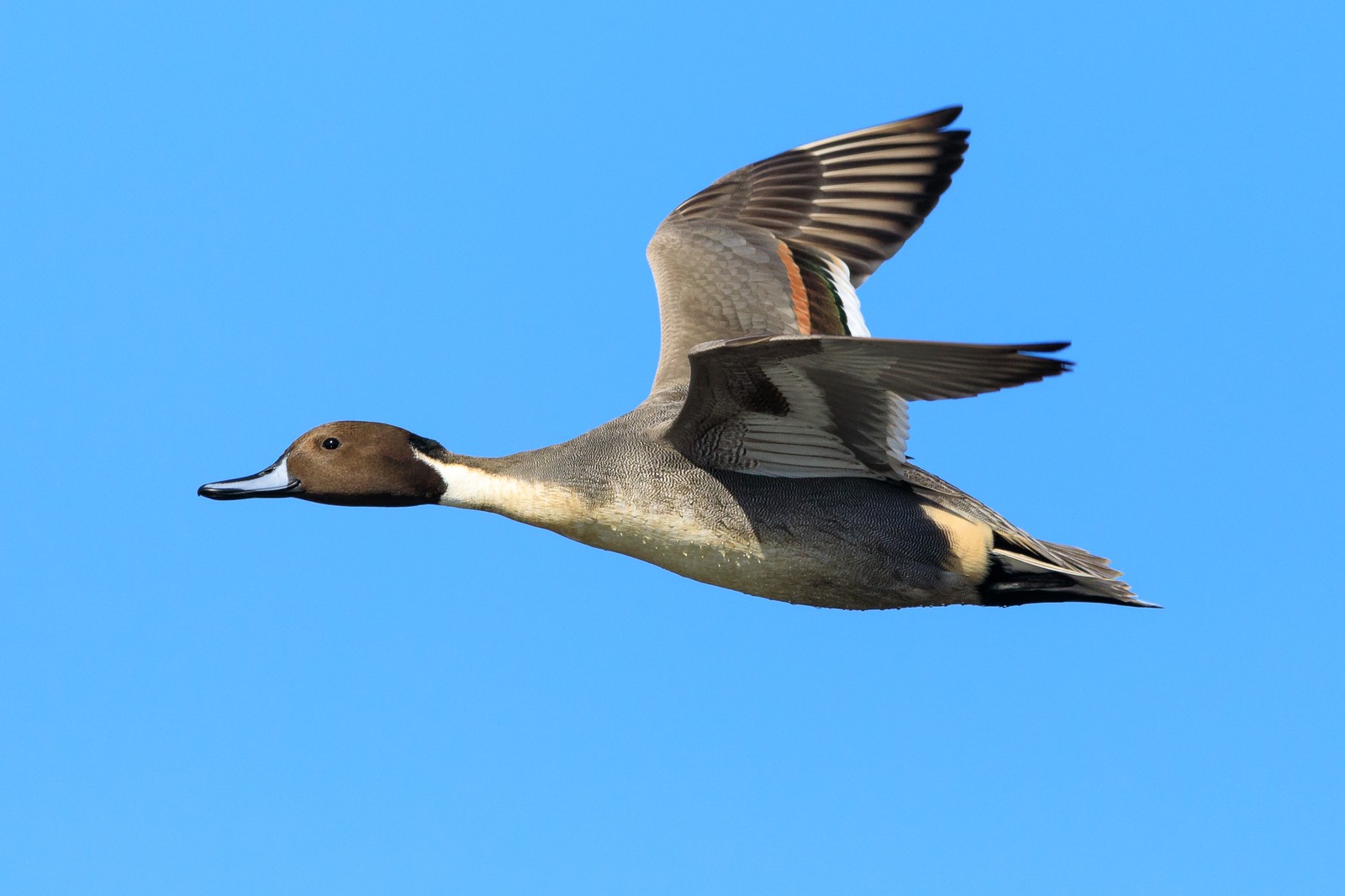
Its name is not the Northern Pintail’s only distinguishing feature: among swimming ducks, a slender body, long neck and pointed tail reveal its shape. The adult male’s central tail feathers become particularly long in bright plumage. The Arabic name refers to a duck in the family Anatidae, not a singing bulbul. Its autumn return to Arab wetlands connects northern breeding grounds with winter waters where food remains available.
Identity card
- Arabic: البلبول الشمالي; also shortened to البلبول
- English: Northern Pintail
- French: Canard pilet
- Scientific name: Anas acuta
- Order and family: Anseriformes; Anatidae
- Length: approximately 51–76 cm, depending on sex and tail length; wingspan approximately 86 cm
- Habitat: shallow fresh and brackish water, marshes and flooded fields
- Arab-world status: passage migrant and winter visitor, with abundance varying among countries and sites
- Global conservation category: Least Concern (LC); scientific name and taxonomy follow AviList v2026 [1]
Autumn does not have one arrival date
Autumn movements begin in northern breeding regions, with different routes linking Eurasia to North Africa, the Middle East and areas farther south. Not every Arab-world flock can be assigned the same origin. In Saudi Arabia, winter occurrence extends from October to March, making late October an appropriate time to search suitable habitat, but not a promise of birds on a particular lake. [6] [7]
Where does it occur in the Arab world?
In Tunisia, a winter 2020–2021 survey, published in 2024, confirms its presence. In Egypt, BirdLife and its partner Nature Conservation Egypt identify Lake Nasser as a stopover and wintering site. These are examples of documented winter occurrence, not evidence that every waterbody in these countries regularly hosts the species. [10] [11]
In Palestine, the Wildlife Society describes it as common in winter and on passage. It is nationally uncommon and non-breeding in Saudi Arabia. Comparing checklists helps avoid applying one country’s status to another; abundance at a site also need not reflect distribution throughout a country. [9] [7]
In the UAE: common on passage and in winter, with some summering individuals. This contrast between neighbouring countries illustrates why “Arab-world occurrence” cannot be reduced to one abundance category. A summer sighting alone also does not demonstrate a nest or successful breeding. [8]
Males, females and immature birds
An adult male in bright plumage has a dark brown head, a white breast with a white stripe extending up the side of the neck, a grey body and long central tail feathers. The slim neck and elongated shape strengthen identification. Tail length varies with sex, age and plumage condition, so a shorter tail should not automatically exclude the species. [2]
The female is mottled brown, with a comparatively plain face and a rather dark grey bill. Immatures and males in eclipse plumage resemble her to varying degrees. Against a female Mallard or Wigeon, combine the long neck, slender body, bill and tail rather than relying on shared brown colouring. Precise ageing in autumn remains more demanding than identifying the species. [2] [5]
How does it feed?
In shallow water, Pintails lower the head and neck or tip up to reach food; on land they pick up grain and seeds. Their diet includes plant material and aquatic invertebrates, with insects particularly important to young birds and during the breeding season. They may feed or rest among other ducks, so a species count must not simply equal the total mixed flock. [5]
Life cycle: from ground nest to winter quarters
Breeding extends across large parts of Eurasia and North America, often in open landscapes near wetlands. Many pairs form during winter, but a pair together at an Arab wintering site need not nest there. The female makes a ground nest concealed in vegetation, sometimes some distance from water, and undertakes incubation and care of the ducklings. [3]
A typical clutch contains 7–9 eggs, incubated for about 22–24 days. Ducklings leave the nest early and feed themselves under the female’s care, becoming able to fly at roughly 40–45 days. After breeding, the birds moult, including replacement of wing feathers and a temporary flightless period; autumn migration and winter settlement follow before the next breeding season. [4]
Its value, and what needs protecting
The Pintail’s journey connects distant places: safe breeding habitat is insufficient if feeding and resting sites disappear along the route. Recognised pressures include wetland loss, drought and damage to nests in farmland. A numerical trend documented in North America must not be transferred to all Arab populations without local evidence. [3]
Global Least Concern status guarantees neither the stability of every population nor permission to hunt. Watch flocks from a distance, avoiding repeated flushing or approaches to a suspected nest. Dated observations and clear photographs can help track arrival times and changing use of sites, provided confirmed field evidence remains distinct from inference.
References
- AviList v2026 — Global Avian Checklist
- Cornell Lab — Northern Pintail identification
- Cornell Lab — Northern Pintail life history
- BTO BirdFacts — Pintail biology
- Audubon — Northern Pintail
- EURING/CMS — Northern Pintail migration atlas
- The Birds of Saudi Arabia, vol. 2, pp. 20–24
- Emirates Bird Records Committee — checklist, 19 February 2026, pp. 10–11
- Palestine Wildlife Society — bird checklist
- Hamza et al. (2024) — wintering waterbirds in Tunisian wetlands
- BirdLife / Nature Conservation Egypt (2025) — Lake Nasser
- AEWA — Anas acuta
Photo: © Frank Schulenburg, via Wikimedia Commons, CC BY-SA 4.0. Photographed in the United States on 2021-11-11; resized and compressed for the website without changing its content.