Among the ducks gathering beside autumn ponds, the Northern Shoveler often announces its identity before its colours are clear: a long bill widening into a spatula. Rather than simply digging into mud, it filters tiny food items from the water. Its seasonal return offers a way to understand the value of shallow wetlands, not just another name to add to a sightings list.
Identity card
- Arabic: أبو مجرف; also مجرفي المنقار
- English: Northern Shoveler
- French: Canard souchet
- Scientific name: Spatula clypeata; older sources use Anas clypeata
- Order and family: Anseriformes; Anatidae
- Length: approximately 44–51 cm; wingspan approximately 69–84 cm
- Habitat: shallow freshwater or brackish ponds, marshes and lakes
- Arab-world status: chiefly passage migrant and winter visitor, with rare local breeding records
- Global conservation category: Least Concern (LC); scientific name and taxonomy follow AviList v2026 [1]
Why it matters this season
Arab wetlands gain importance as ducks move from northern breeding grounds towards their winter quarters. In Saudi Arabia, winter presence extends from October to March. On the western flyway, Danish ringing records document some birds reaching Morocco in October. These are examples of different migration routes, not a single arrival date for every Arab country. [6] [12]
Different statuses across the Arab world
In Tunisia, a winter 2020–2021 survey, published in 2024, confirms its presence. In Algeria, researchers published a June 2019 record from Sebkhet El-Mahmel of a pair accompanied by eight young. “Winter visitor” therefore describes the predominant pattern without excluding all local breeding; that record does not establish widespread residency either. [9] [10]
In Egypt, historical assessments of Lake Nasser include the species among wintering ducks. This documents the site’s role, not a current population count. In Palestine, the Wildlife Society’s checklist describes it as very common in winter and on passage. Inclusion in a national list does not mean equal abundance at every pond, or that the species breeds there. [11] [8]
Rare breeding has been recorded in Qatif, Saudi Arabia. In the UAE: locally common to very common on passage and in winter, occasionally in summer. An individual remaining through summer is not, by itself, evidence of nesting. [6] [7]
The bill first, then the plumage
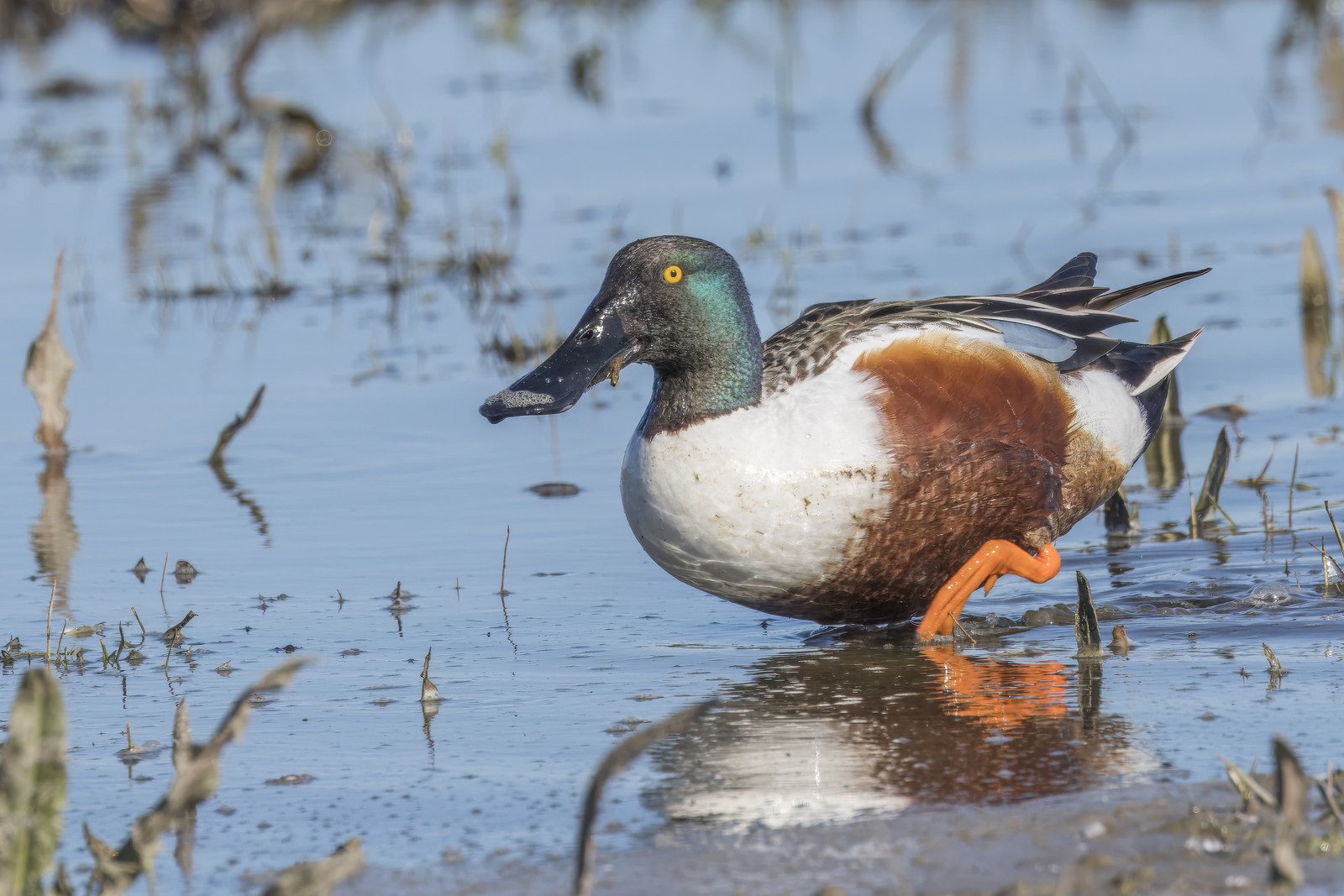
A male in bright plumage has a dark green head, white breast and chestnut flanks. The wing shows a pale blue area and a green speculum. These colours are useful, but the bill’s widened tip remains the most dependable feature when poor light conceals the head’s sheen. [2]
Females and immature birds are mottled brown; a moulting male may look more similar to them. Brown markings alone do not establish that a bird is female. When comparing it with a female Mallard, consider the conspicuously expanded bill together with head and wing structure. Colour or a distant photograph is not enough to assign sex and age confidently. [3]
Small food, distinctive behaviour
Fine plates along the bill edges form a filter for aquatic invertebrates and seeds. Birds sometimes swim in circles or sweep their bills from side to side while feeding. This specialisation helps explain their association with productive shallows. Finding one on a treatment pond or in turbid water does not establish that the water is clean or safe for people. [4]
From nesting to the next migration
Most breeding occurs in northern temperate Eurasia and North America. The female makes a ground nest concealed by vegetation, lines it with down, incubates the eggs and tends the young. BTO data give a typical clutch of 9–11 eggs, around 22–23 days of incubation and flight at roughly 40–45 days. These are approximate biological intervals, not a fixed calendar for every population. [5]
Ducklings hatch covered in down and can swim soon afterwards, but still need cover and care. After breeding, plumage is renewed; males become temporarily flightless while their wing feathers are replaced. Birds subsequently gather and move towards wintering areas. A quiet bird seen in summer must therefore be distinguished from evidence of a nest or brood. [4]
Its value, and responsible watching
The Shoveler illustrates the diversity of feeding strategies within a wetland, linking tiny aquatic organisms with the bird food web. Its conservation requires connected feeding and resting places, rather than protection of an attractive image in isolation from habitat. Global Least Concern status does not guarantee that every local gathering is secure or that draining a small pond has no consequences. [13]
Use binoculars from a fixed position and do not flush a flock for a photograph. Record the date, location, number and behaviour: these details help distinguish passage from repeated occupation. Hunting status depends on the rules applying to the country, site and season; it cannot be inferred from the conservation category or the label “wild duck”.
References
- AviList v2026 — Global Avian Checklist
- Cornell Lab — Northern Shoveler identification
- RSPB — Shoveler identification
- Cornell Lab — Northern Shoveler life history
- BTO BirdFacts — Shoveler biology
- The Birds of Saudi Arabia, vol. 2, pp. 20–24
- Emirates Bird Records Committee — checklist, 19 February 2026, pp. 10–11
- Palestine Wildlife Society — bird checklist
- Hamza et al. (2024) — wintering waterbirds in Tunisian wetlands
- Slimane, Ali & Telailia (2023) — Northern Shoveler breeding record in Algeria
- World Database of Key Biodiversity Areas — Lake Nasser, historical assessment (2001)
- Natural History Museum of Denmark — Northern Shoveler migration atlas
- AEWA — Spatula clypeata
Photo: © Charles J. Sharp, via Wikimedia Commons, CC BY-SA 4.0. Photographed in the Netherlands on 2026-04-07; resized and compressed for the website without changing its content.