Prepared by: Editorial Board
Since its launch, Sayd magazine was never merely a platform for hobby details and equipment. It was a dialogue space that brought together artists, poets, businesspeople, and pioneering women of the outdoors under one ethical charter: respect for nature, compliance with the law, and opposition to random hunting.
Here we revisit, in a documented chronological sequence, some of the most notable conversations Sayd’s pages carried that embody this long record:
March 2016 | Businessman-hunter George Khashan: “Maturity leads us to protect nature”
In early 2016, businessman George Khashan offered a responsible reading of the hunter’s relationship with the wild, explaining that protecting game begins with self-discipline before fear of enforcement. He said: “I do not hunt in large quantities out of fear of the law, but so that I can keep going hunting and so the next generation can go too… There is no written law in nature itself; we are the ones who set it through our ethics and upbringing.”
September 2016 | Artist Nicola Al-Asta: “Hunting is a refined sport spoiled by selfishness”
In autumn 2016, the magazine met Lebanese artist Nicola Al-Asta, who spoke of his long-standing love of the mountain and offered a model of an artist who sees the gun as a means of contemplation and calm, not of boasting about bags. With his characteristic candor he said: “My mother used to consider me a ‘hapless’ hunter… but for me hunting is art, patience, and a renewal of positive energy. Hunting is a refined school of ethics, and the worst thing in it is human greed and the selfishness of turning it into a slaughter.”
August 2020 | Visual artist Mukhtar Hadi Yazbek: A brush that distinguishes the hunter from the “indiscriminate shooter”
In summer 2020, the magazine recorded a distinctive artistic contribution by Mukhtar Hadi Yazbek, who designed two paintings adopted by the Society for the Protection of Nature in Lebanon (SPNL) and the Middle East Center for Sustainable Hunting for regional awareness work. He told the magazine: “The language of color crosses borders; with my brush I wanted to document the fundamental difference between a sustainable hunter who respects balance and an indiscriminate shooter who assaults wildlife.”
November 2022 | Poet and journalist Hani Nadeem: “What spoils hunting is lack of awareness”
In late 2022, poet Hani Nadeem spoke in depth, treating his going to the mountain as a return to humanity’s first roots before the falsehood of modernity. He said: “I return as a real human being without the cosmetics of city life… I am a son of the land and the soil. Hunting is a sport of nobles, and what spoils it is only lack of awareness and recklessness toward the environment—which requires firmness and strict application of the law.”
February 2024 | Lebanese hunter Sarah Akiki: “Hunting is communion with the land and a challenge with elegance”
In early 2024 the magazine devoted distinctive space to women’s presence, interviewing agricultural engineer Sarah Akiki, who trained in hunting from childhood. She pushed back against the traditional view of the woman hunter, affirming: “Abroad, a woman does not lose her femininity if she practices hunting, and woman has been a hunter since time immemorial. What matters to me is not the number of bags but the pleasure of walking and connecting with nature, and our care as women hunters for keeping the mountain clean and not leaving trash far exceeds that of others.”
February 2024 | Hunter Rita Habib Al-Shaar: “Learn from the woman how to be a hunter, not a show-off”
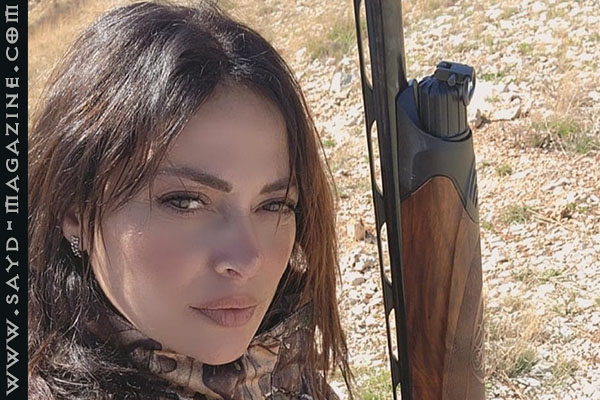
Hunter Rita Habib Al-Shaar — from Sayd magazine’s archive.
In the same month, the magazine documented the experience of Rita Habib Al-Shaar, a Lebanese mother who combines family commitments with a passion for regulated hunting, raising a firm cry against chaos and night hunting: “Hunting is joy, calm, and adventure. The value of hunting is not in boasting by posting numbers of dead birds as a crime of extermination, but in preserving balance… And my constant message to the Ministry of Environment: no leniency with night hunting and violators.”
In closing, this timeline shows that Sayd was never a fleeting publication, but a living record of shifts in environmental awareness in our community, and a platform where different groups—from stars, intellectuals, and businesspeople to women hunters and field pioneers—met to root an unchanging principle: hunting is an art, a responsibility, and a true partnership to protect the land.