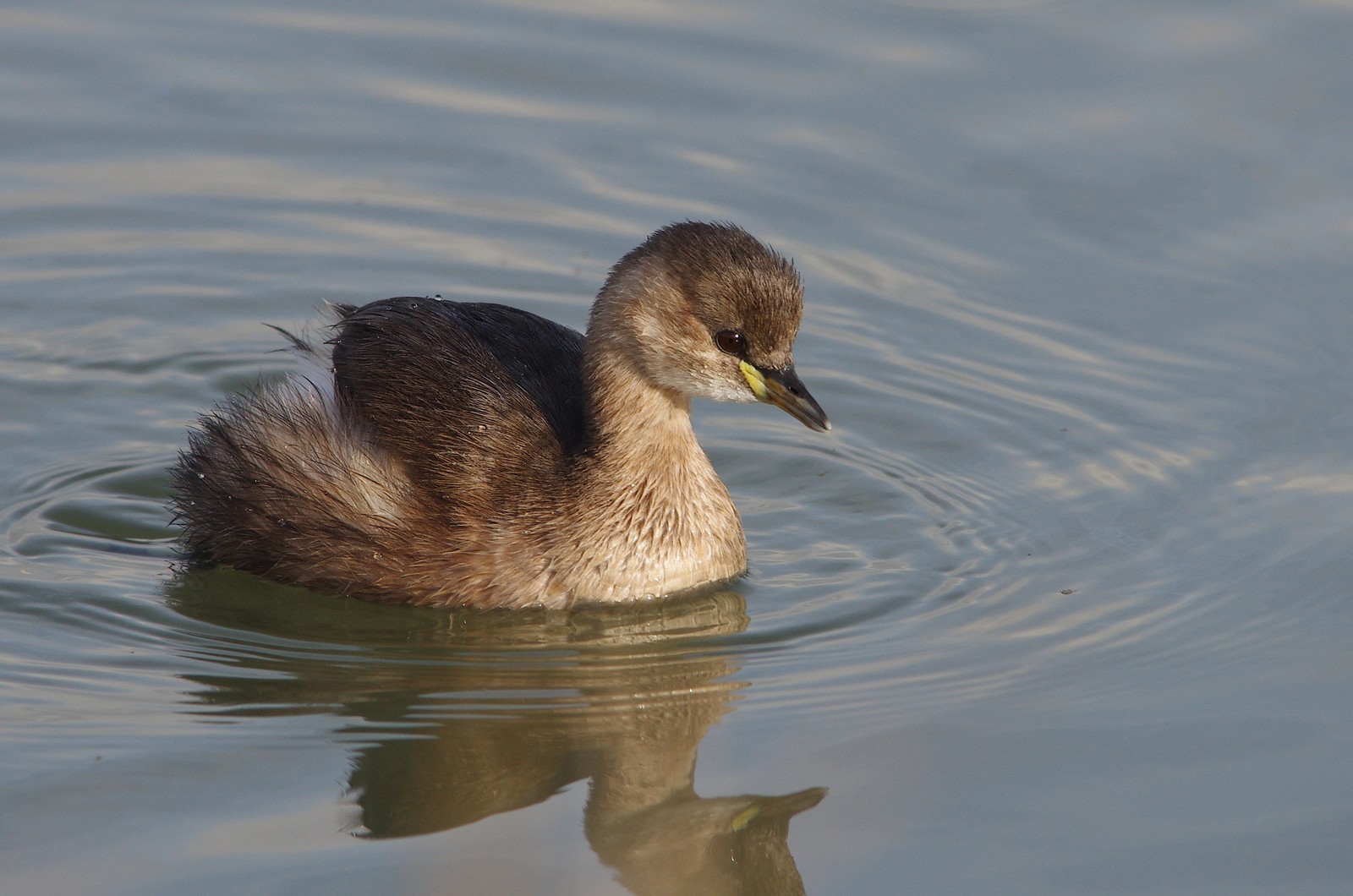
A Little Grebe disappears below the surface and reappears away from the observer’s original view. Its small size conceals a busy life: diving for food, building among aquatic plants and sometimes carrying chicks on its back. An autumn sighting is not necessarily a migrant; in several Arab wetlands, residents meet winter visitors. [11]
Identity
Arabic name: الغطاس الصغير, documented in The Birds of Saudi Arabia. The scientific name is Tachybaptus ruficollis; the French name is Grèbe castagneux. It belongs to Podicipedidae, order Podicipediformes, not the duck family. AviList v2026 includes tricolor within the species while identifying a need for wider review of species limits in this complex. The listed global conservation category is Least Concern, LC. [1] [2] [8]
Plumage, age and sex
Breeding plumage combines a dark head with chestnut cheeks and foreneck and a pale patch at the bill base. Outside this plumage the face and neck become paler and less contrasting. Young birds retain pale and dark head and neck striping; chick markings should not be mistaken for another species. [6]
The sexes look similar, and colour intensity alone cannot reliably sex a bird in an ordinary photograph. The ringing guide gives a length of about 25–29 cm and notes that ageing may require flight-feather examination. Field recognition therefore combines small size, head and bill shape and neck pattern rather than one colour. Several unobtrusive views are more useful than chasing the bird for a closer photograph. [7]
Black-necked Grebe Podiceps nigricollis differs in breeding plumage through its black head and neck and golden feather tufts behind the eyes; these seasonal features must not be projected onto a pale winter bird. [14]
Arab seasonality: residents and visitors
In Saudi Arabia the reference describes a rare breeding resident and common winter visitor, distributed patchily, with winter occurrence from September to March. The UAE’s February 2026 checklist calls it a common resident and locally common migrant and winter visitor; the first confirmed breeding was at Kalba in April 1989. Neither statement means that all Gulf birds migrate or that abundance is uniform across countries. [2] [4]
Lebanon has local resident and summer-breeding populations, including at Aammiq, Anjar and Oyun el Samak. The 2020 checklist records winter reinforcement chiefly in November–late February and passage in September–late November and mid-March–late April. The Tunisian study published in 2024 describes it as sedentary and records it during winter 2020–2021. An autumn increase therefore cannot automatically be assigned to arrival from abroad without tracking evidence. [3] [5]
An original nesting study confirms breeding at Lake Tonga in northeast Algeria. The IUCN country list also includes Morocco, Egypt, Iraq, Oman, Yemen and Sudan; country inclusion establishes occurrence, not the residency or breeding calendar of every population. Its distribution extends beyond these examples, but local seasonality requires local evidence. [9] [10]
In Egypt, the Lake Burullus KBA account lists Little Grebe among breeders, based on historical documentation and a latest assessment dated 2016, not a new count. Iraq’s Central Marsh surveys in October 2013–June 2014 classified it as resident and confirmed breeding through juvenile sightings. [12] [13]
Habitat, food and behaviour
It uses ponds, lakes, reservoirs and basins combining open water with emergent vegetation, sometimes entering brackish water. Food is mainly insects and larvae, supplemented by molluscs, crustaceans, amphibians and small fish, many caught by diving. An artificial pond can have ecological value, but the presence of a grebe alone does not prove clean water or a healthy ecosystem. [2]
Its repeated, whinnying trill may be heard before the bird is seen among plants. Quiet waiting helps connect a call with its source; a sound recording still requires reliable comparison and does not establish a breeding pair or nest. A feeding bird should be distinguished from direct breeding evidence such as an occupied nest or dependent chicks. [11]
Nesting and life cycle
Both adults build with aquatic vegetation; the nest may float, anchored to plants. They share incubation and care, cover eggs when leaving and may carry chicks on their backs. Early swimming ability is not independence from parental care. [2] [6]
BTO reports a typical clutch of 4–6 eggs, incubation of about 20–21 days and fledging at about 44–48 days. These are reference values, not fixed limits for every Arab population. A study published in Ardeola in 2015 followed nesting at Lake Tonga during 2010–2012, with egg laying from late March to late July. This is valuable local evidence, not a calendar for the Gulf or Nile Valley. [8] [9]
Ecological importance and threats
Its food web includes insects, other invertebrates and small fish, while marginal vegetation and suitable water conditions support nesting. At Lake Tonga, nest success varied with site conditions; predation and flooding were among recorded causes of failure. Site management needs this context before attributing change to a single cause. [2] [9]
Least Concern does not mean that every local population is safe. Repeated surveys at the same sites are more informative than comparing two photographs or counts made with different effort. Responsible observers avoid cutting paths through reeds or approaching nests for photographs, record date, place and approximate age where possible, and leave sex undetermined when diagnostic evidence is absent. [1]
Scientific references
- [1] AviList v2026
- [2] The Birds of Saudi Arabia, Volume 2
- [3] Updated checklist of the birds of Lebanon (2020)
- [4] Emirates Bird Records Committee: checklist, 19 February 2026
- [5] Hamza et al. (2024), winter waterbirds of Tunisia
- [6] LPO: Grèbe castagneux
- [7] Blasco-Zumeta & Heinze: Little Grebe identification, ageing and sexing
- [8] BTO BirdFacts: Little Grebe
- [9] Athamnia et al. (2015), Nest-site selection and reproductive success in northeast Algeria, Ardeola 62:113–124
- [10] IUCN: Tachybaptus ruficollis, assessment and country distribution
- [11] RSPB: Little Grebe
- [12] Key Biodiversity Areas: Lake Burullus, assessment 2016
- [13] Fazaa, Dunn & Whittingham (2017), Iraq’s Central Marsh
- [14] RSPB: Black-necked Grebe identification
Photo: © El Golli Mohamed, via Wikimedia Commons, CC BY-SA 4.0. Photographed at Lake Tunis, Tunisia on 2015-01-29; resized and compressed for the website without changing its content.