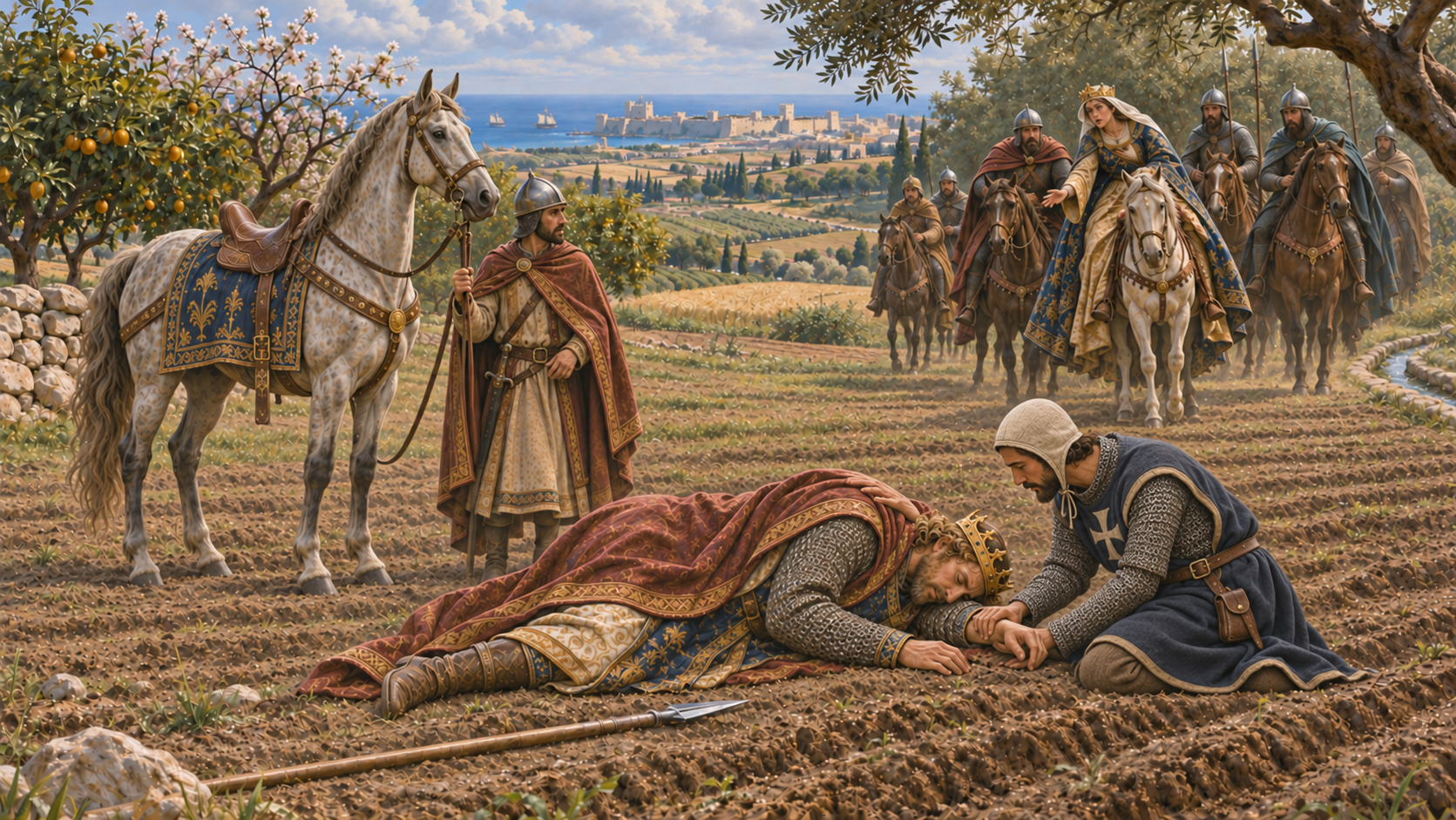
In 1142, Fulk, king of the Crusader Kingdom of Jerusalem, and his wife, Queen Melisende, were staying in Acre when the queen wished to go on an outing outside the city. The king and his entourage accompanied her, heading to a place outside Acre with gardens and fields watered by several springs.
Along the way, boys who were ahead of the procession startled a hare hiding among the furrows. Those present raised their voices, and the king seized his lance and urged his horse to chase the hare.
But the horse fell during the rush and threw the king to the ground. According to the historian William of Tyre, the saddle struck King Fulk’s head, causing a severe injury. His companions hurried to him and found him unable to speak and unconscious. The procession was thrown into confusion and the queen grieved, while news of the accident reached the people of Acre.
The final return to Acre
Fulk was carried into the city while he was still breathing. The account says that he remained unconscious for three days and died on the fourth. His body was then taken to Jerusalem, where he was buried in the Church of the Holy Sepulchre.
Fulk ruled the Crusader Kingdom of Jerusalem alongside Melisende, who held the hereditary right to the kingdom. After his death, the queen continued to exercise power while their son Baldwin was still young.
The sources differ on the date of his death. William of Tyre’s text gives the year as 1142, while a study by the historian Bernard Hamilton favours November 1143, based on the sequence of events in the royal family. References within the source also differ on the exact day of his death.
Springs and ploughed furrows
William’s description gives the incident a setting that extends beyond the story of the chase. The destination, as described in the French translation, was watered by several springs, and the hare emerged from ground with “ploughed furrows”.
These details depict a scene on the outskirts of Acre, where water and ploughed land formed part of the place through which the procession passed. The historian did not name the location, but he preserved a fleeting image of the city’s countryside: a king on horseback, a hare emerging from its hiding place, and a brief chase that changed the course of rule.
Sources: William of Tyre, A History of Deeds Done Beyond the Sea, Book XV, Chapter 27, and the French translation, pp. 443–445; and Bernard Hamilton, “The Queens of Jerusalem, 1100–1190”.
AI-generated illustration inspired by Fulk’s accident near Acre.