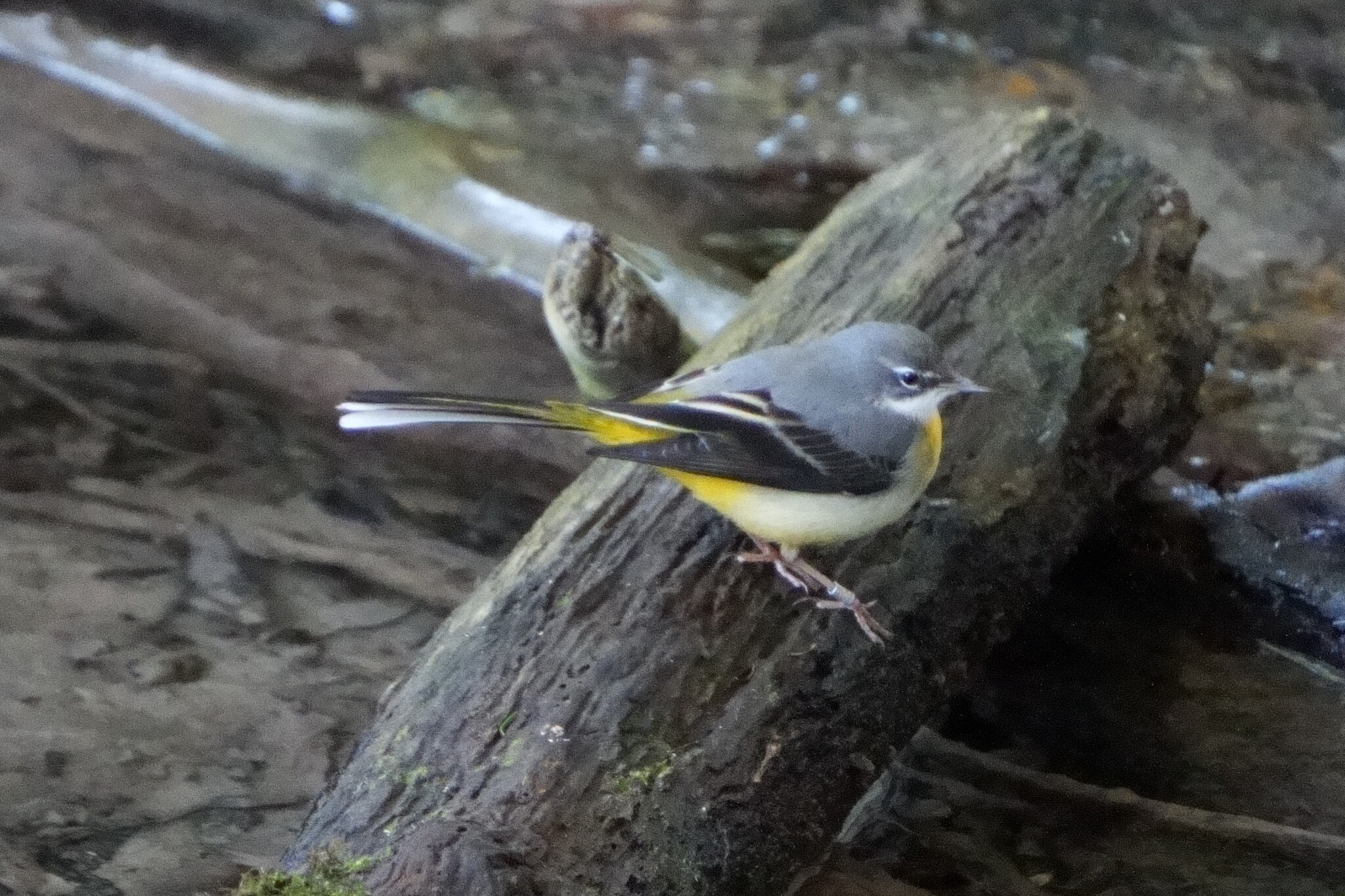
Motacilla cinerea — Identification, habitats, breeding and occurrence in the Arab region
Identity and recognition
The Grey Wagtail, Motacilla cinerea, belongs to Motacillidae, the wagtail and pipit family. Its name describes only part of its appearance: the back is grey, but the undertail is conspicuously yellow and the tail is extremely long relative to the body. Legs are pinkish brown. A breeding male has a black throat; females have a paler throat, sometimes with variable black. Young birds are less vivid, with a pale throat and weaker yellow on the breast. These characters change with age and season, so throat colour alone is not a reliable year-round sexing method.
Distinguishing similar birds
Yellow undertail feathers help separate it from a White Wagtail. Distinguishing it from yellow wagtails requires closer comparison: look for the combination of a grey back, proportionately longer tail and pale legs, rather than yellow plumage alone. A pale wing stripe may show in flight. Feeding around rocks and water margins also provides a clue, but habitat never replaces identification: other wagtails can visit the same stream.
Habitat, food and behaviour
Breeding birds are associated with streams and rivers, especially where rocky margins provide insects and sheltered nesting places. Outside the season they also use slower water, ponds, lakes and channels; some move downhill to milder areas. They collect insects and other small invertebrates along edges and exposed surfaces, sometimes catching prey in the air. A field study in Cyprus recorded flies and dragonflies among nestling foods, illustrating the connection with insects around water.
Breeding and annual cycle
The nest occupies shelter near water, such as a rock or wall recess, a space beneath a bridge or roots in a bank. Suitable nestboxes may be accepted. British records give a typical clutch of five eggs, incubation of about 12–13 days and a nestling period of roughly 14–15 days. These reference durations vary; the breeding season is established locally. Successful nesting requires food and a site protected from flooding and repeated disturbance.
Arab-region distribution and seasonality
Residence and migration differ across Arab countries. Jordan’s checklist describes a winter visitor and a less common passage migrant. Syria’s 2025 checklist documents uncommon resident breeding in the northern coastal region, together with widespread wintering and passage in different regions. The Moroccan checklist published in 2010 records resident breeders and winter visitors. Qatar e-Nature, by contrast, describes a rare passage migrant. An October observation in the Levant may therefore fit passage or the beginning of winter presence. Occasional Gulf records should not be turned into a claim of common wintering throughout the Gulf. Kuwait’s endorsed checklist, updated in September 2026, records uncommon passage and scarce winter presence.
Ecology and conservation
The bird depends on connections between water, its margins and invertebrate food. Maintaining suitable flow, varied banks and sheltered nesting places benefits its habitat. Water pollution, channel deterioration and altered banks can threaten habitat and prey; severe winter weather can affect some populations. Its global category is Least Concern, not a guarantee that every local population is stable. Regular monitoring is useful, but a single wagtail sighting is not, by itself, a certificate of clean water.
References
British Trust for Ornithology — BirdFacts: Grey Wagtail
RSPB — Grey Wagtail
Qatar e-Nature — الذعرة الرمادية
Jordan BirdWatch — Jordan Bird List
Aidek et al. — An Annotated Checklist of the Birds of Syria: Species Diversity, Subspecies, Distribution, and Conservation Status, 2025
Thévenot et al. — Liste des oiseaux du Maroc, Go-South Bulletin 7, 2010
Ornithological Science 22 — Grey Wagtail breeding ecology in Cyprus, 2023
LPO PACA — La Bergeronnette des ruisseaux
Sovon — Motacilla cinerea
Kuwait Ornithological Rarities Committee — Official Kuwait Bird List, September 2026
Photo: Andrew Cunnington — CC0 1.0.