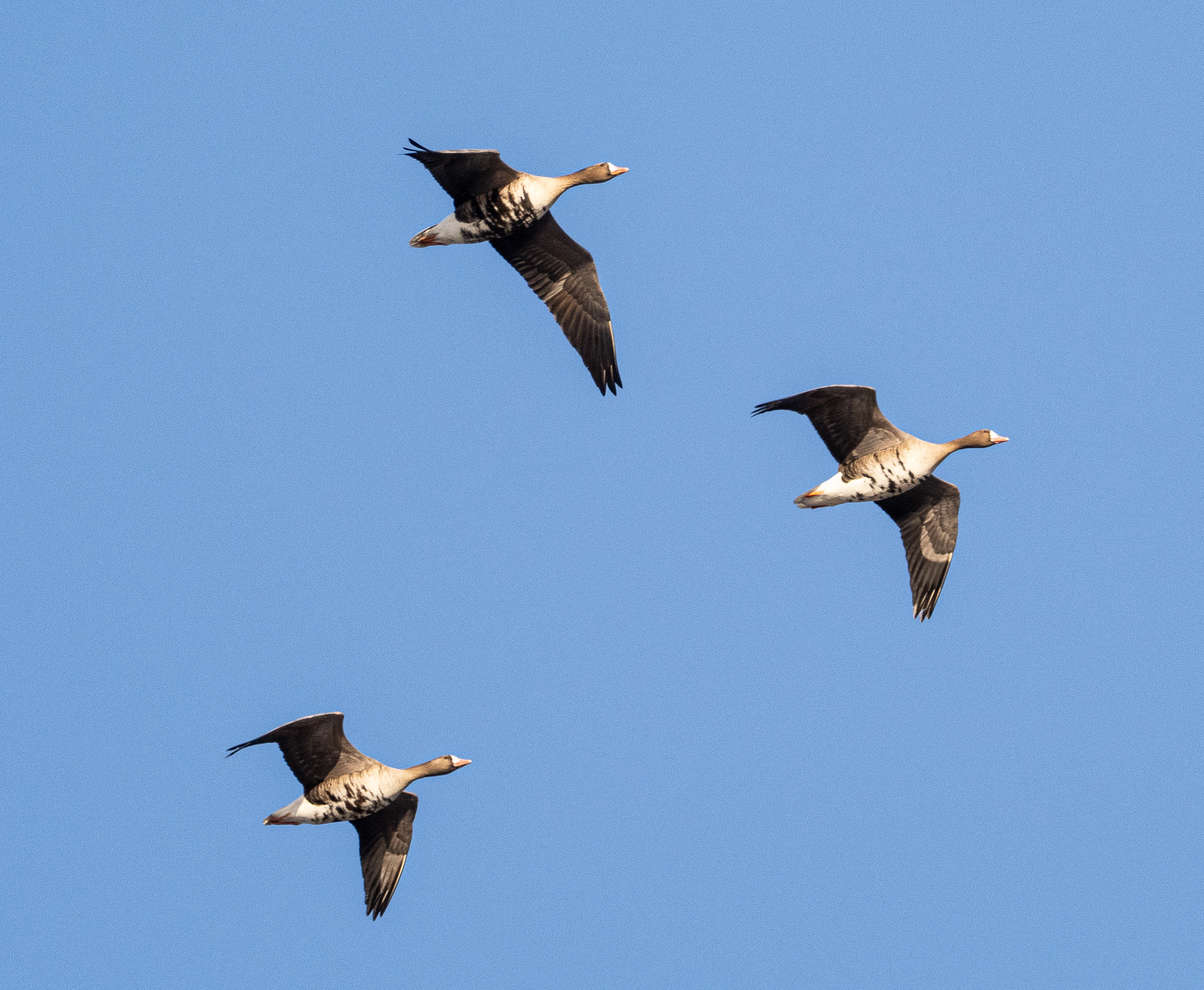
Anser albifrons
Identity and identification
Greater White-fronted Goose Anser albifrons belongs to Anatidae. Adults show white around the bill base, irregular black belly bars and orange legs. Young birds lack some of these marks; head, bill and body proportions help separate the species from Lesser White-fronted Goose.
Habitat and food
It grazes in open, damp landscapes and rests on quiet water. Flocks commute between feeding and roosting areas, so conservation must retain both.
Breeding and development
It breeds in northern regions in a lined ground nest. BTO gives a typical clutch of 5–6 eggs, incubated by the female for 27–28 days. Downy young walk early; the reference fledging age is 40–43 days. Walking ability does not imply flight.
Arab occurrence and seasonality
Lebanon’s 2020 checklist documents passage and irregular winter occurrence, usually from mid-November to early March. Qatar’s current list describes a rare winter visitor. November precedes the main Lebanese winter period; presence in Qatar remains rare. Neither status describes a resident population.
Observation and conservation
Chasing flocks and draining wetlands reduce feeding and resting opportunities. Avoid approaching roosts to force birds into flight for photographs.
British Trust for Ornithology — BirdFacts: White Fronted Goose · RSPB — White Fronted Goose · Ramadan-Jaradi et al. — Updated checklist of the birds of Lebanon, Sandgrouse 42 (2020) · Qatar Bird Observation Group — Qatar Bird List · AviList Core Team — Global Avian Checklist v2026, 20 October 2026
Species illustration: Tero Linjama — CC0 1.0. · 1 · https://creativecommons.org/publicdomain/zero/1.0/