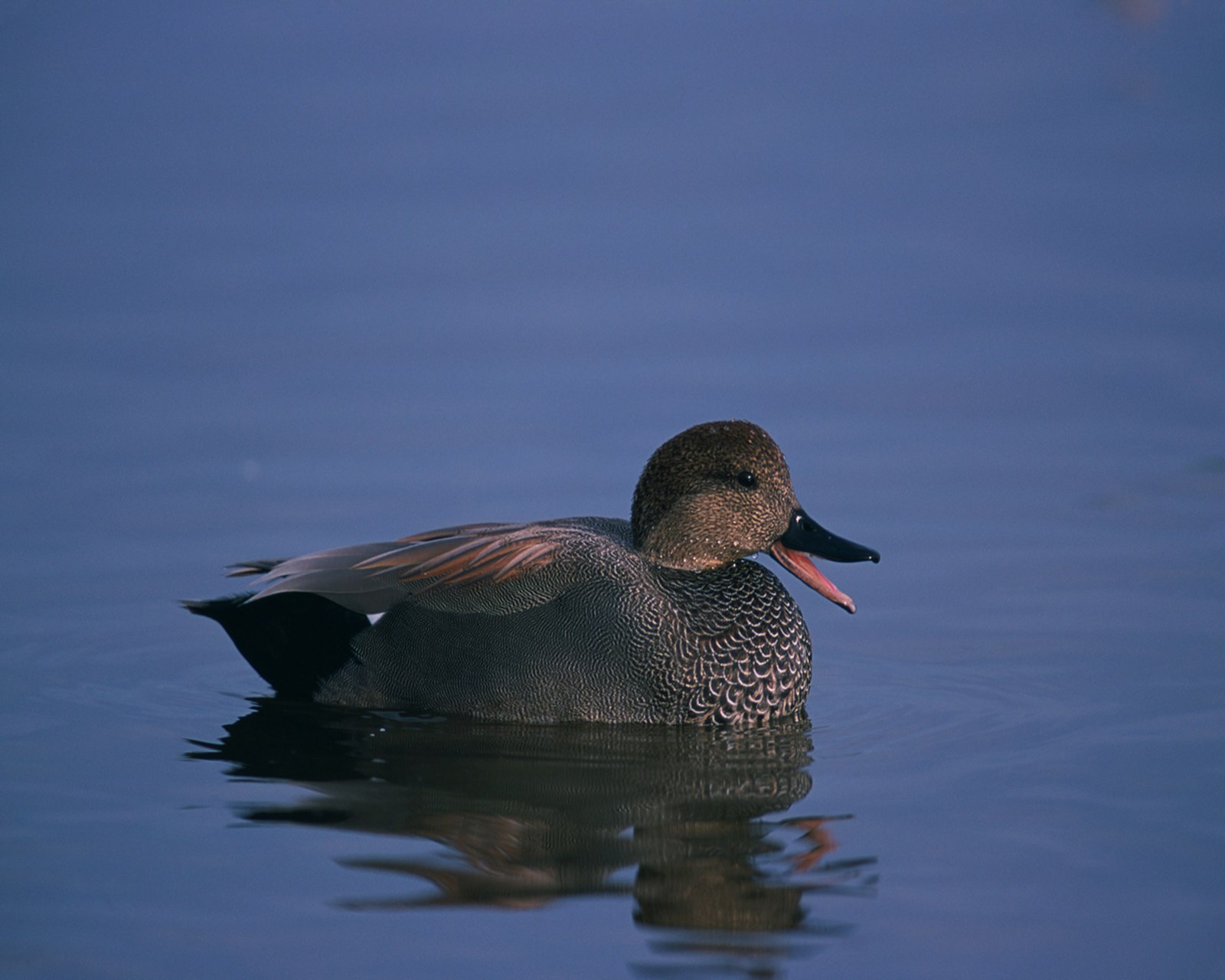
Mareca strepera — a dabbling duck with a white wing patch
Identity and name
The Gadwall, called “al-batt al-sumari” and “sumariya” in Arabic references, belongs to Anatidae and the order Anseriformes. The scientific name used here is Mareca strepera; older references and some regional checklists use Anas strepera for the same species. It is a dabbling duck rather than a diving duck that normally feeds completely underwater. A male may look dull from a distance, but binoculars reveal intricate patterning rather than uniform grey.
Identification
A male in characteristic plumage is grey-brown, finely patterned across the body, with a black rear end and a dark bill. The wing has a white patch, with black and chestnut areas visible on closer inspection. The forehead is steep and the body a little slimmer than a Mallard’s. The female is mottled brown, with orange edges to her dark bill; the white wing patch shows in flight and may be visible at rest.
Juveniles resemble females, so the absence of grey does not determine sex or age. Males also acquire female-like eclipse plumage after breeding. The white wing patch, narrower bill and pale belly help distinguish Gadwall from Mallard; these features should be assessed together rather than relying on one colour or a distant photograph.
Habitat and food
Gadwall use lakes, ponds and marshes rich in aquatic vegetation, in fresh and sometimes brackish water, both natural and artificial. They usually feed near the surface, tipping forwards to reach submerged plants. Leaves, stems and seeds are important foods; invertebrates, including insects and small molluscs, become more important during breeding. They may take vegetation gathered by other birds, including coots and diving ducks, as these return to the surface.
Behaviour and life cycle
They mix with other ducks and form flocks outside the breeding season; pairs may already be evident in autumn and winter. The female builds a ground nest concealed by vegetation and lined with plant material and down; small islands sometimes provide suitable sites. BTO records give a typical clutch of 9–11 eggs, incubated by the female for about 24–26 days. Chicks hatch covered in down and able to move, and usually become capable of flight at around 45–50 days. These are reference durations, not a uniform calendar for every population.
Distribution and migration
The breeding range extends across large parts of North America, Europe and Asia, with local breeding in northwestern Africa. Northern populations are strongly migratory, whereas others remain resident or move shorter distances. In Europe, birds undergo a post-breeding wing moult that temporarily prevents flight before continuing their movements. Summer presence alone therefore does not demonstrate permanent residency or nesting at a site.
Occurrence in Arab countries
The North African waterbird guide documents winter occurrence in Morocco, Algeria, Tunisia, Libya, Egypt and Sudan, without extending that generalisation to Mauritania. This describes distribution, not equal abundance in every country or wetland. Lebanon’s 2020 checklist describes a very scarce, irregular winter visitor from late October to mid-March.
In Kuwait it is an uncommon passage migrant and scarce winter visitor, and breeding has been recorded; nesting cannot therefore be ruled out across the entire region. Oman lists it as a fairly common winter visitor. The UAE checklist describes an uncommon to fairly common migrant and winter visitor, but seldom numerous. Records from Dhahran, Saudi Arabia, describe an uncommon winter visitor during October–March; this is local evidence, not a classification for the whole kingdom.
Why late October?
This period overlaps part of the species’ autumn movements; in Lebanon, the documented winter occurrence window begins late in the month. It is not a single peak throughout the Arab world and does not guarantee birds at every lake. Recording dates, counts and water conditions is useful; watch quietly without making birds stop feeding or abandon their resting place.
Conservation and pressures
The 2025 global Red List assessment classifies Gadwall as Least Concern (LC). This does not mean local problems are absent: the assessment identifies water pollution, disturbance from recreation, hunting across much of the range, and lead poisoning through ingestion in Spain. Protecting vegetation and feeding, nesting and resting sites supports the species; global abundance does not replace country-level monitoring.
References
BirdLife International / IUCN Red List, 2025 assessment; BTO BirdFacts; Cornell Lab of Ornithology; U.S. Fish & Wildlife Service; Smithsonian; EURING/CMS Migration Atlas; North African waterbird identification guide, AAO and ONCFS; Official Kuwait Bird List; Birds of Oman; EBRC UAE checklist, July 2026; Lebanon checklist, Sandgrouse 42, 2020; Birds of Saudi Arabia, Dhahran checklist. Information reviewed: 26 October 2026.
Photo: Gary Kramer / USFWS — Public Domain.