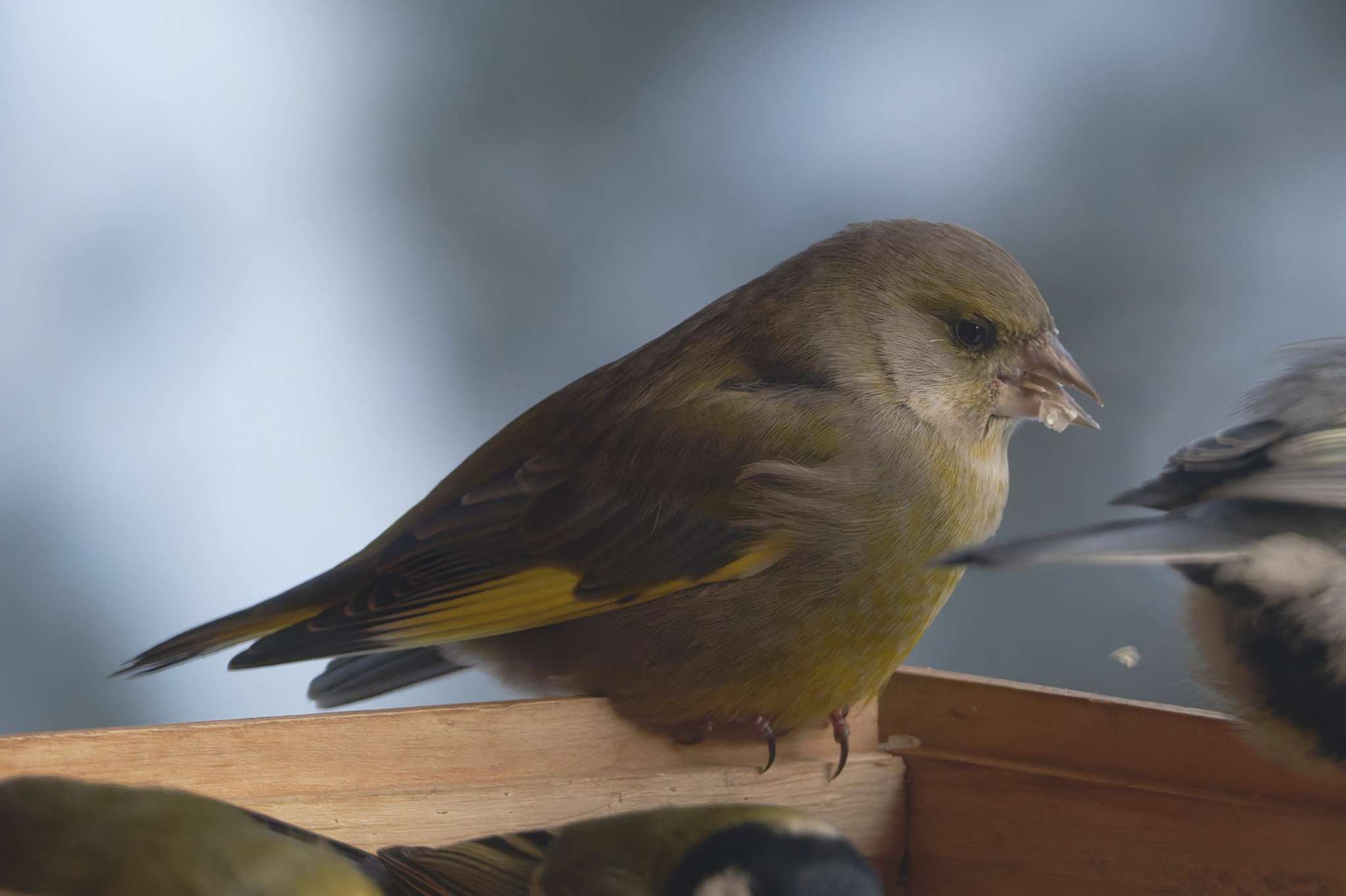
Chloris chloris — A seed-eater of orchards, woodland edges and gardens
Name and identity
The European Greenfinch, also called al-khudayri in the Lebanese guide, is Chloris chloris, a member of Fringillidae within Passeriformes. Older references may call it Carduelis chloris: these are taxonomic names for the same species. AviList 2026 uses Chloris. Its native range spans much of Europe, North Africa and western Asia; introduced populations also occur elsewhere. “European” in its English name does not exclude native breeding populations in Arab countries.
Identification
A stocky body, heavy conical bill and short, slightly forked tail are characteristic. Males are olive-green with conspicuous yellow on the wings and tail sides; females are greyer and browner but retain diagnostic yellow areas. Juveniles resemble females with stronger streaking. European Goldfinch differs in its red face and black-and-white head; Siskin is smaller, slimmer and more streaked, with a finer bill. Greenness alone is unreliable for sexing or ageing because light and feather wear alter its appearance. Bill shape, yellow markings and overall build should be considered together.
Habitat, food and behaviour
It uses orchards, gardens, open woodland, forest edges and farmland interspersed with trees and shrubs. Plant food, especially grass, tree and shrub seeds, dominates its diet. Its strong bill handles harder seeds than those accessible to many fine-billed birds. It moves between the ground, branches and seed-bearing plants, forming non-breeding flocks that may mix with other finches. The male sings from an exposed perch, combining repeated phrases with prolonged wheezing notes. Its presence around people reflects food and cover, rather than a universal need for artificial feeding.
Breeding and parental care
The female builds a cup nest in a tree or shrub, using plant material with a finer lining. BTO gives a typical clutch of four or five eggs and female incubation of about 14 days; the male feeds her during this period. Chicks receive regurgitated food including seeds, initially from the female and later also from the male. They leave the nest at approximately 14–16 days, with parental feeding continuing as flight and foraging skills develop. More than one brood can be raised. These are reference durations; the 2026 Lebanese guide places local breeding between mid-March and mid-August, varying with site, altitude and conditions.
Distribution and migration in the Arab region
Native populations occur in Morocco, Algeria, Tunisia and the Levant, with the range extending to northern Iraq. AviList also records northeastern Egypt and winter movements of Levantine populations towards Sinai and Egypt. In Lebanon it is a very common resident breeder and winterer, with smaller passage movements in spring and autumn. A November observation therefore need not represent a newly arrived migrant. In contrast, Kuwait’s checklist treats it as a vagrant. Partial migration differs among populations: some northern birds move south, while others remain resident or make local movements.
Ecological role and conservation
AviList 2026 conservation data classify it globally as Least Concern. Disease, habitat loss, hunting and trapping can nevertheless affect local populations. British studies linked a major decline to trichomonosis; that geographical evidence is not a diagnosis of Lebanese birds. Avoid concentrating birds at dirty or crowded feeding points, and retain fruiting trees, shrubs and seed-rich field margins. The species illustrates the wildlife value of botanically varied gardens and orchards. Repeated counts at consistent sites are more informative about local change than a single casual sighting.
References
AviList Core Team — AviList v2026, 20 October 2026.
Ramadan-Jaradi & Itani — Birds of Lebanon: A Photographic Guide to 409 Species, second edition, UNDP, 2026.
Kuwait Ornithological Rarities Committee — Kuwait Bird List.
British Trust for Ornithology — BirdFacts: Greenfinch.
Royal Society for the Protection of Birds — Greenfinch.
New Zealand Birds Online — European greenfinch: breeding and parental care.
Photo: Лариса Артемьева — CC0 1.0.