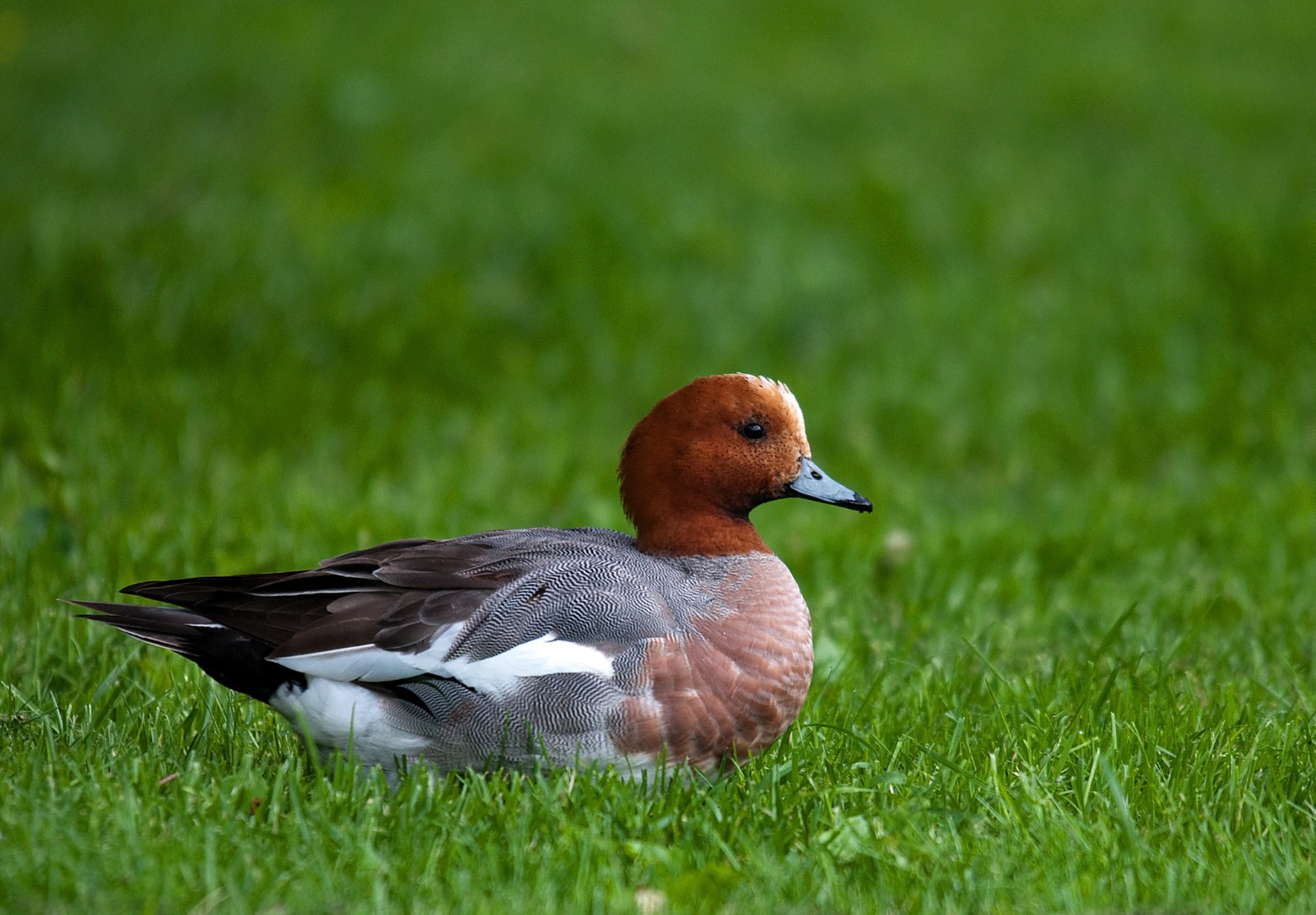
When a group of ducks leaves the water to graze on short grass, Eurasian Wigeon may be among them. A brightly plumaged male combines a pale forehead with a chestnut head and grey body, but the forehead is not its only identifying feature. This migratory duck links Eurasian breeding areas with wintering sites, including Arab wetlands whose value changes with water, food and freedom from disturbance.
Identity card
- Arabic: الصواي الأوراسي; also الصواية
- English: Eurasian Wigeon
- French: Canard siffleur
- Scientific name: Mareca penelope; older sources use Anas penelope
- Order and family: Anseriformes; Anatidae
- Length: approximately 42–52 cm
- Habitat: lakes, marshes, wet grassland, sheltered bays and coastal lagoons
- Arab-world status: chiefly passage migrant and winter visitor; abundance varies among countries
- Global conservation category: Least Concern (LC); scientific name and taxonomy follow AviList v2026 [1]
Why watch for it in late October?
This period combines continuing autumn movements with the first settlement of some ducks at wintering sites. In Saudi Arabia: passage in October–November, wintering in November–March, and no breeding. These are regional dates, not a calendar to apply uniformly from Morocco to Oman. In practice, record repeated presence, flock size and behaviour rather than assuming that the first sighting marks the completion of winter arrivals. [8]
From the Maghreb to the eastern Arab world and the Gulf
In Tunisia, a winter 2020–2021 survey, published in 2024, confirms its presence. In Egypt, BirdLife and its partner Nature Conservation Egypt identify Lake Nasser among its stopover and wintering sites. These examples do not describe its entire Arab range, but provide specific evidence rather than suggesting a uniform distribution across a broad map. [11] [12]
In Palestine, the Wildlife Society describes it as locally common in winter and on passage. “Locally” matters: it does not mean common at every site. In the UAE: uncommon to fairly common on passage and in winter, with some summering individuals. Summer presence does not automatically establish breeding. [10] [9]
Presence within a country must also be distinguished from the role of a particular site: a bird may use one lake to rest, another to feed, or stop for a few days before continuing its journey. Country lists cannot replace dated site records, and a single observation cannot establish peak timing or a long-term population trend.
How can it be distinguished from similar ducks?
A male in bright plumage has a chestnut head, a pale forehead stripe, a pinkish breast, a grey body and a dark rear. A large white wing patch may be visible. The bill is short, blue-grey and black-tipped, and the head is rounded: useful structural clues when colours are unclear. [2]
Females are brown or grey-brown, young birds resemble them, and males in eclipse plumage become less striking. A white belly may show in flight, but is not a sufficient standalone feature. American Wigeon, especially females, and hybrids can cause confusion. If the combination of features is unclear, leaving identification unresolved is more accurate than forcing a name onto a distant photograph. [3] [6]
A duck that grazes and feeds near the surface
The diet is predominantly plant-based, including leaves, stems, seeds and other plant parts. Wigeon graze on land and take food at or just below the water surface, sometimes benefiting from plants brought up by other waterbirds. Invertebrates also contribute, particularly during growth and breeding. Feeding can occur by day or night, and groups resting or moving together may include other duck species. [4] [6]
Life cycle: northern breeding and mobile winter quarters
The breeding range lies in northern Eurasia near freshwater, including boreal woodland and tundra-edge habitats. The female selects a ground site concealed by vegetation, builds a down-lined nest, incubates and cares for the ducklings. This nesting description should not be transferred to an Arab wintering site as though the birds seen there normally breed at that location. [4]
A typical clutch contains 8–9 eggs, with natural variation, and incubation takes about 24–25 days. Ducklings leave early and feed themselves under the female’s care, flying at roughly 40–45 days. Breeding is followed by moult and renewed plumage; replacement of the wing feathers brings a temporary flightless period before seasonal movements resume. [5]
Value, conservation and careful observation
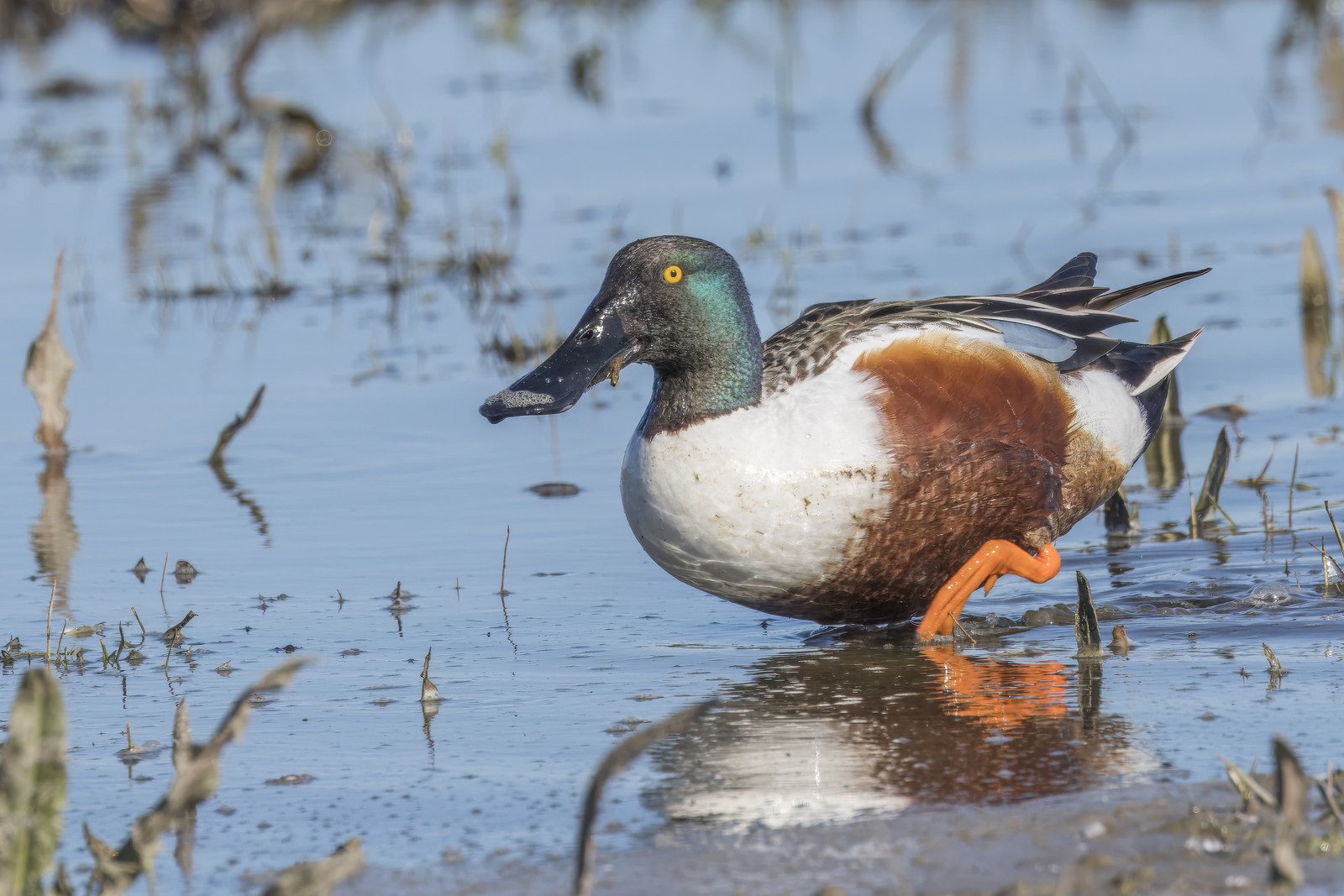
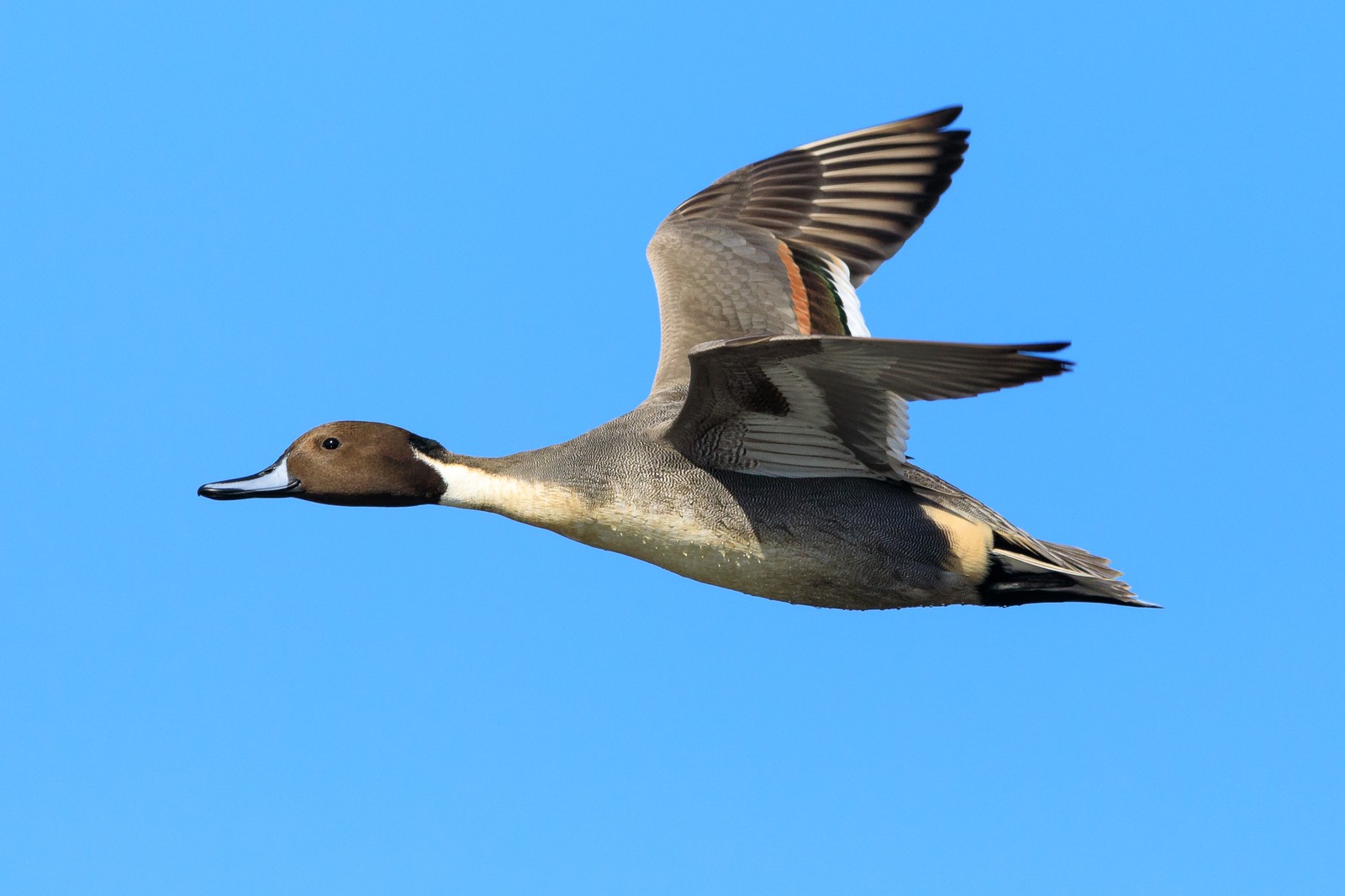
Comparing Wigeon with Shoveler and Pintail shows that ducks sharing a wetland do not all feed in the same way. Maintaining a variety of water depths, vegetation and quiet margins therefore retains feeding and resting options. A site’s value is not only the number of birds present, but also whether they can use it without repeated disturbance.
The global category is Least Concern, but local monitoring and protection against habitat loss and degradation remain necessary. Watch from a distance; do not chase birds to expose a wing patch or obtain a closer photograph. Record what you actually observed, including limits to identification confidence. Hunting permission is a separate matter governed by applicable local rules, not a species name or one day’s abundance. [13]
References
- AviList v2026 — Global Avian Checklist
- Cornell Lab — Eurasian Wigeon identification
- RSPB — Wigeon identification
- Cornell Lab — Eurasian Wigeon life history
- BTO BirdFacts — Wigeon biology
- Audubon — Eurasian Wigeon
- EURING/CMS — Eurasian Wigeon migration atlas
- The Birds of Saudi Arabia, vol. 2, pp. 20–24
- Emirates Bird Records Committee — checklist, 19 February 2026, pp. 10–11
- Palestine Wildlife Society — bird checklist
- Hamza et al. (2024) — wintering waterbirds in Tunisian wetlands
- BirdLife / Nature Conservation Egypt (2025) — Lake Nasser
- AEWA — Mareca penelope
Photo: © Nimged, via Wikimedia Commons, CC BY-SA 4.0. Photographed in Finland on 2010-06-18; resized and compressed for the website without changing its content.