A small seed specialist with autumn passage and variable winter occurrence across the Arab region
Identity and recognition
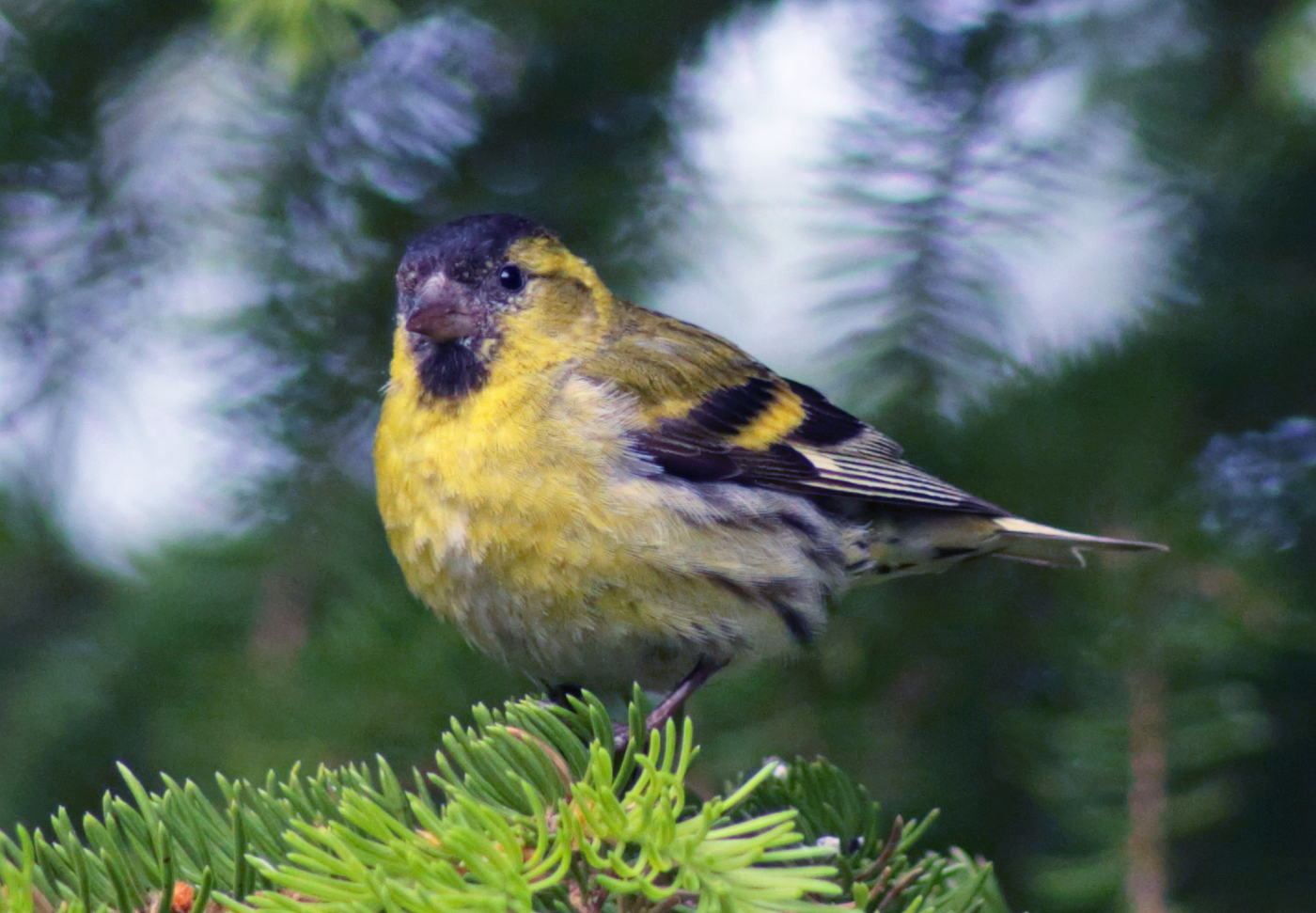
The Eurasian Siskin Spinus spinus is a small member of Fringillidae, formerly often placed in Carduelis. Arabic references use «حسون الشوك», while Qatar’s nature guide gives the variant «حسون الشوكة الأوربي». Males are yellow-green with a black cap and chin and dark wings crossed by yellow. Females are greyer and more streaked, without the conspicuous black cap. Juveniles show heavier streaking and less yellow. The short forked tail has yellow sides, and the fine conical bill extracts small seeds. These combined features are more useful than colour alone.
Distinguishing similar birds
European Greenfinches are bulkier and have much stronger bills. European Serins have shorter, stouter bills, whereas Siskins show prominent yellow tail sides and wing bars. Sex and age influence the visibility of the black head markings: their absence in a female or young bird does not rule out Siskin. Following a bird as it climbs thin branches and hangs below them gives a better view than a fleeting glimpse of yellow among leaves.
Habitat, food and behaviour
Breeding is associated particularly with coniferous woodland. Outside breeding, alders, birches, suitable gardens and parks provide feeding opportunities. Birds extract seeds from cones and catkins, sometimes hanging upside down, and collect fallen seeds from the ground. Flocks are mobile and vocal, with an undulating flight. Populations range from resident to migratory, with migration generally more pronounced at northern latitudes. EURING documents movements reaching North Africa and the Middle East; routes and annual arrivals vary with population origin and food resources.
Breeding and annual cycle
The nest is concealed among tree branches, often in a conifer, and uses fine twigs, moss and softer material. A normal clutch contains four or five eggs, incubated by the female. BTO gives typical incubation of 12–13 days and a nestling period of 13–15 days. Care continues after the young leave the nest, and favourable food conditions can allow more than one brood. These describe the known breeding range, whereas Arab-region records mainly concern winter visitors and passage birds.
Arab-region distribution and seasonality
Lebanon’s 2020 checklist records autumn passage from late October to late November and winter presence from December to mid-February, notably in conifers in Mount Lebanon and the Beqaa. Jordan lists it as a winter visitor, as does Morocco’s 2017 checklist. Occurrence becomes less regular farther east and south: Kuwait’s updated 2026 list calls it a rare winter visitor, while Qatar’s nature guide treats it as a vagrant. Late October is therefore appropriate for watching the start of Lebanese passage, with substantial differences between countries and years.
Ecology and conservation
Siskins consume seeds within woodland and garden food webs, and their presence reflects tree diversity and seasonal seed production. Their current global category is Least Concern. Winter counts must be interpreted alongside mobility: a flock disappearing from one site may have moved to another food source. Maintaining varied tree stands and cold-season feeding habitats is useful. Records combining species, number, date and habitat reveal more than comparing a single sighting with an entire previous year.
References
AviList — The Global Avian Checklist, v2026
BTO — BirdFacts: Siskin
Naturalis Biodiversity Center — Spinus spinus
Vogelbescherming Nederland — Sijs
EURING/CMS — Eurasian-African Bird Migration Atlas: Eurasian Siskin
Ramadan-Jaradi et al. — Updated checklist of the birds of Lebanon, Sandgrouse 42, 2020
Jordan BirdWatch — Jordan Bird List
Bergier et al. — Liste des oiseaux du Maroc, 2017
KORC — Kuwait Bird List, September 2026
Qatar eNature — حسون الشوكة الأوربي
Photo: Estormiz — CC0-1.0.