Its plumage changes from a black summer belly to winter grey, while its journeys connect northern breeding habitats with passage and wintering coasts.
Name and classification
Dunlin, Calidris alpina, is a small wader in the family Scolopacidae and order Charadriiformes. Its French name is Bécasseau variable. Arabic references use both al-durayja al-albiyya and al-durayja al-mutaghayyira; these alternative names do not denote different species.
Plumage, age and similar species
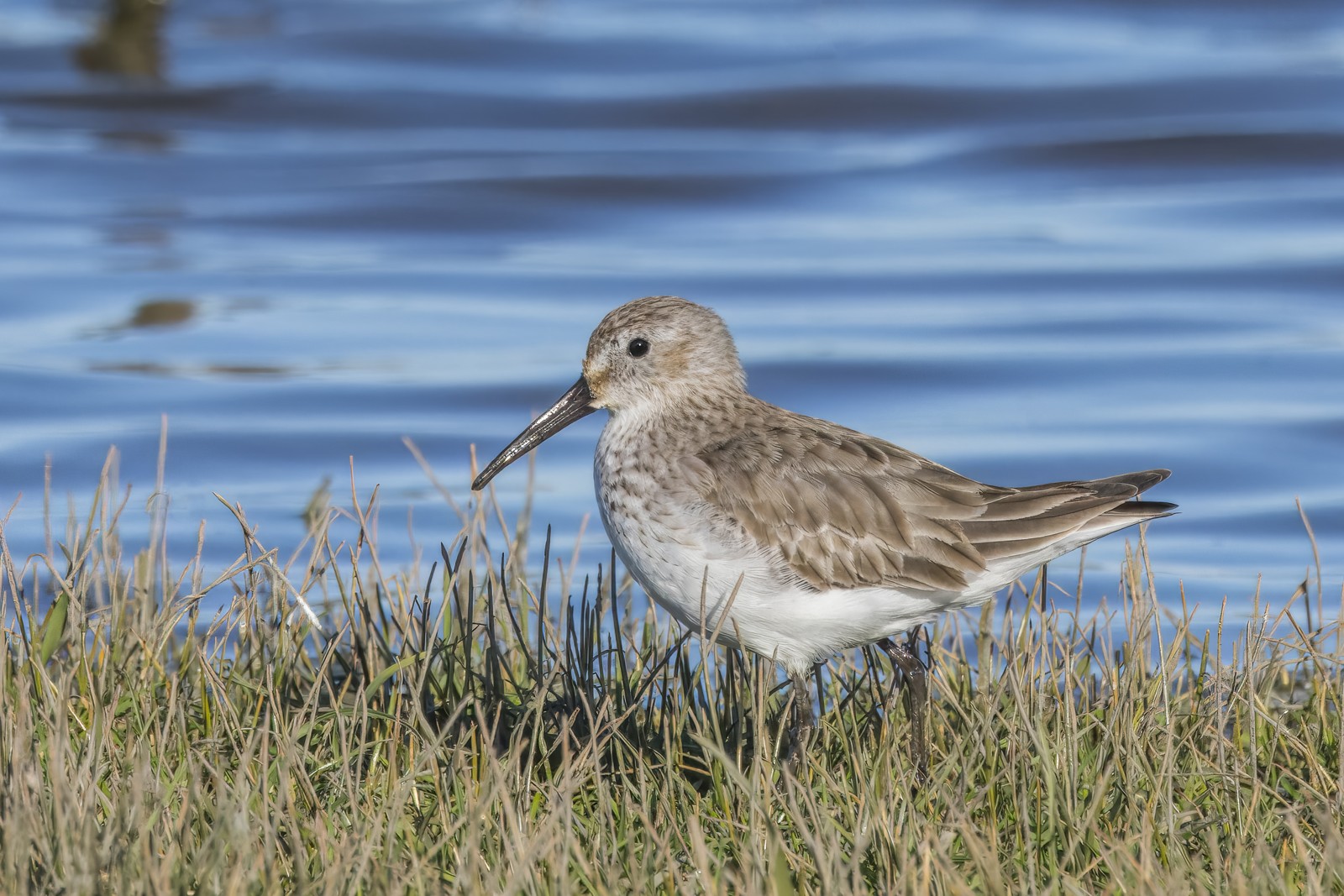
It has a black bill curving slightly downwards and dark legs. Breeding plumage includes a black belly patch and reddish-brown patterned upperparts; in winter, the back is grey and the belly white. Birds arriving in autumn may retain some summer feathers, so individuals need not look identical.
Juveniles show stronger patterning and pale edges to their back feathers, with dark spotting below. The sexes look similar and bill length varies, so a general photograph does not establish sex. Curlew Sandpiper, Calidris ferruginea, usually has longer legs and a longer bill; Sanderling, Calidris alba, is paler in winter and shorter-billed. These features must be considered together because age and moult complicate comparisons.
Food and the tidal rhythm
It takes worms, molluscs, crustaceans, insects and other invertebrates by picking or probing wet mud and sand. Coastal feeding areas change with the tides; when water covers the mudflats, birds gather at nearby roosts.
Its close-knit flocks are striking: as they turn, they appear alternately dark and pale. Small groups also occur beside inland lakes and pools during passage. Large numbers at one site do not establish that the species is secure throughout its range.
Life cycle and breeding
Breeding areas lie mainly in northern, Arctic and sub-Arctic regions, including tundra, grasslands and wet peatlands. The nest is on the ground and a clutch usually contains four eggs. Chicks can move and seek food early but still need care and protection while growing.
After breeding, populations leave for wintering areas along different routes. Ringing data show that some European breeders reach North Africa, whereas other populations travel elsewhere. Dunlins in Arab countries do not all originate in one country or follow a single route.
Arab distribution and seasonal relevance
Its Arab range extends from Mauritania and the Maghreb to Egypt, the Levant, Iraq, the Gulf and the Arabian Peninsula, with local differences in abundance and occurrence. Banc d’Arguin in Mauritania is particularly important as a wintering area for some northern populations. Libyan winter surveys document coastal distribution and use of some inland wetlands.
In Lebanon it is recorded as a passage migrant and winter visitor; in Oman it is a regular wader during passage and winter. Autumn is therefore a useful season to look along coasts and pools. An out-of-season bird does not by itself establish residence or breeding, and inclusion on a national list does not mean regular numbers occur at every site in that country.
Ecology and conservation
The IUCN global assessment of 2024 classified Dunlin as Near Threatened (NT), with an overall declining trend. This supersedes references still displaying its former Least Concern category. Its future depends on northern breeding habitats and on passage and wintering sites together.
Loss of mudflats, wetland degradation and disturbance affect opportunities to feed and rest. Observers can help by recording species, location and date while avoiding intrusion into roosts or repeatedly forcing birds to fly.
References
Sources: BirdLife International and the 2024 global Red List assessment; British Trust for Ornithology; Naturalis biodiversity museum; Royal Society for the Protection of Birds; Atlas of Wintering Waterbirds of Libya; Palm Islands and Oman references; Birds Canada/Avibase.
Photo: Charles J. Sharp / Wikimedia Commons; Marken, Netherlands, 7 April 2026. CC BY-SA 4.0; resized and recompressed without cropping or changing the content. · 1 · https://creativecommons.org/licenses/by-sa/4.0/