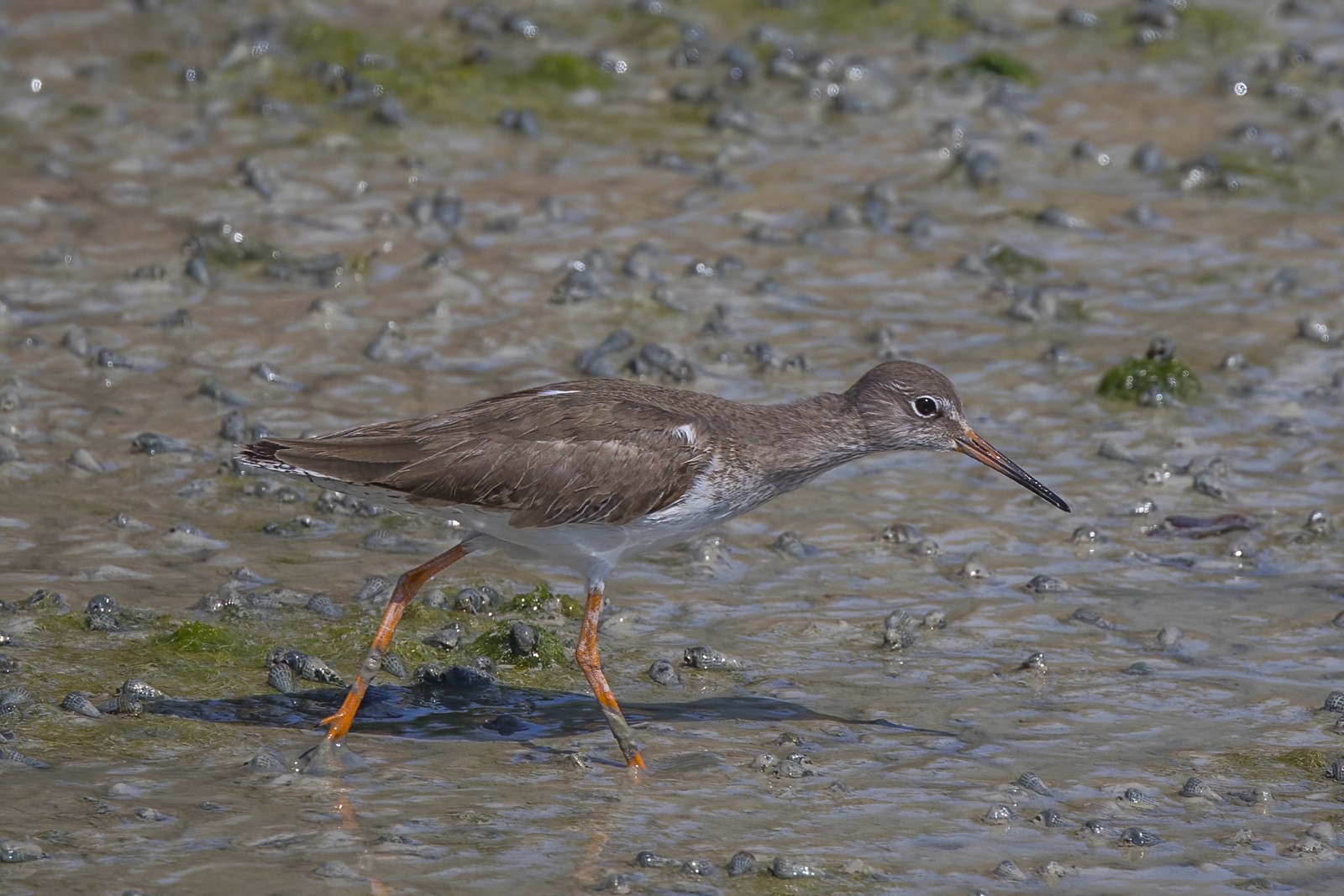
Red legs and a white trailing edge to the wing identify a wader that reaches many Arab wetlands on migration and in winter.
Name and classification
Common Redshank, Tringa totanus, belongs to the family Scolopacidae and order Charadriiformes. Its French name is Chevalier gambette. Associated with shallow water, it is distinct from Spotted Redshank, Tringa erythropus, which can look similar outside the breeding season.
Identification and age differences
Adults have red or orange-red legs and a red base to the bill, with a dark tip. The upperparts are grey-brown, more strongly marked in breeding plumage; winter plumage is plainer and less patterned. In flight, a broad white trailing edge to the wing is an important feature, beyond leg colour alone.
Juveniles have pale, spotted feather edges, and their legs may be less red than those of adults. The sexes look similar. Spotted Redshank has a longer, finer bill and lacks the same broad white wing edge. Identification therefore combines bill shape, wing pattern and body structure rather than a single feature.
Feeding habitat and alarm behaviour
It uses estuaries, saltmarshes, mudflats, lake edges and wet grasslands. It picks small invertebrates from the mud surface or probes the substrate with its bill. Coastal feeding opportunities change as mud is exposed and water recedes; safe resting places are needed when feeding grounds are flooded.
It is a vocal bird and may give clear whistles when disturbed. Outside the breeding season it can occur with other waders; breeding pairs defend the area around their nests and may join in warning of danger.
Breeding and life cycle
It breeds across extensive parts of Eurasia, not only near the sea: waterlogged grasslands and marshes are important nesting habitats. The ground nest is concealed among vegetation, and a clutch usually contains four eggs. Chicks leave the nest and begin taking food early, but need parental protection and vegetation in which to hide.
After breeding, birds move towards stopover and wintering sites; routes and distances differ between populations. Some non-breeding birds may remain in wintering areas during summer, so a summer sighting does not automatically indicate a nest.
Arab distribution and seasonality
Lebanese references document passage and winter occurrence, while references for Qatar and Oman describe regular passage and winter visitors. The UAE national Red List documents a non-breeding population; Iraqi and Egyptian wetland references also record the species.
In North Africa it occurs among wintering wetland birds, including at Libyan sites, but the regional waterbird identification guide also reports local breeding in Tunisia and Libya. Its Arab occurrence must therefore not be described as exclusively wintering. Autumn brings renewed interest to water margins and tidal areas as migrants arrive, without implying one arrival date or equal abundance in every country.
Ecological role and conservation
It links mud-dwelling invertebrates to avian predators and depends on wetlands suitable for feeding, breeding and resting. Its global Least Concern (LC) classification does not rule out local or regional declines. Wet-grassland drainage, coastal alteration, pollution and disturbance are pressures worth monitoring. Protecting wintering sites must be accompanied by protection of breeding habitats along its migratory range.
References
Sources: BirdLife International; British Trust for Ornithology; German Federal Agency for Nature Conservation; UAE National Red List of Birds; Qatar e-Nature; regional waterbird identification guide; Palm Islands, Libya and Oman references.
Photo: Charles J. Sharp / Wikimedia Commons; Dohat Arad, Bahrain, 18 February 2022. CC BY-SA 4.0; resized and recompressed without cropping or changing the content. · 1 · https://creativecommons.org/licenses/by-sa/4.0/