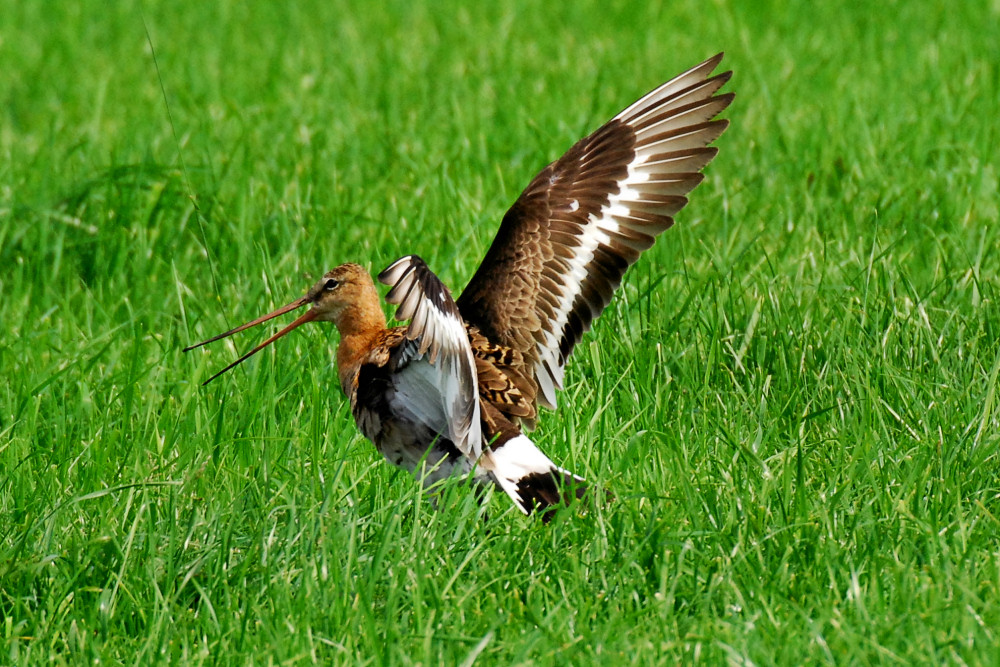
Limosa limosa — a long-billed wader between migration and wintering grounds
Identity and classification
The Black-tailed Godwit, also called “Baqwiqa Sultaniya” in some Arabic references, is a wader in the family Scolopacidae and the order Charadriiformes. Its scientific name is Limosa limosa, and Linnaeus described it in 1758. It is not an exclusively coastal bird: freshwater wetlands and damp meadows matter throughout its life, alongside estuaries and coastal lagoons.
How to recognise it
About 36–44 centimetres long, it has long legs, an extended neck and a long, almost straight bill, pink or orange at the base and dark at the tip. Breeding plumage includes rusty colouring on the head, neck and breast, with dark barring below. Males are usually more colourful; females are larger on average and have longer bills. Winter plumage is mainly grey-brown, while juveniles show a warm buff-orange wash and pale edges to their back feathers.
In flight, a broad white bar crosses each wing; the rump is white and the tail has a conspicuously black end. These markings are more useful than colour alone for distinguishing it from the Bar-tailed Godwit Limosa lapponica, which lacks the prominent white wing bar, has a barred tail and a bill that tends to curve slightly upwards.
A global range, several migration systems
Its discontinuous breeding range extends from Iceland through Europe to northern Asia and eastern Russia. Different populations spend the non-breeding season in Europe, Africa, the Middle East and southern Asia, reaching Australasia. They do not all follow one shared journey: Icelandic and continental European birds differ in their routes and wintering areas, and some individuals change their stopovers between years.
Occurrence in Arab countries
Winter occurrence is documented in Morocco, Algeria, Tunisia and Mauritania, with winter records also from Libya, Egypt, Iraq and Yemen. This does not imply equal abundance or regularity in each country. Mauritanian wetlands, including the Senegal River delta, form part of the western wintering network. In Lebanon it is a scarce passage migrant in March–April and August–November; in Jordan it is a passage migrant and a less numerous winter visitor.
In Saudi Arabia it is an uncommon passage migrant and winter visitor, with migration particularly evident in March–April and October–November. Oman classifies it as a common passage migrant and winter visitor. In the United Arab Emirates its distribution is very local, notably at Ras Al Khor, and a few birds remain through summer. In Kuwait it is an uncommon passage migrant, a rare winter visitor and a scarce summer visitor. Late October is therefore a fitting time to introduce it, especially in Saudi Arabia and the eastern part of the region, but is not a uniform arrival date throughout the Arab world. Summer presence does not establish year-round residence or breeding.
Habitats, diet and behaviour
It uses mudflats, shallow pools, marshes, flooded grasslands and rice fields, with habitat preferences varying among populations. It probes mud or picks food from the surface, taking worms, insects and their larvae, molluscs and crustaceans; seeds and rice grains may supplement its diet outside the breeding season. Birds often feed and rest in flocks, so they need undisturbed feeding and roosting sites, not simply an isolated patch of water.
Breeding and life cycle
It breeds mainly in open, wet meadows and marshes within its northern range; its usual occurrence in Arab countries is non-breeding. The nest is a shallow ground scrape lined with vegetation, and a clutch usually contains four eggs. Both parents incubate for about 22–24 days. Down-covered chicks can move around soon after hatching and typically become capable of flight after about 25–30 days. These are typical durations, not fixed deadlines for every nest. After breeding, birds gather and progressively move to their non-breeding areas.
Conservation and responsible observation
Its global category is Near Threatened (NT), which should not be confused with more severe assessments applying to particular countries. Major pressures include wetland drainage, intensive agriculture and early meadow mowing, which reduce breeding success, as well as deterioration of stopover and wintering sites. Conservation requires protecting these places across the entire migration route. Watch from a distance that does not make birds stop feeding or take flight; never chase them to reveal their wing bars.
References
Scientific references: BirdLife International; BTO, BirdFacts; CMS and AEWA, Black-tailed Godwit Action Plan; The Birds of Saudi Arabia, Vol. 2, p. 127; EBRC Annotated Checklist of the Birds of the UAE, February 2026 update; Birds of Oman; KuwaitBirds; Jordan BirdWatch; Lebanese Science Journal, 2020. Information reviewed: 25 October 2026.
Photo: Berend Jan Stijf — Wikimedia Commons, public domain.