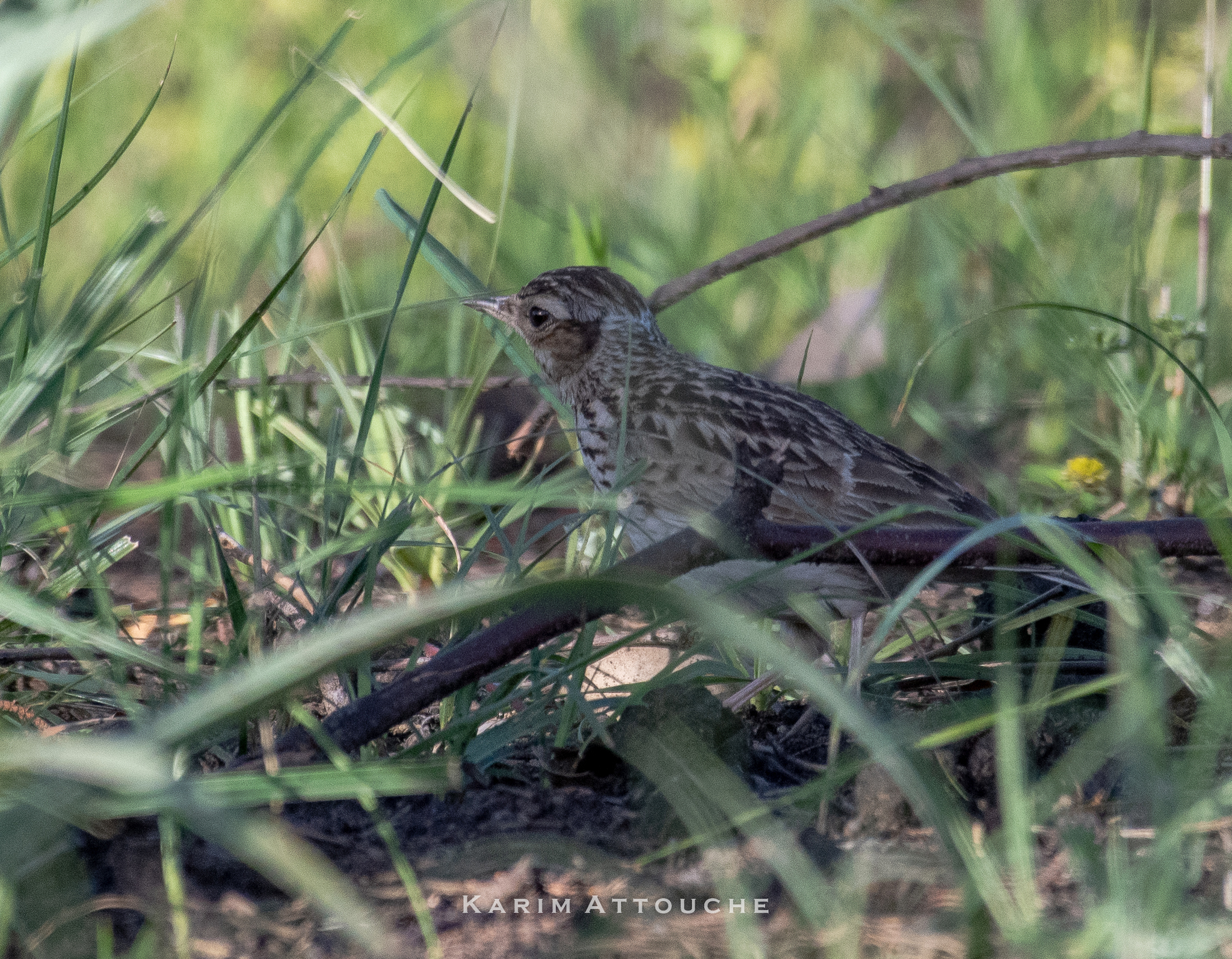
Lullula arborea — The voice of open woodland edges and grassy slopes
Name and identity
Woodlark is Lullula arborea, a member of Alaudidae within Passeriformes. The Lebanese guide uses the Arabic name Qubbarat al-ghab; Kuwaiti references also use Qubbarat al-ghabat. AviList 2026 recognises the same species in Lullula. Its name may suggest dense forest, but it is more closely associated with open ground interspersed with trees and shrubs, and with woodland edges. Such habitat combines feeding and nesting ground with elevated vegetation used for perching and singing.
Identification
It is a streaked brown lark with a short tail and broad pale eyebrows that meet across the back of the head. The crest is short and not always obvious; a dark mark bordered with white occurs at the front of the wing. Sexes share similar plumage. Juveniles look more spotted and scaled through pale feather edges; after complete moult, plumage pattern alone cannot determine age. Compared with Skylark, it has more compact proportions, a shorter tail and lacks the conspicuous white trailing wing edge. Crested Lark has a longer crest and different bill and proportions. Broad rounded wings and a short tail help confirm identification in flight.
Habitat, food and behaviour
Well-drained ground with short or patchy vegetation and scattered trees or shrubs is preferred. Habitats include woodland edges, clearings, pastures, slopes, small fields and some orchards and vineyards. Food is collected from the ground and low vegetation. Insects and spiders are important during breeding, with seeds prominent in autumn and winter; chicks receive small animal prey. The male is known for clear sequences of song given from a perch or during circling flight, and song may be heard beyond the main breeding period. Small groups may forage together in winter.
Breeding and parental care
The nest is placed on the ground beside a grass tussock or vegetation cover, with the female building a grass cup in a shallow hollow. BTO gives a typical clutch of three to five eggs, incubated by the female for about 14 days. Both parents feed the chicks, which generally leave at 11–13 days; flying ability may still be limited and care continues outside the nest. A further brood may follow. These are reference durations, whereas the Lebanese guide records egg laying from early April in mountain habitats. A young bird on the ground is not necessarily abandoned; observe from a distance rather than forcing it to move.
Distribution and migration in the Arab region
Its western Palearctic range extends from Europe into North Africa and parts of western Asia. The Lebanese guide describes it as a common breeding resident of open edges and rocky, grassy mountain habitats, with winter movements to lower elevations. A November observation may therefore reflect movement within the country rather than arrival from abroad. Some southern populations are resident, while northern populations migrate or move in response to conditions. Kuwait classifies it as a rare passage migrant and winter visitor. Lebanon’s “common resident” status should consequently not be extended to the Arabian Peninsula or to every wooded habitat.
Ecological role and conservation
AviList 2026 conservation data classify it globally as Least Concern, while local population status varies. Agricultural intensification, loss of vegetation structure or dense overgrowth of formerly open sites can remove suitable habitat. Ground nesting increases sensitivity to disturbance, trampling and operations that directly affect nests. Maintaining mosaics of open grassland and scattered trees, reducing pesticides and avoiding nesting areas are more appropriate than treating dense tree planting as a solution for every bird. Recording altitude and season during observations helps clarify local mountain movements.
References
AviList Core Team — AviList v2026, 20 October 2026.
Ramadan-Jaradi & Itani — Birds of Lebanon: A Photographic Guide to 409 Species, second edition, UNDP, 2026.
Kuwait Ornithological Rarities Committee — Kuwait Bird List.
British Trust for Ornithology — BirdFacts: Woodlark.
Royal Society for the Protection of Birds — Woodlark.
LPO PACA — Observatoire de la Biodiversité du Mont-Ventoux: Alouette lulu.
Blasco-Zumeta & Heinze — Aranzadi bird identification, ageing and sexing guide: Lullula arborea.
Photo: karim Attouche — CC0 1.0.