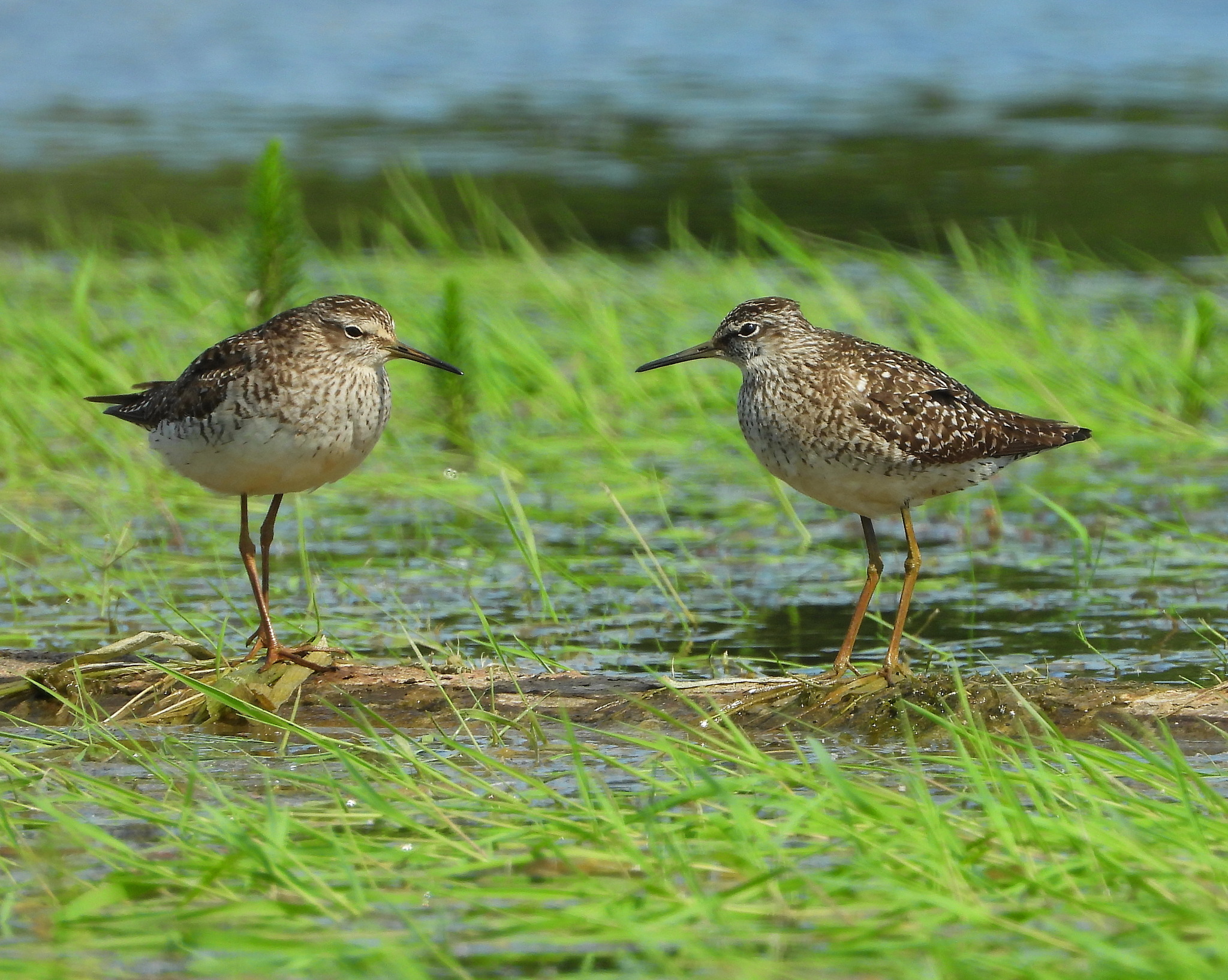
Tringa glareola — a migrant of pools and flooded fields
Identity and name
The Wood Sandpiper, Tringa glareola, belongs to Scolopacidae within Charadriiformes, following AviList 2026. Kuwaiti Arabic references use “taytawa al-ghayt”. Its English name does not mean a bird of dry woodland: northern breeding habitats are wet, while passage and winter birds seek shallow water and marsh edges. Distinguishing these seasons explains why a species called “wood sandpiper” may be encountered in a flooded field in an Arab country. Lebanon’s 2026 guide calls it durayjat al-ghab in Arabic.
Recognition
A slim wader, it has a fine, nearly straight bill, yellowish to greenish legs and a clear pale eyebrow extending behind the eye. Brown upperparts carry pale spots; the underparts are white with breast streaking. Juveniles tend to show more regular buff-toned spotting, while winter adults may appear greyer and less contrasting. Male and female plumage is similar, so photographs should not be labelled by sex without independent evidence. In flight, a conspicuous white rump is visible, but there is no extended white wing stripe.
Similar species
Green Sandpiper, Tringa ochropus, shows stronger contrast between dark upperparts and pale underparts, relatively shorter legs and a less extensive eyebrow behind the eye. Its underwing is dark, unlike the paler underwing of Wood Sandpiper. Common Sandpiper, Actitis hypoleucos, has a conspicuous white wing stripe in flight and a different structure. Combine eyebrow, body proportions, rump and underwing rather than relying on leg colour altered by light or mud. Identification does not justify deliberately flushing a bird: await natural movement or retain an uncertain identification.
Habitats, feeding and breeding
It favours shallow freshwater with vegetated edges: pools, marshes and flooded fields rather than exposed marine beaches. It picks insects, larvae and other invertebrates, including worms and molluscs, from the surface or shallow water. Birds occur singly or in small groups, with stopovers providing opportunities to replenish energy. Breeding takes place in northern Eurasian wetlands near woody cover, usually with a ground nest. Downy chicks are mobile after hatching and require safe wet habitat until their flight ability develops.
What does a November record mean?
Lebanon’s 2026 guide describes common passage on the coast, islands and wetlands, not regular winter visitation. The 2020 checklist places autumn passage from late July to early November, so early November can coincide with its end. Kuwait’s official list calls it a common passage migrant but rare winter visitor; Oman’s database describes abundant passage and winter occurrence. Winter surveys document it in Morocco and Libya, including inland locations, without demonstrating equal abundance between countries. These contrasts show why an Arab-wide seasonal label is misleading: a winter sighting does not establish residency or breeding.
Protecting small stopovers
Globally it is Least Concern, but drainage, polluted water and the loss of marsh edges still matter. A small safe pool in a dry landscape may be a valuable stopover; area alone does not determine importance. Avoid approaches that interrupt feeding, and retain marginal vegetation instead of clearing every bank. Its consumption of invertebrates places it in a food web, but does not automatically establish control of a particular pest or prove good water quality.
References
AviList Core Team — AviList v2026, 20 October 2026.
British Trust for Ornithology — BirdFacts: Wood Sandpiper; RSPB — Wood Sandpiper.
Naturalis Biodiversity Center — Birds of Europe: Tringa glareola.
Bird Count India — Identifying waders, 2017.
Ramadan-Jaradi et al. — Updated checklist of the birds of Lebanon, Sandgrouse 42, 2020.
Kuwait Ornithological Rarities Committee — Kuwait Bird List; Kuwait Birds — Arabic checklist.
Birds of Oman — national species database.
Waders wintering in Morocco, Wader Study Group Bulletin 96, 2001; Results of the seventh winter waterbird census in Libya, January–February 2011.
Ramadan-Jaradi & Itani — Birds of Lebanon: A Photographic Guide to 409 Species, second edition, UNDP, June 2026.
Photo: Лариса Артемьева — CC0-1.0.