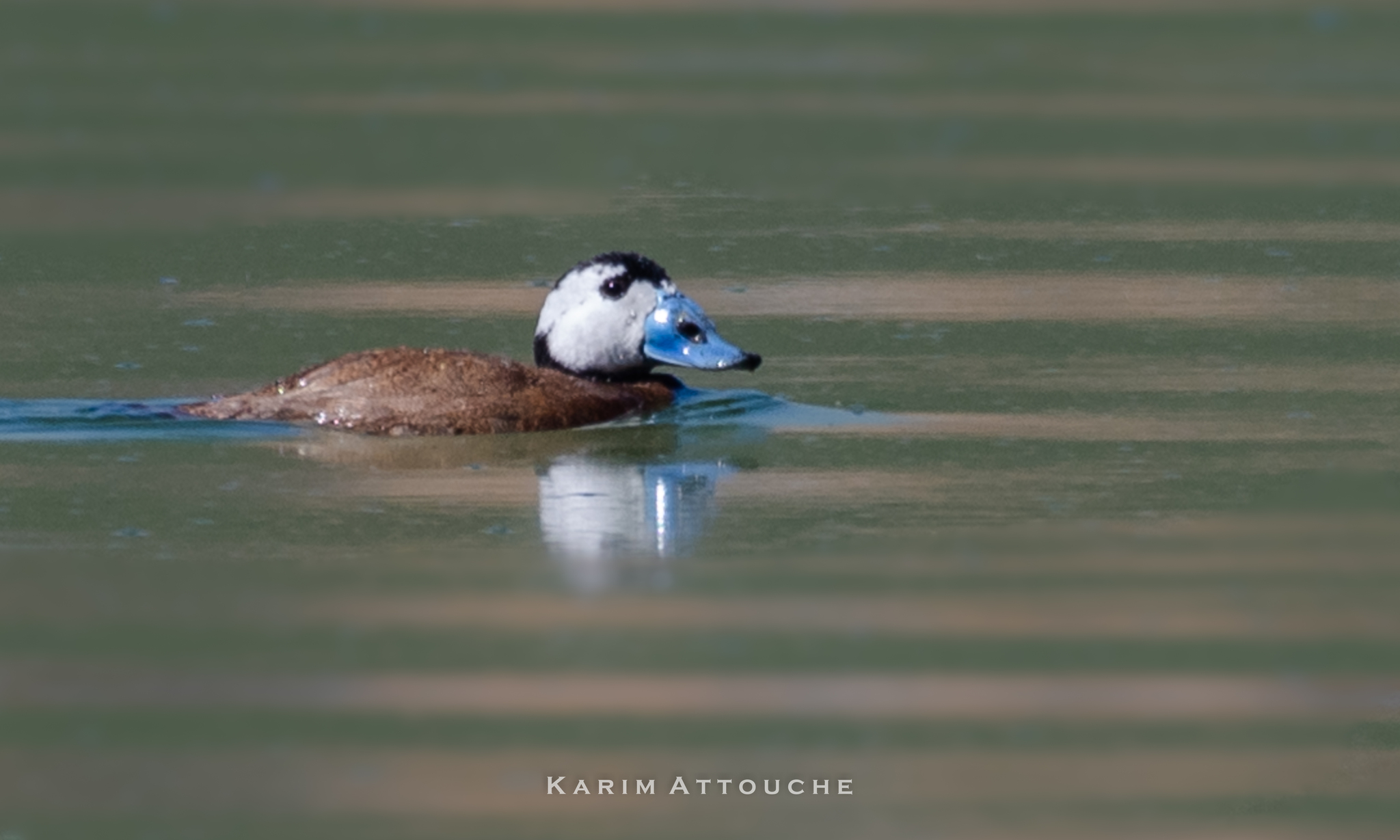
Oxyura leucocephala
A diving duck with a distinctive profile
White-headed Duck Oxyura leucocephala is a small, heavy-headed member of the stiff-tailed ducks. About 43–48 cm long, it sits low in the water, often with its narrow tail raised. The adult breeding male combines a white face and head with a dark crown, brown body and striking blue bill. The swollen base of that bill gives the profile particular character; identification should consider its shape as well as colour.
Females are grey-brown with pale cheeks crossed by a dark stripe and a grey bill. Young birds resemble females, so a brown-headed individual is not necessarily an adult female. Introduced Ruddy Duck is an important comparison because it can hybridise with this species. Suspected hybrids need expert assessment: an unusual head pattern or intermediate bill is a reason to obtain photographs, not to force an identification from one feature.
Wetland structure and feeding
This is a bird of lakes and marshes rather than open coastal seas. It uses natural and artificial waterbodies, including somewhat saline waters, but breeding sites need substantial emergent vegetation. Reeds and bulrushes provide concealment, while open water allows feeding and escape. A wetland can therefore lose breeding value when its vegetation is stripped even if its surface area appears unchanged.
Food is obtained by diving and includes aquatic invertebrates, notably insect larvae, together with seeds and other plant material. Water depth, underwater vegetation and food availability all influence which parts of a lake are used. Protecting the species involves the functioning aquatic habitat, not simply preserving a patch of water on a map. Excessive nutrient loading and introduced fish can alter that habitat and its food resources.
Courtship, nesting and young
Breeding males display and compete for access to females. The nest is concealed in waterside or emergent vegetation and formed from plant material. The female incubates and tends the brood. Published breeding ranges differ between accounts and populations; SEO/BirdLife describes clutches of 5–10 eggs, incubation of 25–26 days and young capable of flight at 60–70 days.
Ducklings can swim and dive soon after hatching and obtain their own food while accompanied by the female. Maintaining water through this growing period is crucial. A lake that fills in spring but dries while broods remain flightless may attract nesting birds without allowing successful recruitment.
A fragmented range and different movements
The distribution extends discontinuously from Spain and North Africa through the eastern Mediterranean into central Asia. The international action plan distinguishes western Mediterranean, North African, eastern and south Asian populations. Western groups include resident birds, whereas substantial eastern populations migrate between breeding, moulting and wintering sites. Local dispersal can also follow changing rainfall and wetland conditions.
Large moulting concentrations are known at sites including the Sudochie wetlands in Uzbekistan and Lake Tengiz in Kazakhstan. The 2018 plan describes departures from eastern breeding localities beginning in late August and continuing into autumn, with substantial passage through the Amu Darya delta. Western birds need not undertake these long journeys, but can disperse between wetlands as conditions change. The degree of exchange between the western Mediterranean and North African populations remains uncertain.
Morocco, Algeria and Tunisia
Morocco supports breeding, wintering and passage occurrence. Maire and colleagues documented breeding at Dar Bouazza, west of Casablanca, in 2025: young were photographed in June after spring courtship. The report places the site within a wider recovery of Moroccan occurrence following its return in the early 2000s.
Algeria also supports breeding and wintering populations. A study published in 2026 describes a pair with five ducklings at the Mekrenaz reservoir in Tiaret on 18 May 2020, presenting it as the first confirmed breeding record in western Algeria. Tunisia is likewise listed for breeding, staging and wintering in the 2018 international plan.
The eastern Arab range
Syria is included for breeding, staging and wintering in the 2018 action plan, whose breeding estimates refer to 2011–2012. That dated evidence establishes its importance, but is not a current census of Syrian wetlands. For Iraq, Salim and colleagues’ 2012 national checklist describes a rare or uncommon winter visitor to the central and southern marshes. The 2018 action plan nevertheless identifies Iraq as a survey priority because information remains insufficient to assess its wider importance for the species.
Egypt's 2019 EORC checklist includes White-headed Duck in Category A, meaning accepted wild occurrence after 1950. That classification alone supplies neither a regular wintering season nor evidence of breeding. Distinguishing a verified occurrence from a population's seasonal role is especially important near the edges of this fragmented range.
Conservation and considerate observation
Drainage, water abstraction, drought, pollution and disturbance can undermine breeding and wintering habitat. Hybridisation with introduced Ruddy Duck is an additional, distinctive concern; habitat restoration alone does not resolve it. International conservation work consequently combines wetland management, monitoring and control of the invasive species by competent authorities.
Observe from established viewpoints with a telescope, avoiding repeated approaches that drive birds from cover. Do not enter reedbeds to search for nests or separate a female from her brood. Useful records include the date, site, number, sex or age where reliable, and evidence distinguishing feeding, courtship and breeding. Photographs of suspected Ruddy Ducks or hybrids should be sent to the appropriate ornithological or conservation body for assessment.
SEO/BirdLife: White-headed Duck · CMS/AEWA/EU: revised action plan, 2018 draft · Maire et al., 2025: breeding at Dar Bouazza · Mairif et al., 2026: breeding in western Algeria · EORC: Checklist of the Birds of Egypt, 2019 · Salim et al. (2012): Annotated checklist of the birds of Iraq
Image available under CC0.