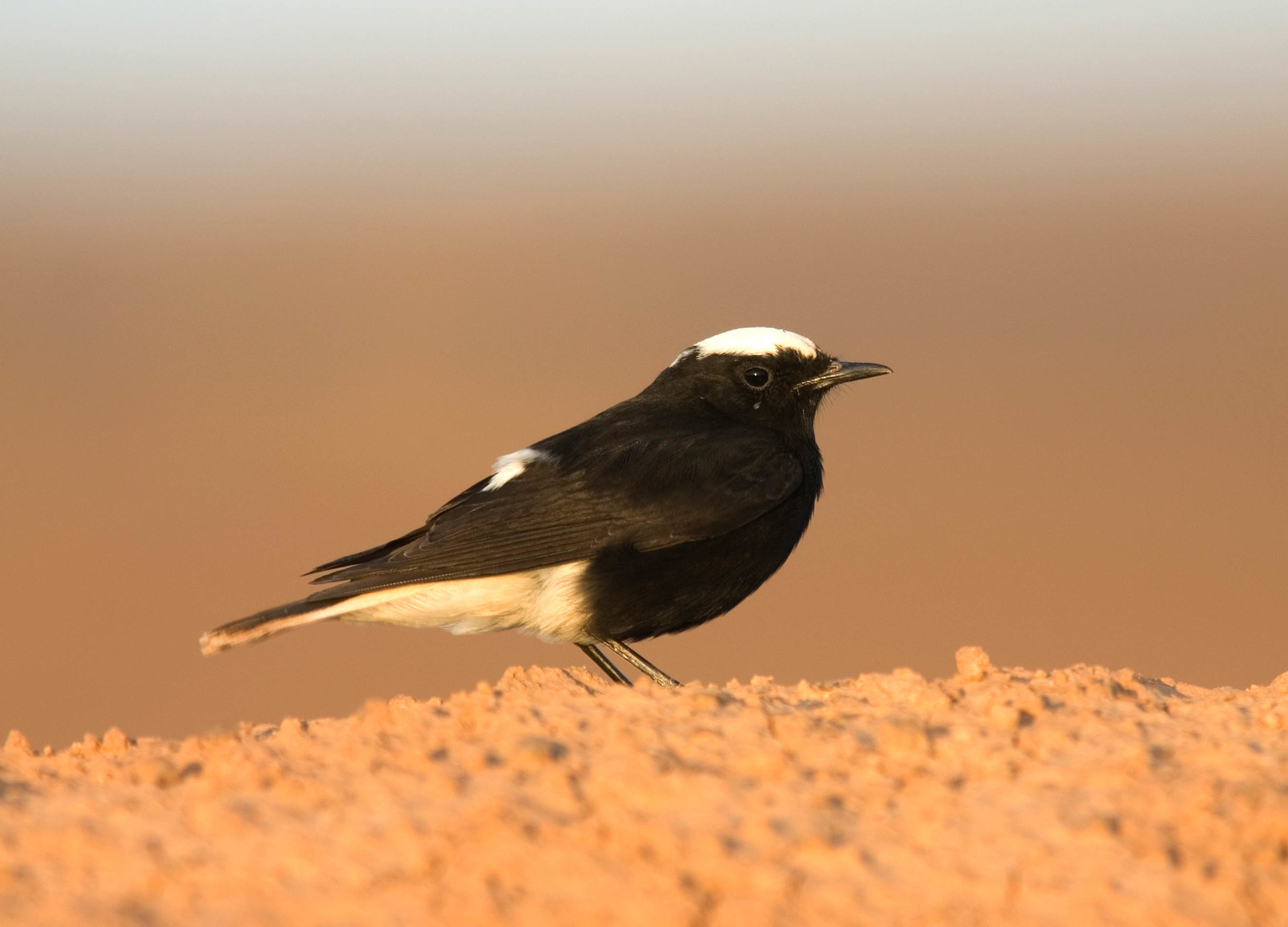
Oenanthe leucopyga
A rock-dwelling bird without an invariably white crown
White-crowned Wheatear, Oenanthe leucopyga, is among the most striking birds of rocky deserts. Many adults combine a dark body with a white crown, while the pale rump and tail flash as the bird moves. Arabic names include “white-crowned” and “white-capped”, with local names such as Umm Ghunayman in Saudi Arabia. It belongs to the flycatcher family Muscicapidae and measures about 17–19 cm. Despite a superficial resemblance, it is not Black Wheatear, Oenanthe leucura.
The name alone can mislead an observer. Young birds and birds in their first year have black heads, and some older individuals retain a dark crown. Absence of white therefore does not exclude this species, and a black head alone cannot establish an exact age. The sexes are broadly similar, and an ordinary photograph does not always permit reliable sexing. These distinctions matter in November, when birds of different ages may be encountered in the same habitat.
The tail is more useful than the crown in difficult cases
Black extends down the underparts towards the area between the legs, while the lower belly and undertail remain white. The tail is largely white, with substantial black on the central feathers, but normally lacks the continuous black terminal band characteristic of Black Wheatear. Young birds can have limited dark tips on outer feathers: “an entirely white tail” is therefore an unsafe shortcut. Watching the tail spread as a bird settles is particularly useful.
Male Hooded Wheatear, Oenanthe monacha, shares the contrasting colours and a similar tail pattern, but its white belly reaches much farther up the underparts; White-crowned retains a broader black lower body. Lighting can also make glossy plumage look dull in photographs. Reliable identification combines the extent of black, structure, tail pattern and possible age, rather than relying on head colour alone.
A broad but discontinuous Arab desert range
Its range crosses rocky parts of North Africa towards Sinai, the Levant and the Arabian Peninsula. Morocco, Mauritania, Algeria, Tunisia, Libya and Egypt form part of this extensive desert setting, with an African extension towards Sudan. Suitable areas are nevertheless fragmented. Mountains, wadis and buildings may offer conditions absent from open sand seas. Density varies between regions, so a coloured area on a distribution map does not mean that every part of that desert is occupied.
Saudi regional references describe a widespread breeding resident in western areas and parts of the central plains, the Tuwaiq escarpment and the edge of the Summan. Jordan BirdWatch also lists it as resident in Jordan. It is resident in parts of Palestine and Sinai as well. A record in a neighbouring country is a different matter: these established populations should not be extended by assumption to every Gulf state, nor should an unusual sighting near the range boundary be converted into a permanent breeding population.
Residency and autumn movement
The species is primarily resident, with some local or short-distance movements, including in winter. It can therefore be seen in November in its usual rocky habitat without the sighting indicating the arrival of a European migrant. Not every individual follows an identical calendar. Residency means that the species remains in a region, not that each bird stays on the same rock throughout its life. Demonstrating individual movements requires ringing or sustained tracking, rather than simply comparing counts on two visits.
A paper published in Sandgrouse in 2019 describes some records outside the main range, including rare occurrences in Iran and elsewhere in the region. These help explain the possibility of dispersal, but do not establish a permanent range expansion. When a bird appears in an unusual place, clear photographs, the date and a description of habitat matter more than an immediate declaration of residency. Breeding needs independent evidence, such as food carried to young or chicks actually observed.
Harsh habitat and varied food
White-crowned Wheatear favours stony slopes, cliffs, dry wadis, lava fields and arid areas with crevices. It may use old walls or the edges of villages and oases where buildings imitate rock cavities and provide hunting perches. It is not a sand-dune specialist, and a place labelled “desert” is not automatically suitable. The fine structure of the habitat, from a raised stone to a shaded crack and an open patch, shapes opportunities to feed and shelter.
It watches the ground from a perch before dropping onto prey, also searching by walking and hopping, and sometimes taking an insect in flight. Food includes beetles, ants, flies, spiders and other invertebrates, alongside fruit, seeds and occasionally small reptiles, depending on availability. Such flexibility does not make human food necessary. Keeping the surroundings natural is more helpful than leaving scraps beside a road or campsite, where birds may be drawn towards vehicles or become more accessible to cats.
Nests and eggs: using available crevices
Pairs nest in rock cavities, beneath large stones or within old walls. The cup is built from plant material and lined with hair, wool and feathers. Small stones may be placed around the entrance or along the approach. This is a recognised wheatear behaviour, but does not justify opening a cavity or moving its stones to check for eggs. The arrangement belongs to the bird's nesting activity and may be in use even when the site seems quiet.
References describe breeding concentrated mainly between late winter and spring, with timing varying by region and conditions. The Saudi account gives clutches of 3–4 eggs and incubation of about 14–15 days, while accounts covering the broader range allow for 3–5 eggs. The female builds and incubates, and both parents care for the young. These differences show why neither one number nor a particular month should become a rigid rule for every Arab desert.
From hatching to independence
After hatching, chicks require food and protection inside the cavity. The Saudi account gives a nestling period of about 14–16 days, with the possibility of two broods in a season. Leaving the nest does not mean instant independence, since parental care continues afterwards. Black-headed birds in their first year can also breed. This provides another reason not to equate a dark crown with a recently fledged youngster that has not reached breeding age.
Success depends on food resources being available when chicks need them. A wadi that has received rain may offer different conditions from a dry neighbouring site, although rain alone cannot establish that a nest is present. Young birds may disperse after the breeding season, while rocky habitats and shelters remain valuable throughout the year. Protecting crevices and walls therefore concerns more than the days when eggs are present: it also preserves resting places and future nesting opportunities.
Habitat protection and undisturbed watching
AviList v2026 records the species as globally Least Concern, LC, but that assessment does not measure the condition of each desert wadi or village. Removing rocks, filling cracks, demolishing an occupied wall and driving indiscriminately off established tracks can alter a small but important local resource. Building restoration or tourism development should take account of wildlife use, rather than assume an arid setting is empty of life.
Watch from a distance and allow the bird to continue feeding. Stop approaching if it repeatedly alarms or moves away each time. Playback and bait are unnecessary for a photograph. Document unusual sightings through the tail pattern, the extent of black and behaviour, rather than a crown photograph alone. Residency in a country does not imply permission to hunt: local regulations and the protection of breeding sites are separate matters from scientific classification.
Photo: Tero Linjama / iNaturalist (CC0 1.0)