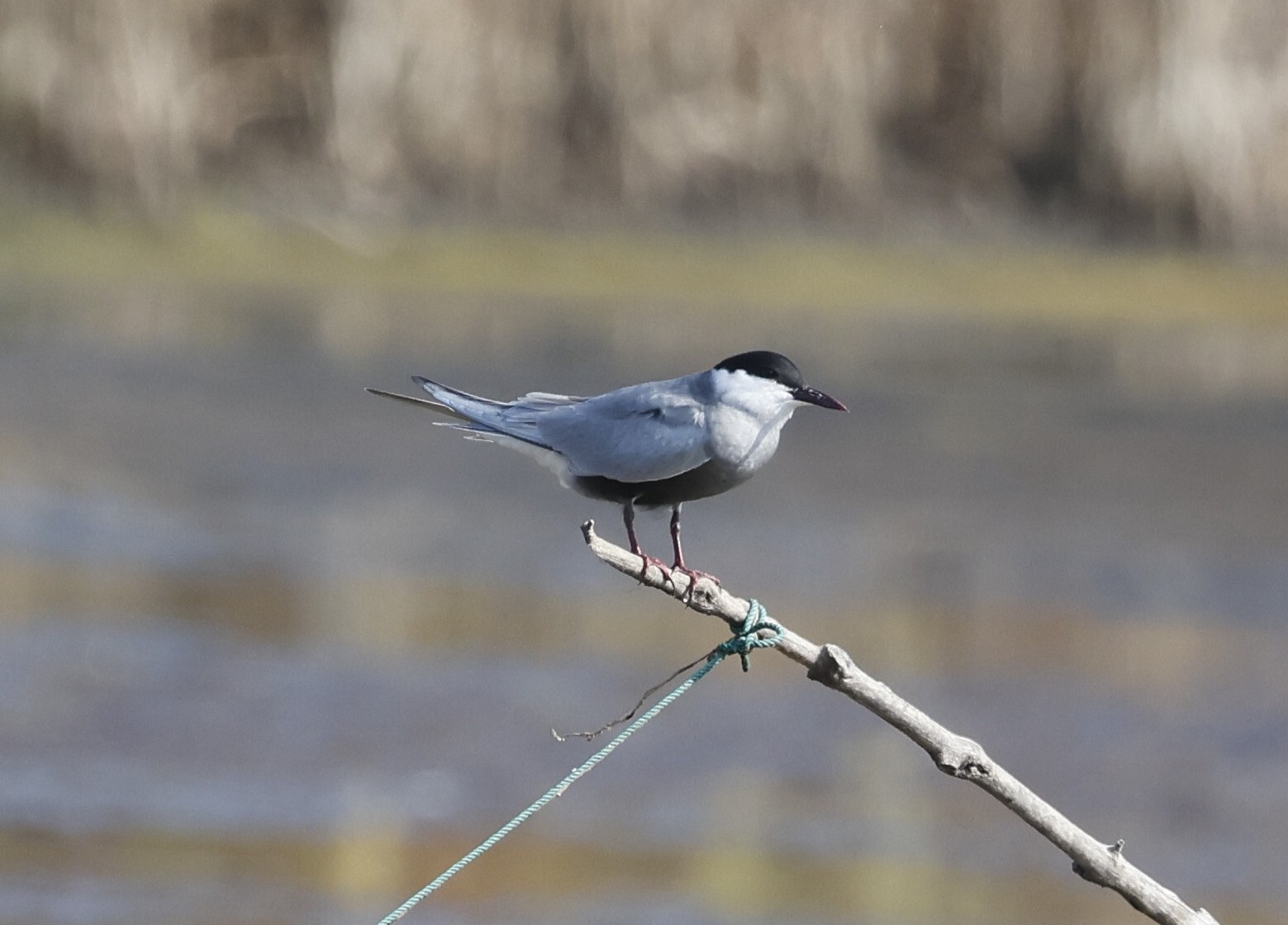
Chlidonias hybrida
Identity and names
Whiskered Tern, Guifette moustac in French, is Chlidonias hybrida, a species in Laridae and the order Charadriiformes. Arabic names include al-kharshana al-sablaa and the Lebanon guide’s “hybrid tern”. It is a small marsh tern, approximately 24–28 cm long depending on the reference. The word “hybrid” in a vernacular name does not mean an individual produced by two different species: this is a recognised species. Its relatively stocky body and short, shallowly forked tail distinguish it from many marine terns.
Identification
Breeding plumage combines a black cap and white cheeks with a grey body and darker belly; bill and legs are dark red. Outside breeding, the underparts and forehead become white and the crown becomes speckled or streaked rather than solid black. Juveniles may have a warm brown patterned back. The sexes have similar plumage, and overlapping size differences generally cannot establish sex confidently at a distance. Transitional plumage increases confusion with White-winged Tern and other species. Check head, rump and wing patterns along with bill and tail structure rather than relying on white cheeks alone.
Habitat, food and behaviour
It uses marshes, ponds, shallow lakes and freshwater wetlands, also appearing in suitable brackish and coastal habitats. It flies buoyantly back and forth above water and vegetation, taking insects and other invertebrates as well as small fish and crustaceans, sometimes making shallow dives. Its feeding does not always resemble the deeper plunge-diving of some marine terns. Water availability affects distribution: a flooded, vegetated area may provide feeding or nesting habitat, then lose that function when drained or cleared. Simply seeing a bird over a pool does not establish which role that site plays.
Range and Arab occurrence
The species occurs in separated populations across parts of Europe, Asia, Africa and Australia, with movements varying by population and water availability. In the Arab region, Lebanon’s 2026 guide describes a scarce passage migrant and rare, irregular summer breeder, recording nesting on an Assi River floodplain in 1995 and 1996. In contrast, Oman’s published official list describes abundant passage and winter occurrence. These differences rule out treating the species as a resident breeder throughout the Arab region, or interpreting all winter presence as late passage on the basis of Lebanon alone. In Kuwait, the local reference describes uncommon passage and scarce winter occurrence, especially at freshwater marshes around Jahra.
Breeding and development
It nests colonially on vegetation platforms over water or among aquatic plants. A scientific paper published in 2026 summarises breeding as a three-egg clutch with shared incubation of about 21 days. It reports approximately 19–21 days in the nest, followed by several weeks of parental care after flight begins. These values come from a European research context, not local measurements of every Arab population. Later parental contributions may differ: research on the studied populations records females leaving before care ends and males continuing. It is therefore misleading to imply that both parents always provide equal care until independence.
November and responsible observation
November in Oman falls within expected winter occurrence. A Lebanese observation should be interpreted against local and seasonal records without assuming new breeding. Watch from a pool margin, allowing birds to pass, and record flight style, feeding and plumage. Avoid entering the water or steering boats towards groups, and do not pursue resting birds for an open-wing photograph. Near any possible colony, distance is especially important: vegetation platforms and small chicks may be hard to see, and forcing them to move is not harmless simply because no immediate injury is visible.
Conservation
Its global category is Least Concern (LC), but local colonies remain vulnerable to drainage, disturbance and changes in water management. The Lebanon guide identifies recreational activities, drainage, illegal hunting and grazing at nesting sites among pressures, as well as avian influenza. Conservation requires aquatic vegetation, work scheduled away from breeding where it is confirmed, and quiet feeding and resting areas. Do not touch dead or sick birds; report their location to the appropriate authority from a safe distance without diagnosing the cause from appearance alone.
References
BirdLife Australia — Whiskered Tern; New Zealand Birds Online — Whiskered tern, updated 2025; British Trust for Ornithology — BirdFacts: Whiskered Tern; UNDP / ABCL / Ministry of Environment — Birds of Lebanon, 2026, p. 203; Oman Birds Rarities Committee — Oman Official Birdlist; Ledwoń et al. — Hormonal stress responses in a species with female offspring desertion: testing the brood value hypothesis, Behavioral Ecology and Sociobiology, 2026; AbdulRahman Al-Sirhan — Kuwait Bird List in Arabic; KuwaitBirds — Whiskered Tern.
Illustrative species photograph: Don Wellmann, iNaturalist, CC0 1.0.