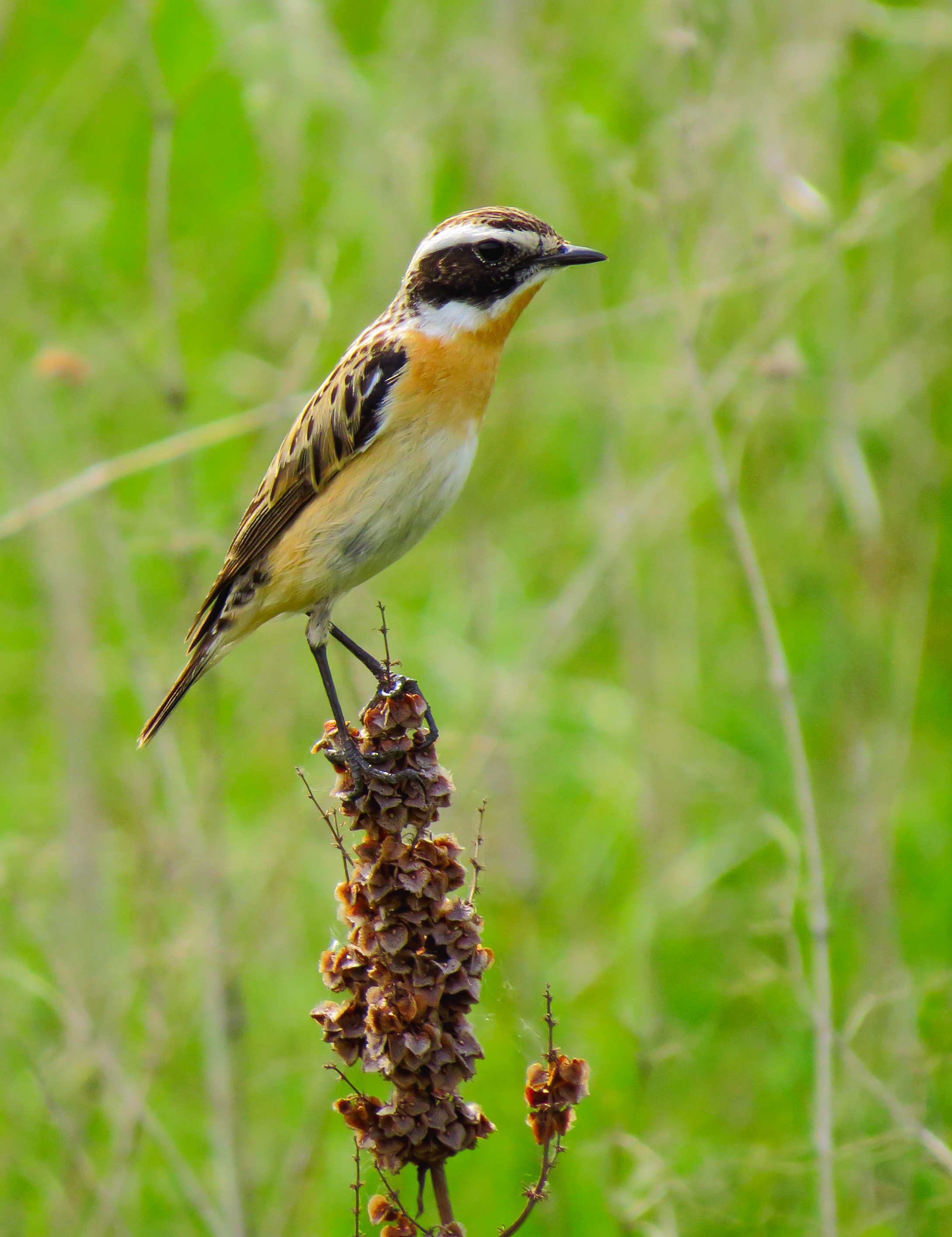
Saxicola rubetra — Identification, habitats, breeding and occurrence in the Arab region
Identity and recognition
The Whinchat, Saxicola rubetra, is a small member of the flycatcher family Muscicapidae. Its Arabic names include al-qulay‘i and al-birqish al-ahmar. Males show a clear white eyebrow above dark cheeks, with an orange throat and breast. Females are less contrasting, with browner cheeks and an eyebrow paler than the surrounding feathers. The back is brown and streaked; the relatively short tail has white at the sides of its base. Juveniles are more conspicuously spotted or mottled, so not every dull bird is an adult female.
Distinguishing similar birds
European and Siberian Stonechats are the main identification challenges. Combine the prominent eyebrow, streaked brown rump and white sides to the tail base, together with the longer primary projection beyond the inner feathers of the folded wing. A white patch may show on the wing coverts, but can be very reduced in first-autumn birds: its absence does not exclude Whinchat. Autumn identification should therefore compare head, rump and tail rather than rely on orange colouring shared with other chats.
Habitat, food and behaviour
Meadows, grassland and pasture provide habitat where tall stems or scattered bushes offer lookout posts. Fields and cultivated areas are also visited on migration. From a stem, fence or low shrub, the bird watches before darting after prey on the ground or in the air. Insects and other invertebrates dominate the diet, with some fruits and seeds taken in autumn. Dense woodland is less important than prey-rich open ground with appropriately spaced perches.
Breeding and annual cycle
The breeding range extends across Europe to western Siberia. The low nest is concealed among grasses or at the base of vegetation, making early mowing and grassland disturbance important risks. Accounts commonly describe four to seven eggs. The female incubates for approximately two weeks, and young leave the nest after roughly another fortnight, before they are fully independent. Dates vary regionally; a bird seen in an Arab field during autumn is not evidence that it nests there.
Arab-region distribution and seasonality
Wintering is mainly in tropical Africa, with Arab countries providing migration routes and stopping places. Jordan’s checklist and Qatar e-Nature classify it as a passage migrant; Qatar Bird Observation Group places passage mainly in April–May and September–October. Saudi Arabia’s Birds of AlUla guide records a scarce migrant at Harrat Khaybar within the guide’s local survey area. Kuwaiti references describe uncommon passage and rare winter visits. The global distribution account also confirms occurrence in Egypt and Maghreb countries. October sightings must therefore be interpreted locally, rather than automatically labelled the arrival of a regular winter resident.
Ecology and conservation
Whinchats connect grassland invertebrates with higher predators. European monitoring highlights grassland deterioration, agricultural intensification and poor breeding success; protecting nesting cover from early mowing is particularly relevant. Migrants also require stopping places with food and shelter. The global category is Least Concern, but documented declines in individual countries remain important. Monitoring Arab-region populations remains important for establishing their own trends.
References
British Trust for Ornithology — BirdFacts: Whinchat
Naturalis — Birds of Europe: Whinchat
Qatar e-Nature — القليعي
Qatar Bird Observation Group — Whinchat
Royal Commission for AlUla — Birds of AlUla
Birds of Kuwait — Whinchat
BirdLife International — Saxicola rubetra, IUCN Red List assessment 2016
RSPB — Species spotlight: Whinchat
LPO — Tarier des prés
Jordan BirdWatch — Jordan Bird List
Photo: Аимаина хикари — CC0 1.0.