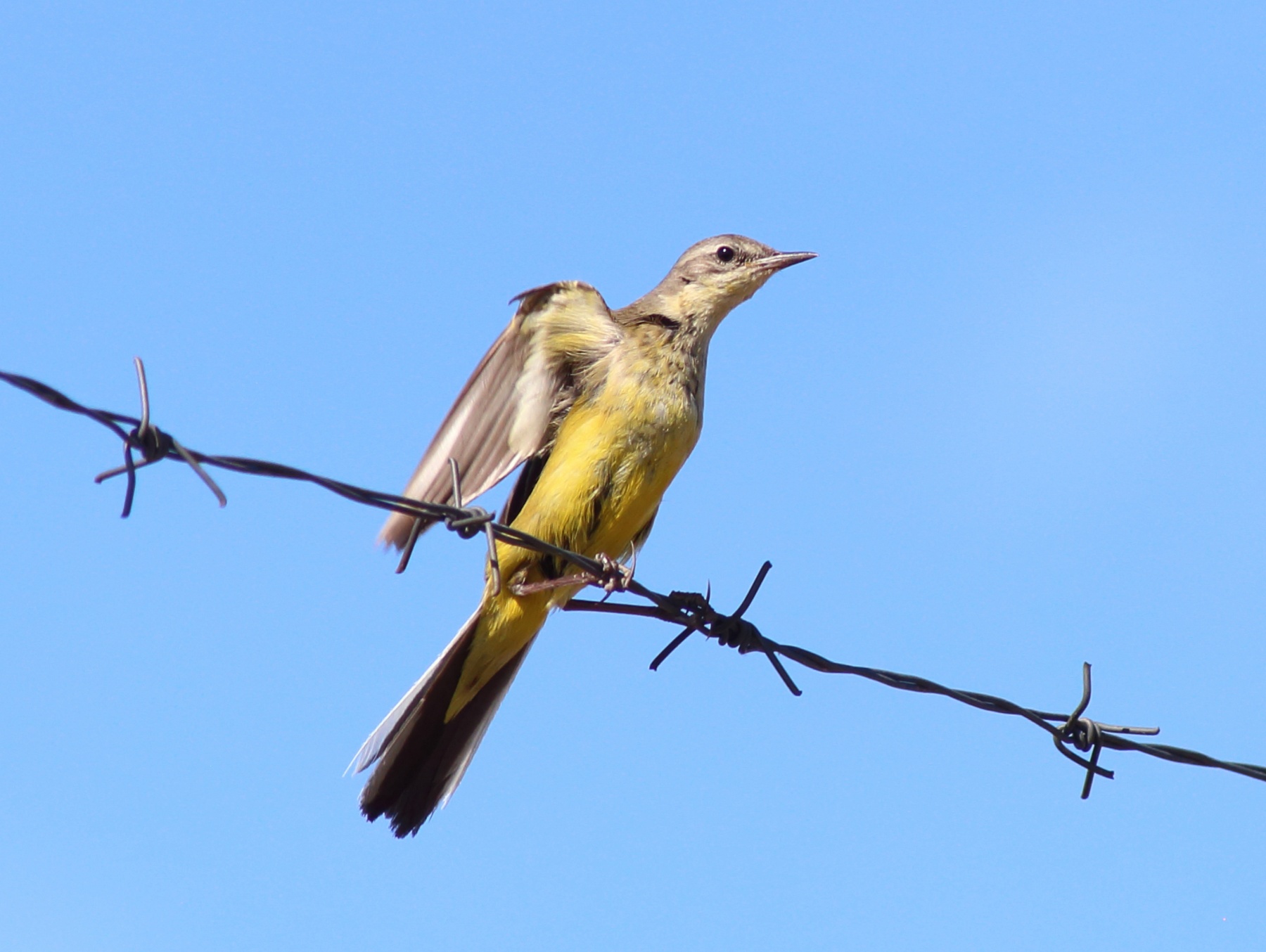
Motacilla flava — Identification, habitats, breeding and seasonal occurrence in the Arab region
Identity and recognition
The Western Yellow Wagtail, Motacilla flava, is a slender member of the family Motacillidae, with dark legs and a habit of walking or running on the ground while moving its tail. Many adults combine yellow underparts with greenish upperparts, but head colour varies among subspecies: not every male has a blue head. Modern taxonomy separates the Eastern Yellow Wagtail, Motacilla tschutschensis. Scientific names also help resolve regional names shared by different wagtails.
Age and similar species
Females and young birds are generally duller than males, but subspecific variation makes identification more complex. Qatar’s field account notes that some first-autumn beema may have almost no yellow below and look grey above. Absence of yellow alone therefore does not exclude a Yellow Wagtail. Immatures can be confused with Eastern Yellow or Citrine Wagtails; head, wing and tail patterns, calls when available, locality and date should be considered together. Reliable assignment of subspecies or sex requires clear views of several features.
Habitat, food and behaviour
Wet grassland, farmland, marsh edges, river margins and irrigation channels provide feeding habitat. The birds search for insects and other small invertebrates on the ground and among low vegetation. They may accompany livestock or take prey disturbed by animals. Irrigated fields can provide important migratory feeding stops, but a bird on a farm is not necessarily nesting there. Habitat use differs between breeding, passage and winter: a site offering a day’s food and rest may not provide the cover and water required throughout nesting.
Breeding and life cycle
The small cup nest is on the ground, concealed in vegetation. The female undertakes most building and incubation, while both parents feed the young. British records typically indicate five or six eggs, one or two broods, approximately fourteen days of incubation and departure of young at around 13–15 days. These are British reference values; timing varies by region. Ground nests require suitable cover; a change in field management during nesting may remove it even while the field still looks green to an observer.
Arab-region distribution and seasonality
Yellow Wagtail occurrence in the Arab region includes residence, breeding, passage and wintering. Egypt supports resident pygmaea associated with the Nile Valley and Delta; breeding iberiae also occur in North Africa. Jordan’s list combines limited breeding with common passage. Lebanese references document autumn passage, particularly September and October, and limited summer breeding nationally. Arabian records include passage and wintering in some areas, varying by locality and subspecies. Wet fields receive passage birds during autumn migration, while the Nile population remains resident year-round.
Ecology and conservation
The wagtail links invertebrate abundance to birds in farmland and wetland food webs and is itself prey for predators. The 2019 IUCN assessment lists Least Concern. Its British Red List status reflects a separate national situation, not automatic global threatened status. Loss of wet grassland, agricultural intensification and reduced prey can create pressures. Retaining wet margins, vegetation cover and insect food supports residents and passage birds while recognizing their different seasonal needs.
References
British Trust for Ornithology — BirdFacts: Yellow Wagtail
RSPB — Yellow Wagtail
Qatar eNature — Yellow Wagtail
The Birds of Saudi Arabia — Western Yellow Wagtail
Bulgarian Society for the Protection of Birds — Breeding Bird Atlas: Yellow Wagtail
OSME — Region List of Birds, version 10.1 (2024)
Jordan BirdWatch — Jordan Bird List
Lebanese Ministry of Environment — Palm Islands Nature Reserve report
BirdLife International — IUCN assessment of Motacilla flava (2019)
Photo: Estormiz — CC0.