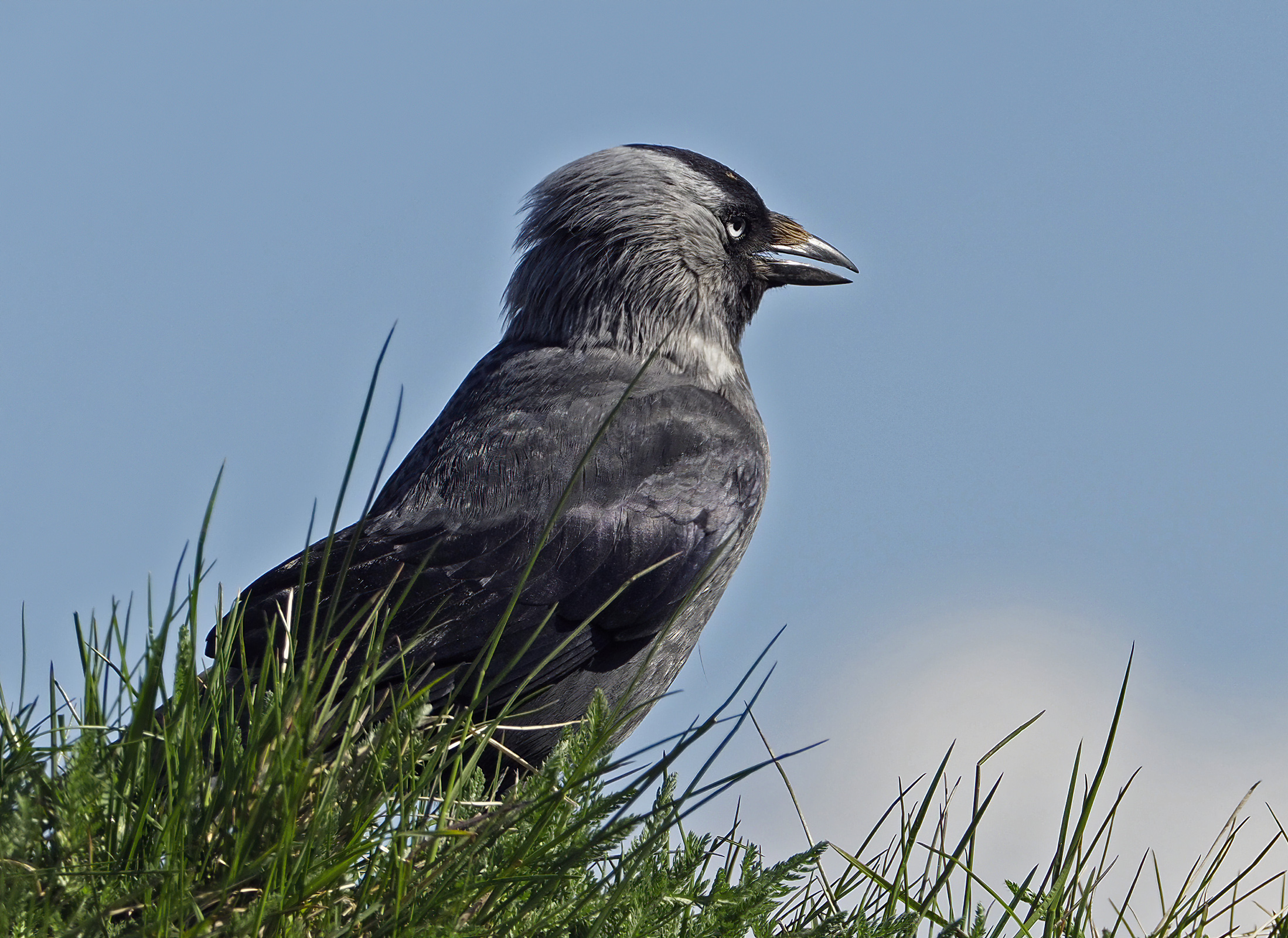
Coloeus monedula — Identification, habitats, breeding and seasonal occurrence in the Arab region
Identity and recognition
The Eurasian Jackdaw, also called the Western Jackdaw, Coloeus monedula, is a member of the crow family Corvidae. Older references may place it in Corvus as Corvus monedula. Compact and smaller than the larger crows, it has a relatively short bill, a dark cap and a silvery-grey nape and neck. Adults have conspicuously pale eyes contrasting with the dark head. Arabic sources sometimes call it “ghurab al-zarʿ”, a name that can also cause confusion with the Rook. The scientific name therefore remains important when matching regional names to species.
Age and similar species
Males and females look broadly alike: ordinary plumage photographs do not reliably establish sex. Young birds are browner, with a less strongly contrasting head; eye colour changes with age. Iris colour alone should not establish exact age or exclude a young Jackdaw. Identification should combine its compact build, short bill, grey neck and voice rather than a single colour. The Rook, Corvus frugilegus, is larger and longer-billed; it is a separate species despite similar vernacular names.
Habitat, food and behaviour
Jackdaws feed in fields, pastures and short grass, while tree holes, rocky cavities and old buildings provide nesting places. Noisy flocks and communal roosts are particularly noticeable outside the breeding season. Their varied diet includes invertebrates, seeds and fruit, sometimes eggs or nestlings. Much feeding takes place on the ground. A bird seen near buildings is not necessarily dependent on human refuse: suitable landscapes can combine open feeding areas with secure nesting cavities.
Breeding and life cycle
The nest is built inside a suitable cavity in a tree, rock face or building. British nest records indicate a typical single brood and four or five eggs. Female incubation lasts around twenty days, and young leave the nest at approximately 32 days. These approximate reference values come from British monitoring. Nesting dates vary with location and climate; the presence of an autumn flock is not evidence of local breeding.
Arab-region distribution and seasonality
Arab occurrence includes residents, winter visitors and rare records. Lebanon’s 2020 checklist describes a regular winter visitor from October to early March in the Beqaa, Anti-Lebanon and Marjaayoun, noting that reported residency lacks specific supporting evidence. Jordan’s list records residents and winter visitors; OSME’s 2024 regional list describes uncommon breeding in Iraq. Morocco’s 2010 checklist documented resident breeders and expansion through the northern Atlantic plains towards Rabat. The regional reference documents Kuwait’s first record in October 2023, contrasting with regular winter occurrence beginning in autumn in Lebanon.
Ecology and conservation
As a consumer of plant and animal food, the Jackdaw participates in several food webs. Its global category is Least Concern in the referenced Red List-based account, but this does not demonstrate that every local population is secure. Loss of cavities and changes in land use can reduce nesting or feeding opportunities. Protecting safe nesting sites and monitoring local populations are useful responses.
References
British Trust for Ornithology — BirdFacts: Jackdaw
RSPB — Jackdaw
Cornell Lab of Ornithology — All About Birds: Eurasian Jackdaw
Jordan BirdWatch — Jordan Bird List
Ramadan-Jaradi and colleagues — Updated checklist of the birds of Lebanon, Sandgrouse 42 (2020)
OSME — Region List of Birds, version 10.1 (2024)
Thévenot and colleagues — Liste des oiseaux du Maroc, mise à jour février 2010
AbdulRahman Al-Sirhan — Arabic–English Names of Middle Eastern Birds
Photo: Matti Virtala — CC0.