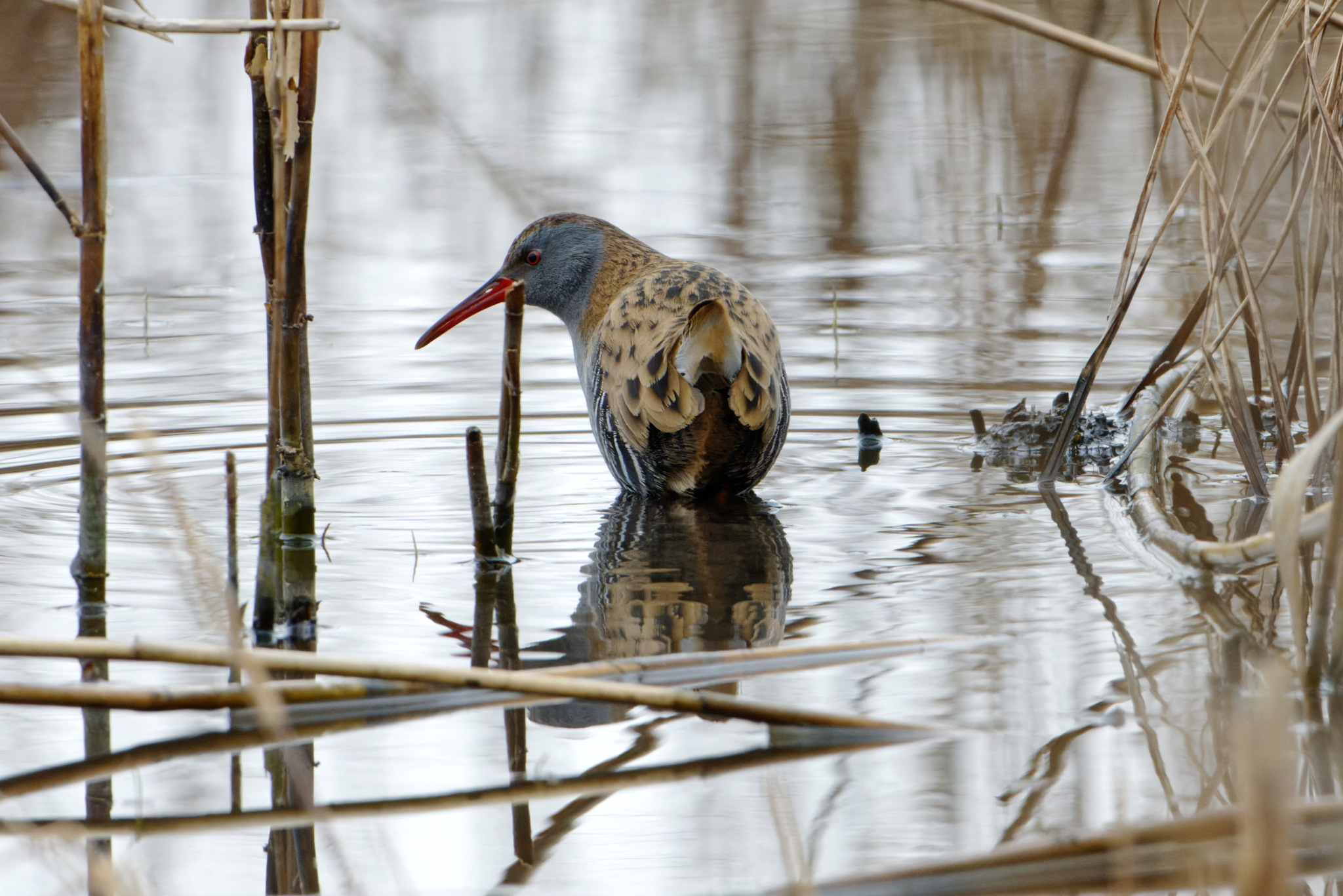
Rallus aquaticus
Identity and identification
Water Rail Rallus aquaticus belongs to Rallidae. Adult plumage combines a long reddish bill, grey face and breast, and black-and-white barred flanks. Its narrow body passes through reeds; the long bill helps separate it from many shorter-billed crakes.
Habitat and food
It picks invertebrates from mud and water margins and also eats plant material. Dense wetland vegetation usually conceals it, so calls may reveal a bird that remains unseen.
Breeding and development
The vegetation nest is hidden close to water. BTO gives a typical clutch of 6–11 eggs and incubation of 19–22 days. Downy chicks become mobile early: leaving the nest site is distinct from being able to fly or becoming independent.
Arab occurrence and seasonality
Lebanon’s 2020 checklist describes common passage and winter presence from early September to early May, with scarce summer breeding. Qatar’s current list describes a rare winter visitor and passage migrant. November therefore suits observation in both countries, with different abundance and status; these descriptions do not establish the same status throughout the Arab world.
Observation and conservation
Retaining reeds, suitable water levels and clean margins protects habitat. Watch from a distance without entering cover or using playback near potentially breeding birds.
British Trust for Ornithology — BirdFacts: Water Rail · RSPB — Water Rail · Ramadan-Jaradi et al. — Updated checklist of the birds of Lebanon, Sandgrouse 42 (2020) · Qatar Bird Observation Group — Qatar Bird List · AviList Core Team — Global Avian Checklist v2026, 20 October 2026
Species illustration: Лариса Артемьева — CC0 1.0. · 1 · https://creativecommons.org/publicdomain/zero/1.0/