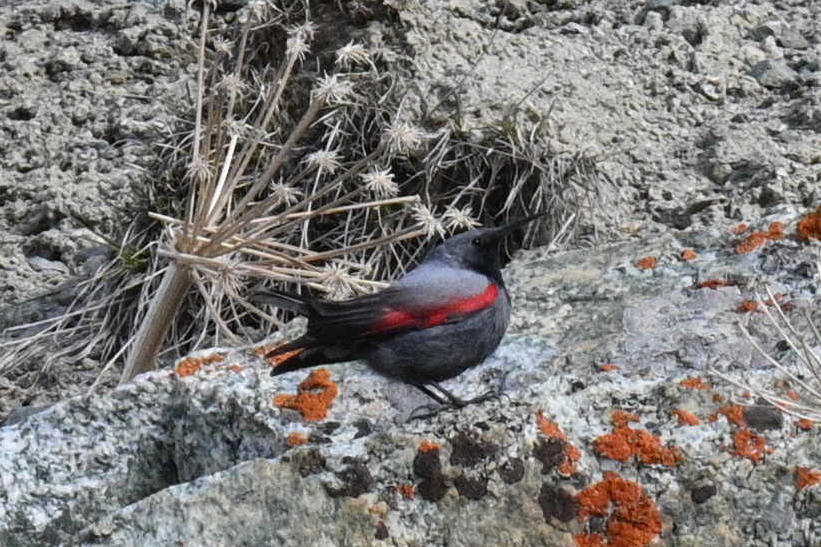
Tichodroma muraria
Identity and names
A flash of crimson against a grey cliff can reveal the Wallcreeper, Tichodroma muraria, a small passerine in the family Tichodromidae. French calls it Tichodrome échelette; Arabic references use متسلق الجدران, متسلق الحيطان or متسلق الصخور. These names describe one species, not several cliff birds. The Lebanon guide gives a length around 16.5 cm, wingspan around 28 cm and weight around 18 g. Such figures describe approximate size rather than measurements expected from every individual.
Identification
At rest, the bird can blend surprisingly well with rock. Grey body plumage contrasts with black flight feathers, white spots on the outer wing and conspicuous red areas revealed when the wings open. The long, slender, downcurved bill is another useful character. Frequent wing-flicking produces brief flashes of colour as it climbs. A breeding male has a black throat, but this becomes pale in winter; females also have a pale throat outside breeding. A pale-throated November bird therefore cannot be sexed simply by the absence of black.
Habitat and food
The essential habitat is a rock face with fissures that shelter food. Mountain cliffs, ravines and precipices are typical, while lower cliffs, quarries and substantial stone buildings may be used outside the breeding season. The bird probes cracks for insects and other invertebrates, including spiders, rather than switching to a seed-based winter diet. It may also catch insects in flight. Watching it move slowly across a wall reveals how apparently bare rock can contain feeding opportunities hidden from an observer standing below.
Range and Arab occurrence
The species occurs through mountain systems from southern Europe towards central and eastern Asia, but its Arab distribution requires careful qualification. Birds of Lebanon 2026 describes an extremely rare winter visitor and only a possible scarce breeding resident. That wording does not establish confirmed Lebanese nesting. Avibase’s Morocco checklist marks it Rare/Accidental, so the country should not be presented as a regular winter stronghold. The occurrence of suitable cliffs alone cannot establish presence. A winter record also says little about where that individual bred.
Breeding and development
Where breeding is established, a deep crevice or cavity shelters the nest, usually on a mountain cliff. The female builds it with plant fibres and other soft material. Specialist accounts describe about four eggs, female incubation lasting roughly 18–20 days, and young becoming capable of flight at around one month. Both parents feed the brood and care continues after departure. These general figures concern the species’ breeding biology; they should not be turned into evidence of reproduction at an Arab wintering locality or applied as an identical calendar across mountain ranges.
November and responsible observation
November brings a useful change in the observer’s search image: some birds descend from high breeding areas to lower rock faces. This altitudinal movement is documented in European mountain populations, but does not promise a sighting in every nearby country. Scan a cliff in sections and wait for movement or a red wing-flash. Keep away from edges, climbing routes occupied by birds and suspected cavities. Do not use playback to draw a rare visitor closer. Record the location, elevation, date and behaviour without advertising a sensitive nest site.
Conservation
Wallcreeper is globally Least Concern. Nevertheless, specialized rock habitats can be damaged, and an elusive species can be difficult to count accurately. The Lebanese guide lists habitat loss and degradation, hunting and disturbance associated with quarrying or climbing. Protecting a site means considering the entire face and its crevices, not merely the point where the bird was photographed. Observation at a distance allows feeding to continue and avoids turning an exceptional encounter into repeated disturbance.
References
UNDP / ABCL / Ministry of Environment — Birds of Lebanon, 2026, p. 340; Naturalis — Birds of Europe: Wallcreeper; Oiseaux.net — Tichodrome échelette; BTO — BirdFacts: Wallcreeper; Avibase — Morocco checklist; SEO/BirdLife — Treparriscos; BirdLife International / IUCN — Tichodroma muraria.
Photo: Лариса Артемьева