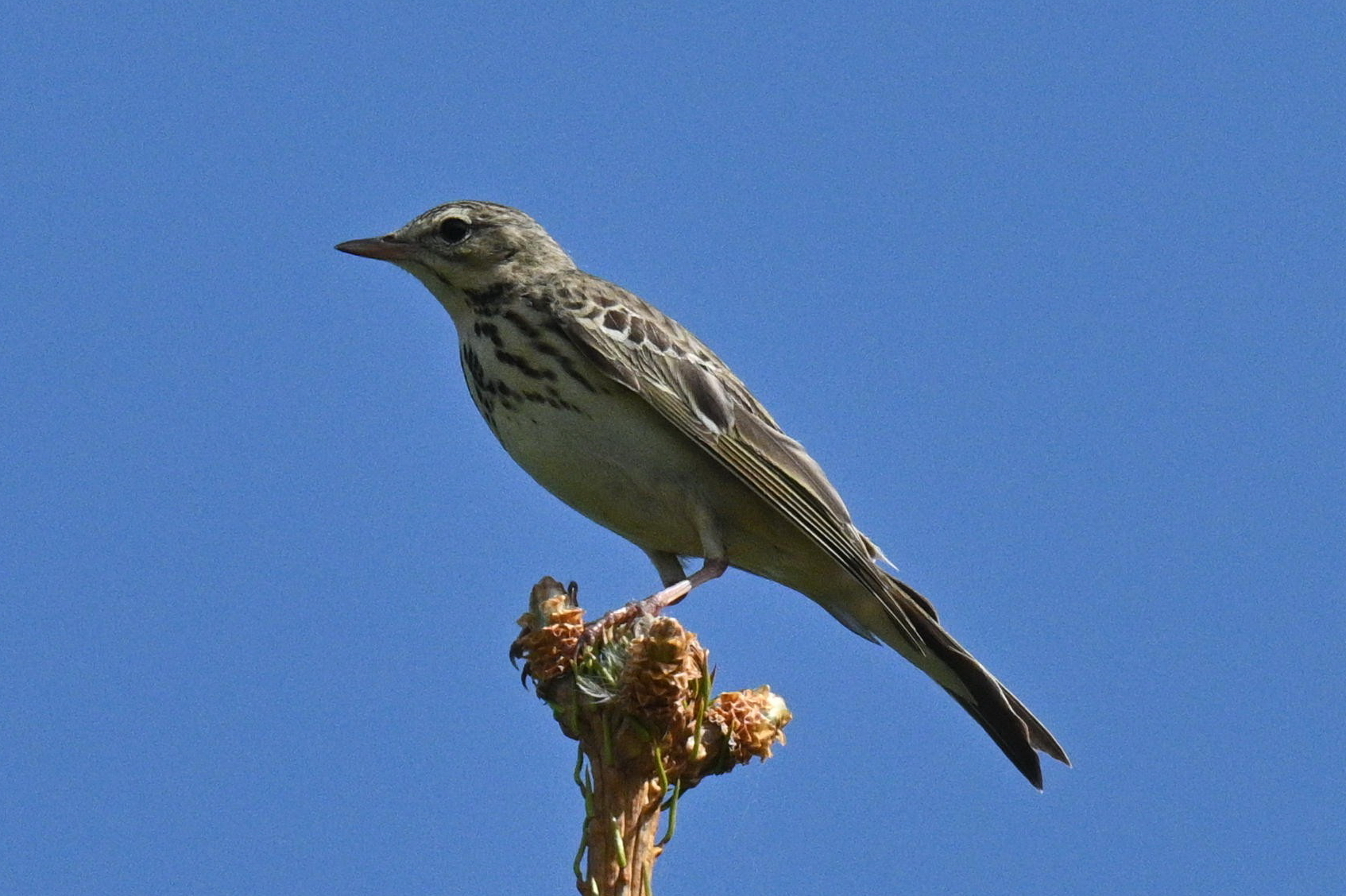
Anthus trivialis
Identity and names
Tree Pipit, Pipit des arbres in French, is Anthus trivialis, a small migrant in Motacillidae, the pipit and wagtail family, and the order Passeriformes. It is about 15 cm long. Despite its tree-associated name, it spends considerable time feeding on the ground. It needs a mixture of open ground, grassy vegetation and scattered trees rather than only dense, closed woodland with little light reaching the floor.
Identification
The brown, olive-tinged upperparts are streaked. The warm-coloured breast has conspicuous dark streaks, finer streaking continues along the flanks, and the belly is relatively white. It resembles Meadow Pipit, but has a heavier bill, a shorter, more curved hind claw and clearer breast-to-belly contrast. The claw is difficult to assess at a distance, and perching on a branch does not establish identity. Males and females look similar; assigning sex or age from one photograph requires caution. A natural flight call, combined with clear views of face, breast and flank, is more useful than colour intensity alone.
Habitat, food and behaviour
It uses woodland edges, clearings, pasture and cultivated land during migration, sometimes also gardens or pond margins where food and cover are available. It picks insects and small invertebrates from the ground and low vegetation, walking quietly through them. During breeding, the male is known for a song-flight that rises from a perch and descends gradually like a parachute. That behaviour belongs to a breeding context: a silent bird crossing an Arab agricultural landscape may be engaged in a very different activity. Recording habitat and feeding behaviour adds useful information to a species name and photograph.
Range and Arab occurrence
It breeds across large parts of Europe and Asia, with populations moving to Africa and southern Asia outside the breeding season. Lebanon’s 2026 guide describes common passage from March to early May and from late August to late November, peaking in September–October. Early-December and late-February records may represent passage rather than winter residence. In Kuwait it is a common passage migrant and scarce winter visitor, recorded in agricultural areas including Al Abraq and Jahra. Oman’s official list describes it as common on passage and in winter. These examples show that seasonal status changes between countries and cannot be inferred from a general range map alone.
Breeding and development
The nest is on the ground, concealed among vegetation, not high in the tree from which the male sings. BTO gives a typical clutch of 4–5 eggs, incubated by the female for about 13 days, and a nestling period of about 12.5–13.5 days. Young chicks require feeding in the nest. Leaving it does not mean instant independence, and British laying dates should not be applied throughout the global range. Breeding conditions vary, and passage through an Arab farm does not demonstrate nesting there.
November and responsible observation
November can remain part of autumn passage in Lebanon while overlapping documented winter occurrence in Oman and Kuwait at different levels of abundance. Observe from a permitted field edge or path and wait rather than following birds through vegetation. Record streaking and any naturally given calls without using playback to draw birds closer. Include numbers, vegetation, behaviour and observation time, and retain a tentative identification if distinguishing features remain unclear. Avoiding private land and possible nest sites protects both birds and relationships with landowners.
Conservation
The global IUCN category is Least Concern (LC), which does not negate regional declines or local pressures. The Lebanon guide identifies agricultural intensification, habitat loss and deterioration, illegal hunting and climate change; the Kuwaiti reference also identifies habitat loss and degradation. Protecting grassy margins, clearings and scattered trees, while reducing pesticide impacts, helps maintain food and shelter. Conserving a bird called Tree Pipit does not mean planting dense trees everywhere: the mixture of open vegetation and perches is central to understanding its needs.
References
British Trust for Ornithology — BirdFacts: Tree Pipit; RSPB — Tree Pipit; KuwaitBirds — Tree Pipit; UNDP / ABCL / Ministry of Environment — Birds of Lebanon, 2026, p. 406; Oman Birds Rarities Committee — Oman Official Birdlist.
Illustrative species photograph: Лариса Артемьева, iNaturalist, CC0 1.0.