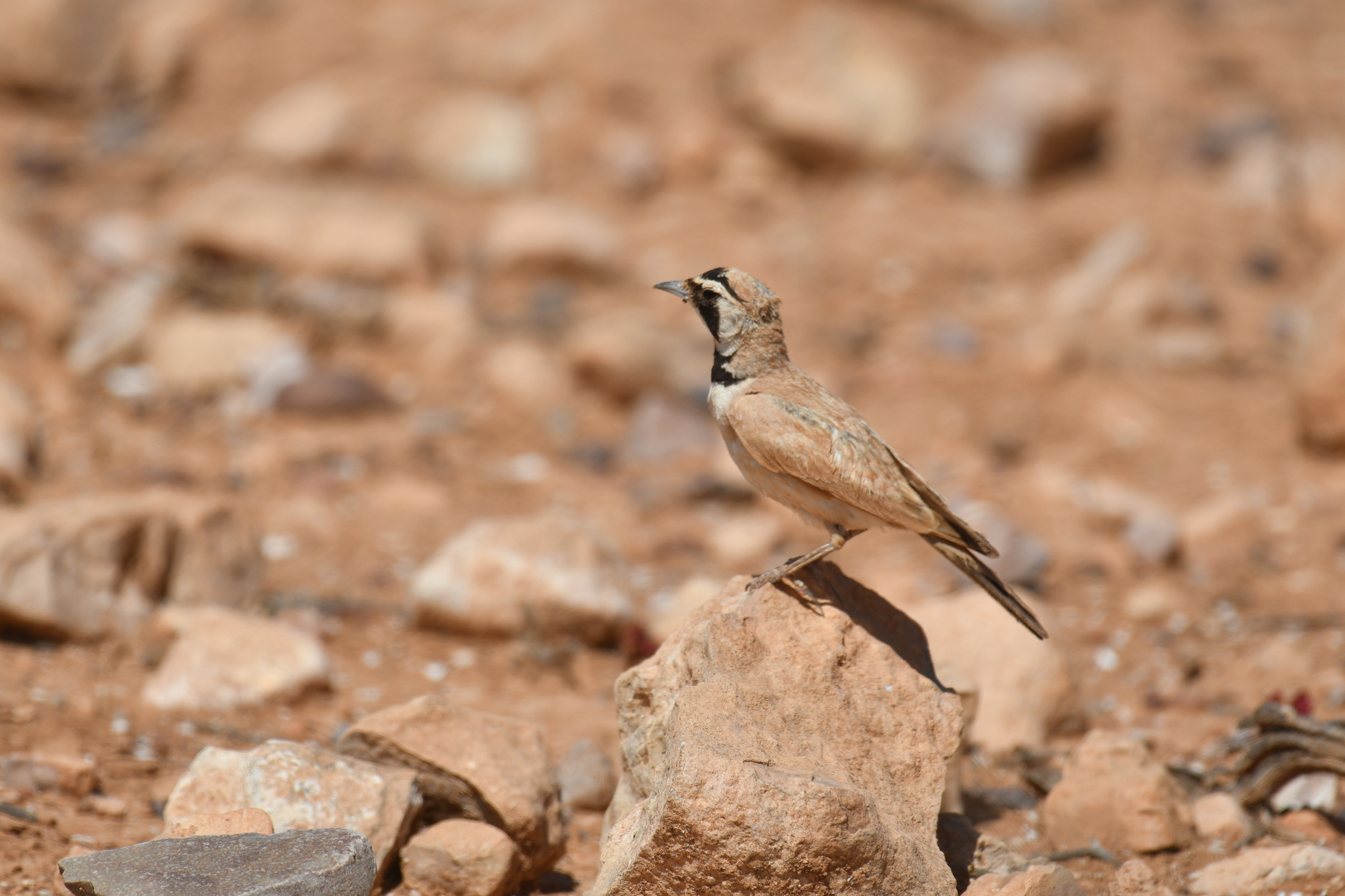
Eremophila bilopha
Feather horns above the desert floor
Temminck’s Lark, Eremophila bilopha, is a small member of the lark family, measuring about 13–15 centimetres in length. Its black-and-white face and two raised feather tufts on the head nevertheless make a strong impression. These tufts are neither true horns nor external ears. The striking markings contrast with sandy upperparts that blend into the ground, making the bird easier to identify when it raises its head than when it bends down to search for food.
Its Arabic names include the desert horned lark and horned lark. The scientific name distinguishes this species from other horned larks, especially mountain birds that may show similar facial patterns. Membership of the genus Eremophila does not mean that all its species occupy the same habitat. This lark is associated particularly with dry plains in North Africa, the Levant and the northern Arabian Peninsula, rather than the high snowy peaks associated with some of its relatives.
Plumage, age and possible confusion
The adult has a black mask and a broad black patch on the upper breast, separated by white areas on the face and throat. The male usually looks more strongly contrasting, with more conspicuous feather tufts, while the female has more subdued head markings. However, the position of the feathers and the light both affect appearance. A lark can lower its tufts until they are difficult to see in a photograph, so their absence in a single image is not enough to rule out the species.
The juvenile initially lacks the adult’s complete facial pattern, and its upperparts look spotted or edged with pale fringes. Someone looking only for the “horns” may therefore confuse it with other small desert larks. Body shape, bill, tail pattern, face and habitat should be considered together. Sandy coloration alone cannot establish a subspecies or an exact age: lighting, dust and feather wear make colour shades less consistent than an ideal field-guide photograph might suggest.
What kind of desert does it need?
Its typical habitat is open, level ground with a firm or gravelly surface, scattered stones, grasses and widely spaced low shrubs. Bare sand dunes or steep rocky slopes are not equivalent substitutes for this habitat. In North Africa it is also associated with dry steppe and plateaux supporting drought-tolerant plants. In Saudi Arabia, the national reference describes stony and sandy plains with scattered rocks and sparse vegetation, particularly in the north.
It moves over the ground by walking and making short runs, and can seem to disappear simply by standing still among stones. Failure to see it during a quick visit does not establish that it is absent. Scanning quiet areas with binoculars is more useful than driving aimlessly across them. Describing its habitat is not intended to reveal a nest site, but to explain that deserts contain different environments. Protecting an area of dunes does not automatically compensate for the loss of a gravel plain where this lark feeds and breeds.
Food and movement outside the breeding season
It picks up seeds from the ground and low plants, supplementing them with insects and occasionally fruit. Food availability is connected to small plants that may seem unimportant to a visitor: they produce seeds, support invertebrates and protect parts of the ground surface. Feeding locations may change after rain or as vegetation dries out. Nevertheless, seeing a bird near a green plant does not by itself prove that it is eating that particular plant.
Groups may be seen outside the nesting season, whereas pairs and territories become more apparent during breeding. The species is primarily resident but capable of wandering; residency does not mean remaining within a few metres throughout the year. The Saudi reference mentions possible southward movement in winter. In November, observing these movements and gatherings can be useful, without assuming that every new arrival has made a long migration from another continent or that a large count on one day represents the national population.
Courtship and the ground nest
The male performs a short aerial display accompanied by song, alongside behaviour on the ground. Pairs establish territories during the breeding season. The starting date varies between regions: references generally place the season between late winter and spring, with variation linked to rainfall and local conditions. The arrival of a particular month is not enough to conclude that all birds in Morocco, Jordan and Saudi Arabia are breeding simultaneously, and song alone does not demonstrate the presence of eggs.
The nest is a small depression in the ground, lined with grasses, roots and soft material, often sheltered by a low stone or a plant. A row of pebbles or soil may lie along its exposed side. The Saudi reference describes the female as doing most of the construction and probably most of the incubation, with both parents caring for the young. “Probably” should not be replaced with excessive certainty: distinguishing the sexes’ roles requires repeated observations rather than a single visit near a nest.
Eggs and chicks: more than the day of first flight
The Saudi reference gives a clutch of two to three eggs, while general references describe a broader range extending to four. Incubation lasts about 13–14 days. The same Saudi source describes chicks leaving the nest at around ten to eleven days, remaining hidden nearby, and then becoming capable of flight at about 15–16 days. These are approximate reference values, not fixed timetables for every nest in the Arab region.
Newly hatched chicks need warmth, food and care, and do not become independent simply by leaving the depression. The site therefore remains sensitive after the nest appears empty. Opening vehicle tracks or searching for chicks to photograph may separate them or expose them to heat and predation. Responsible behaviour means moving away when an adult carrying food delays approaching its young, and not touching or relocating a chick simply because it is on the ground. That position is a normal part of its development.
Distribution across Arab countries
The African range extends from Mauritania through suitable desert and semi-desert environments in Morocco, Algeria, Tunisia and Libya to Egypt. Its occurrence within each country varies with the terrain, rainfall and vegetation; this broad range does not mean that it occupies the entire Sahara. These countries form a core part of the range of a species with year-round Arab connections, rather than necessarily hosting a European visitor that passes through for a few days and disappears.
In the Levant and adjoining areas, the regional review describes resident occurrence in Jordan, southern Syria and western and southern parts of Iraq. In Saudi Arabia it is a resident breeding lark of the northern plains, and may extend southward in some years. Kuwaiti references establish breeding together with uncommon wandering occurrence in autumn, winter and spring. Regional residency is therefore compatible with changing numbers of sightings at a particular Kuwaiti site from one season to another.
The Saudi pattern should not be extended to every Gulf country. The regional reference records vagrant occurrence in the United Arab Emirates; a vagrant is neither a breeding resident nor a winter visitor guaranteed to arrive. Observations should preserve this distinction between inclusion on a national list and the nature of the species’ occurrence. Similarly, a desert photograph from one Arab country does not automatically document another, however similar the sand and stones may look.
Conservation and a quiet visit
AviList 2026 lists the species globally as Least Concern, or LC. This does not mean that its habitats are unaffected: land levelling, road expansion, off-road driving and deteriorating vegetation may alter the plains on which the birds depend. Older population estimates remain dated estimates, not a live census that can establish the condition of every local population or its rate of change.
Good observation starts with choosing an existing route and stopping far enough away for the bird to continue its behaviour. Visitors should not approach repeatedly until it flies, provide food to lure it into a photograph, or publish the coordinates of an active nest. Record the number, time and habitat, and identify uncertain birds as such rather than turning every sandy lark into this species. Protecting the desert includes small details, from a seed-producing plant to a motionless chick between two pebbles.
Photo: Justin Philbois / iNaturalist (CC0 1.0)