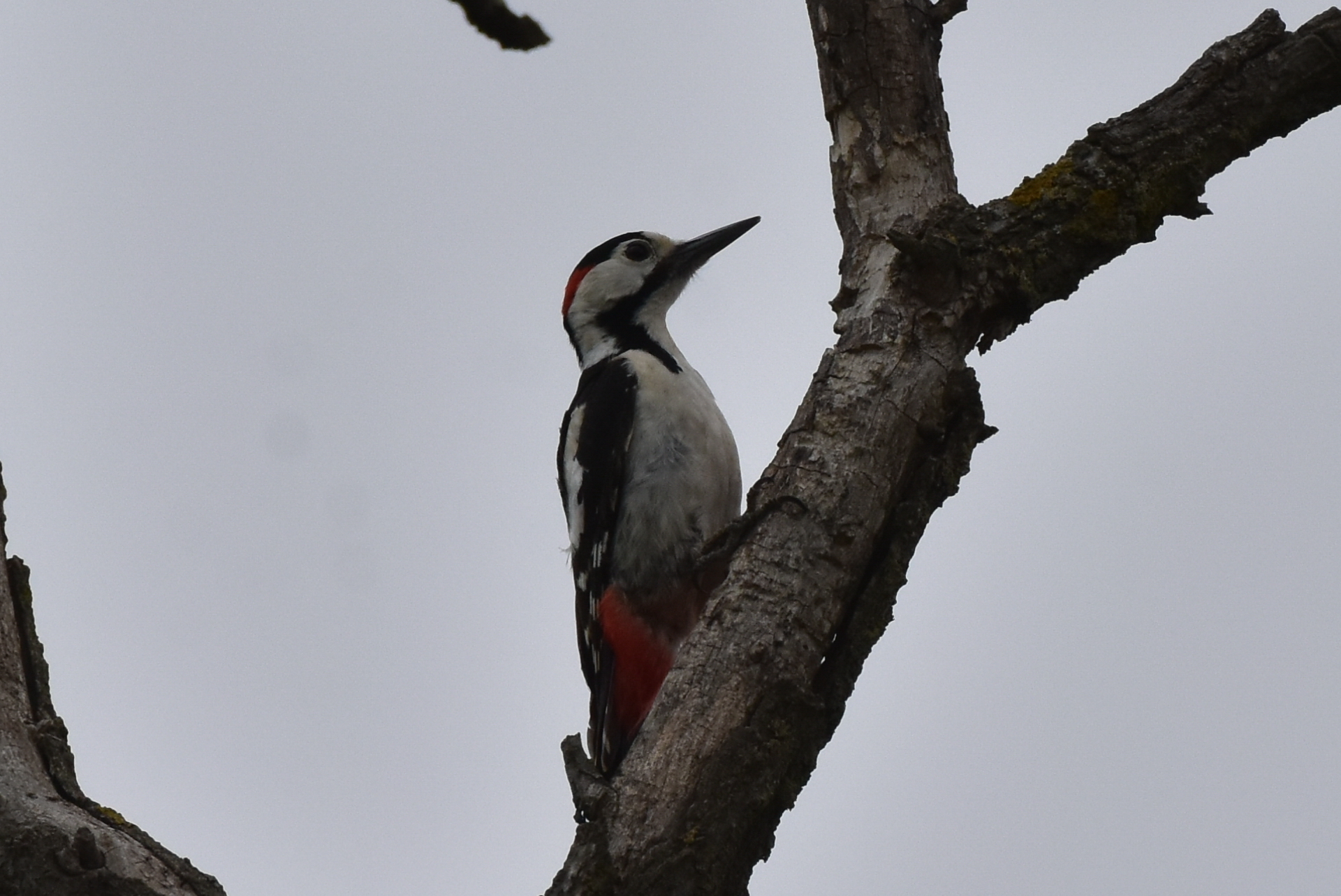
Dendrocopos syriacus
A woodpecker living among trees and people
Syrian Woodpecker is a resident bird of open, tree-rich landscapes, from scattered woodland to orchards and old gardens. Its scientific name, Dendrocopos syriacus, places it in the woodpecker family Picidae, but does not mean it is confined to Syria: its range extends through parts of Europe, the Caucasus and western Asia. About 21–24 cm long, it combines black and white plumage with a pinkish-red undertail area. In an Arab landscape visited by many seasonal migrants, it offers a different story: a bird whose year-round life depends on the trees of its own region.
In November it can be sought in its known habitats without waiting for a migration wave. Its autumn presence primarily reflects residency, although some individuals move locally. Calls may reveal it before it is seen on a trunk, while its undulating flight becomes conspicuous when it crosses between trees. Failure to find it on one visit does not establish that it has disappeared. Birds can move between separated patches of woodland and orchards.
Identification, sex and age
Prominent white shoulder patches stand out against the dark back, and pale markings cross the black wings. The face has an extensive white area. The black line running from the bill towards the breast does not close the white space behind the cheek as it does in Great Spotted Woodpecker. This open cheek pattern is particularly useful, supported by relatively little white on the outer tail feathers and a softer, pinker undertail area. Several features together are safer than judging size alone.
An adult male has a red patch on the nape, absent in an adult female. Juveniles have red on the crown, so red on the head cannot by itself identify an adult male. Young birds can be especially confusing when compared with other woodpeckers. A side view of the head and a clear tail photograph help documentation, provided these are obtained without chasing the bird or tapping an occupied nest tree to force it into view.
Arab distribution: local residency, not uniform occurrence
In Syria the species is associated with woodland and orchards, including the coastal mountains, the Anti-Lebanon range and the surroundings of Damascus. Syrian references also record it around Aleppo and Ghouta. This is a patchwork of suitable environments, not continuous occupation of the whole country. In Palestine, the Mahmiyat platform describes it as common, and an older scientific study documents breeding in the Gaza Strip. That historical study alone cannot establish present bird numbers or the current condition of their habitats.
Jordan BirdWatch's list, updated in May 2020, classes it as resident, and the organisation's work includes it among breeding birds of traditional, tree-rich farmland in northern Jordan. Iraq's annotated bird checklist records it in northern woodland. These environments differ from open deserts and wetlands. Inclusion on a national list therefore does not mean the species is available throughout that country, or that it arrives there as a winter visitor.
Lebanon: documented breeding and care with historical evidence
The Society for the Protection of Nature in Lebanon explains that a 1974 reference considered the species locally extirpated, before breeding was confirmed at Qammouha and Fneideq in 1995. Nesting was subsequently recorded between 1996 and 2005 at mountain sites and around Aammiq and Qaraoun, with dispersing birds observed in the Litani Valley. This history illustrates why a gap in records, or an old judgement of status, should not become a permanent description of a species.
In its account published in 2021, the society describes a subsequent local decline and identifies tree cutting, disturbance, persecution and illegal hunting among the pressures. This should be read as a dated Lebanese assessment, not a new census of every Arab population. Likewise, global Least Concern status does not rule out the loss of nesting trees or reduced survival opportunities at individual sites. The global picture cannot replace repeated local monitoring.
Old trees and a diet that follows available resources
This woodpecker needs suitable trees within a network of habitats more than an unbroken expanse of dense forest. Traditional orchards, gardens with large trees, open woodland and village edges can provide food and potential cavities. European studies document substantial use of tree-rich farmland. Success there does not mean replacing all the old trees in an Arab orchard with small ones will preserve the same ecological function. Tree age and structure matter more than simply counting trunks.
Its food includes insect larvae, beetles, ants and other invertebrates, found by pecking, picking prey and working at bark. It also eats seeds, fruit, walnuts and almonds, sometimes wedging an item in a crack to break it open. Plant food is a genuine part of its diet, not evidence that it has stopped eating insects. This variety provides options as resources change, including in autumn and winter, but cannot guarantee survival where trees and shelter disappear.
From drumming to a cavity and eggs
Repeated drumming communicates presence; not every sound made with the bill is feeding activity. During the breeding season the bird excavates a cavity in a suitable trunk or branch, often where the wood is easier to work. The entrance remains small compared with the chamber inside. Spring activities begin earlier in parts of the Levant than in some European regions. A Polish nesting calendar should therefore not be transferred unchanged to Lebanon or Palestine.
General references describe clutches of about 3–7 eggs, with regional differences in average size. A study of 73 nests in southeastern Poland during 2003–2006 recorded clutches of two to seven eggs and incubation lasting 9–13 days. These are measurements from one population, illustrating the relatively rapid stage rather than promising one duration for every Arab nest. Both parents care for the young. Details of their division of labour and timing require repeated observation, not an inference from a single bird visiting a hole.
Nestlings, independence and the rest of the year
The chicks hatch inside the cavity and require regular feeding; they cannot fly when they emerge from the eggs. The Polish study recorded 24–30 days in the nest before departure. Dependence on the parents continues for a time after fledging, so a young bird sitting on a branch is not necessarily independent or abandoned. Young birds may later leave their birthplace, explaining some sightings away from usual breeding sites without requiring an assumption of long-distance migration.
The presence of a hole does not guarantee successful breeding. Other species may compete for cavities, and the same study documented a contribution from starlings to nest losses at its site. Retaining trees of different ages and alternative cavities therefore benefits the bird community. Holes should not be blocked simply because one appears unused. Outside the nesting season, access to food and shelter remains essential: these needs do not end when breeding is over.
Protection and responsible observation
Practical protection starts with retaining mature trees and safe areas of decaying wood where they pose no danger to people, and assessing pruning or felling before work begins. This does not mean leaving a hazardous tree untreated. It means combining public safety with habitat conservation through informed assessment. Careful pesticide management also helps: a bird that feeds on invertebrates needs accessible prey, not merely trees that look green but support little life.
Watch from a steady distance, keep the flight path to the cavity clear, and retreat if adults stop approaching or repeatedly give alarm calls. Do not place food near a nest to attract a bird for a photograph, or remove healthy young from their surroundings. Records are more useful when they include habitat, date, behaviour and numbers, while protecting precise nest locations. Global Least Concern status is neither permission to hunt nor a substitute for local law.
Photo: Лариса Артемьева / iNaturalist (CC0 1.0)