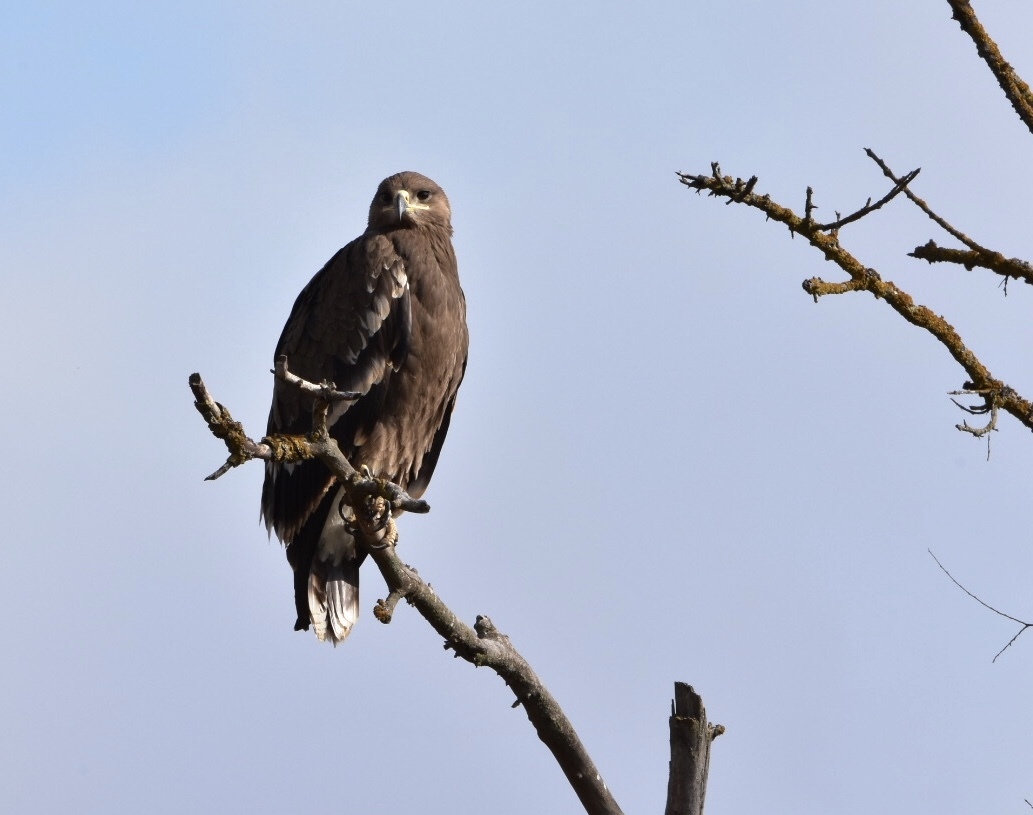
Aquila nipalensis
Identity and identification
Steppe Eagle Aquila nipalensis belongs to Accipitridae. Large and brown, it has broad wings and a long gape reaching approximately the rear of the eye. Juveniles show pale wing bands. Distant separation from Tawny Eagle and other eagles is difficult; brown colour alone is insufficient. It is placed in the order Accipitriformes. The IUCN category carried in AviList 2026 is Endangered (EN).
Habitat, food and behaviour
Steppe and dry open country provide small mammals, birds and carrion. Winter birds may gather at concentrated food, including waste sites. Thermal soaring saves travel energy but makes routes sensitive to weather and time of day.
Breeding and parental care
Breeding nests stand on ground, rocks and sometimes structures or trees. The Peregrine Fund reports one to four eggs and incubation around 45 days; young begin flight around 55–65 days. Feather growth does not mean immediate independence. Prey and conditions influence breeding success.
Range and Arab occurrence
Asian steppe breeding areas connect through the Middle East to Arab, African and Asian wintering regions. Lebanon has scarce spring and autumn passage. Winter concentrations in Arabia do not establish Lebanese winter status.
Seasonality and observation
Lebanon’s checklist records passage in February–May and September–mid-November. November can coincide with the end of passage and arrival farther south. Assigning a photograph to an Arab locality requires independent geographic provenance; an identification image cannot document an individual’s route.
Ecological role and conservation
Electrocution, poisons, collisions and habitat loss are threats. Gathering around contaminated food can create collective risk. Insulating dangerous poles, reducing toxicants and preserving migration corridors are practical measures; accurately documenting mortality helps identify causes.
References
Ramadan-Jaradi et al. — Updated checklist of the birds of Lebanon, Sandgrouse 42 (2020), 186–238.
The Peregrine Fund — Steppe Eagle.
AviList Core Team — AviList: The Global Avian Checklist, v2026 (20 October 2026).
Photo: Лариса Артемьева — CC0 1.0.