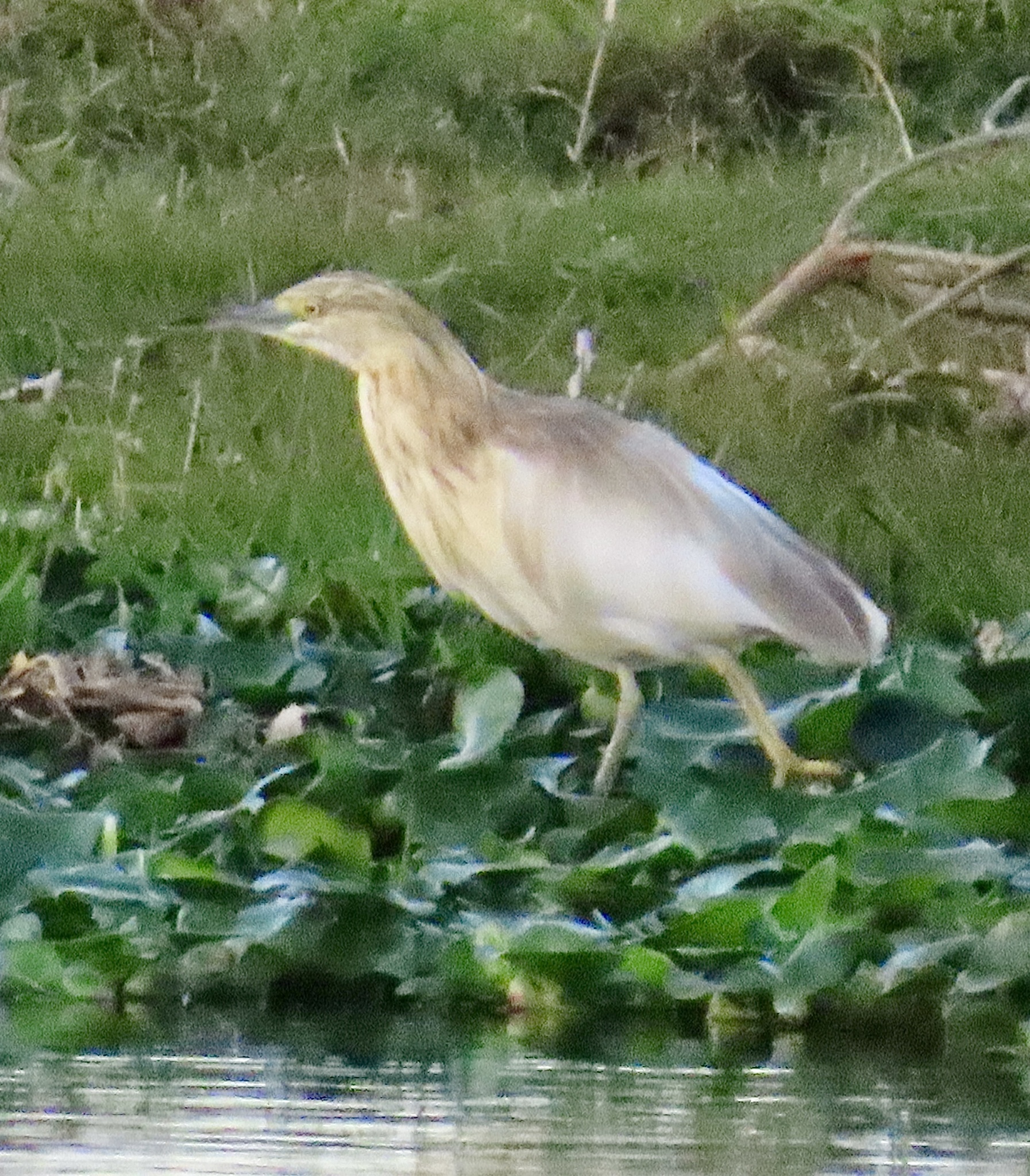
Ardeola ralloides
Identity and identification
Squacco Heron Ardeola ralloides belongs to Ardeidae. At rest it looks buff-brown, with streaking on head and neck; in flight its white wings are striking. Breeding adults develop longer head plumes, while juveniles are more heavily streaked. Night herons have a shorter-necked appearance and more contrasting dark crown. It is placed in the order Pelecaniformes. The IUCN category carried in AviList 2026 is Least Concern (LC).
Habitat, food and behaviour
Shallow water, reedbeds, irrigation channels and marsh margins provide feeding habitat. It waits or walks slowly before seizing small fish, amphibians and aquatic insects. Floating vegetation may serve as a platform; concealment and short strikes replace prolonged pursuit.
Breeding and parental care
It nests colonially, often with other herons, in shrubs or trees near water or among reeds. Twigs form the nest and both parents contribute to care and provisioning. Young remain dependent around the nest after hatching. Breeding requires relatively undisturbed habitat with reliable food and water.
Range and Arab occurrence
It crosses North Africa and the eastern Mediterranean and breeds at scattered wetlands within its wider range. Lebanon’s updated checklist calls it a common passage migrant with small winter numbers. The first confirmed Lebanese breeding was documented in May 2020; that local record does not establish widespread breeding.
Seasonality and observation
Lebanese passage is prominent from mid-March to early June and early August to late September, with a few wintering birds. November sightings therefore require careful documentation but are possible. Seasonality differs among Maghreb wetlands, the Nile basin and the Levant.
Ecological role and conservation
Its diet connects aquatic invertebrates and small fish with wetland predators. Drainage, polluted channels and disturbance of nesting colonies are pressures. Observe mixed colonies from a distance: adults forced from nests can leave eggs and chicks exposed to heat and predation.
References
Ramadan-Jaradi et al. — Updated checklist of the birds of Lebanon, Sandgrouse 42 (2020), 186–238.
British Trust for Ornithology — BirdFacts: Squacco Heron.
AviList Core Team — AviList: The Global Avian Checklist, v2026 (20 October 2026).
Photo: Irene — CC0 1.0.