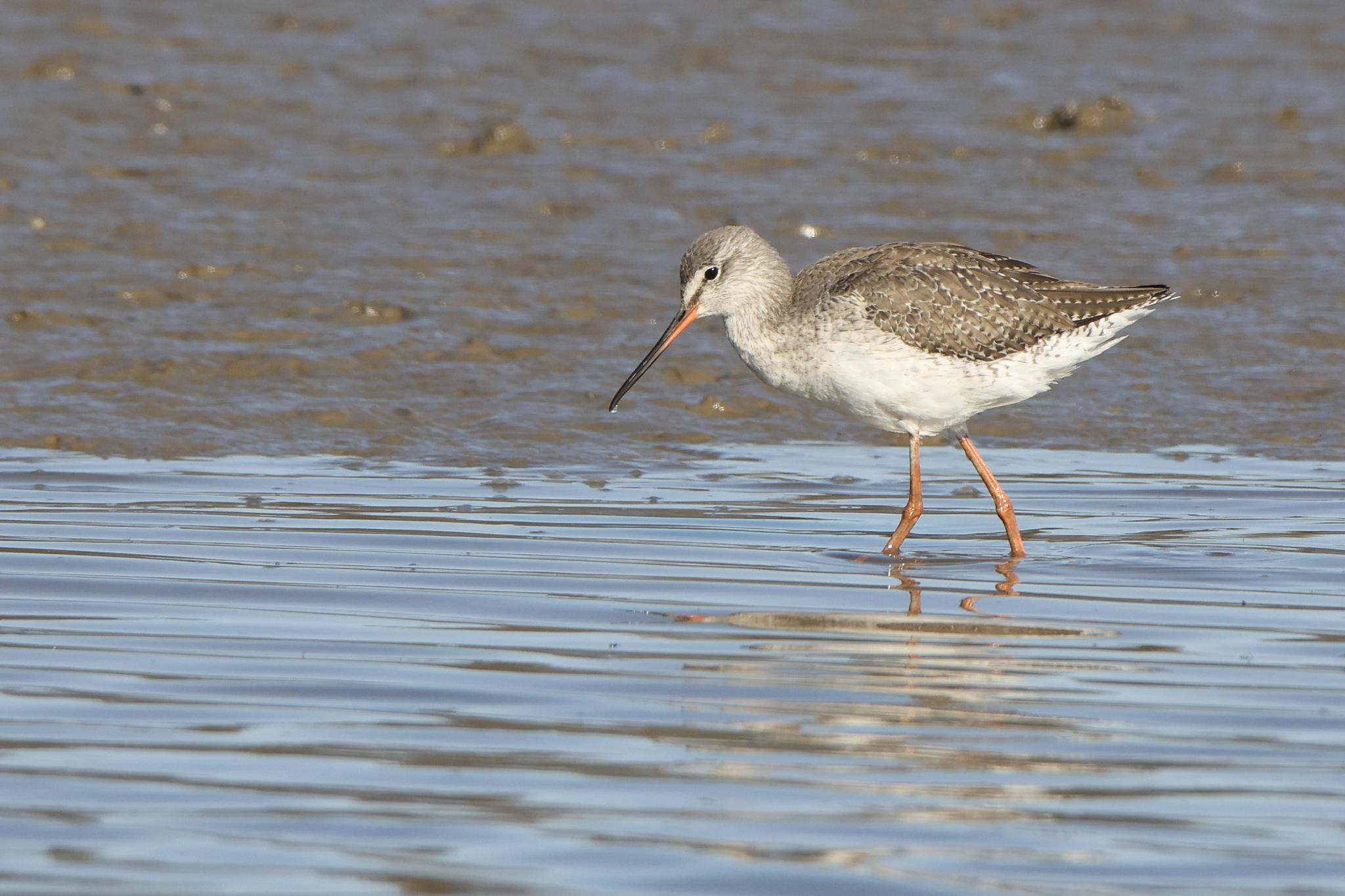
Tringa erythropus — from summer black to winter grey
Identity and names
The Spotted Redshank, Tringa erythropus, is distinct from the Common Redshank, Tringa totanus. Both belong to Scolopacidae within Charadriiformes. AviList 2026 retains this scientific name. Arabic references use variant forms of “spotted red-legged sandpiper”; attaching the scientific name avoids confusion between local names. Neither spotting nor red legs alone identifies it, because its plumage changes markedly with the season and several other waders have reddish legs.
Summer, winter and juvenile plumage
Breeding adults become strikingly black, with white spotting above. In winter they turn grey-backed and white below, with a conspicuous white eyebrow. Juveniles have brown, pale-spotted upperparts and more strongly barred underparts; some juvenile markings disappear progressively during autumn. Sexes look alike outside the breeding season, so an ordinary winter photograph should not be sexed. The bill is long and fine, dark with reddish colour at the base of the lower mandible. Legs may appear reddish or very dark depending on plumage and lighting. The bill is not wholly red.
Separating it from Common Redshank
Compared with Common Redshank it appears more slender, longer-billed and longer-legged, and greyer and paler in winter. A particularly useful flight character is the absence of Common Redshank’s broad white trailing edge to the wing; it still has a white wedge extending through the back and rump. It can mingle with redshanks and greenshanks, so a familiar flock need not contain only one species. A grey November bird should not be rejected merely because it differs from photographs of black spring adults.
Food, breeding and migration
It uses pools, shallow lakes, mudflats and fresh or brackish water, not only marine shores. Food includes insects and larvae, worms, crustaceans and small fish; birds may swim or tip forward into the water to reach prey. Breeding takes place in northern Eurasian tundra and wetlands near trees, with a ground nest. The male carries most incubation responsibility, and chicks are mobile after hatching: equal parental care should not be assumed for every bird species. Winter distribution extends from parts of Europe and Africa into southern and eastern Asia, requiring safe feeding and resting sites along the journey.
Arab distribution and seasonal context
Lebanon’s 2026 guide describes scarce passage and rare winter and summer visitation on coasts, islands and wetlands. Its 2020 checklist placed passage mainly in March–April and late July–September; the newer guide takes precedence for current status without implying winter abundance. Kuwait records scarce passage and winter presence; Oman lists it as common in both seasons. Documented winter range includes Egypt, southern Iraq and Yemen, and historical counts confirm winter presence in Morocco and Libya. A November profile therefore suits Arab winter wetlands, while abundance must remain locally qualified. Country presence does not imply occurrence everywhere, and old surveys cannot establish unchanged present-day numbers.
Conservation and observation
Its global status is Least Concern. Wetland integrity, water quality and prey availability remain essential, threatened by drainage, reclamation, pollution and disturbance. Observe far enough away for feeding to continue, and record date, location and plumage without publicising sensitive sites where this would increase pressure. Global status does not decide hunting legality, and a single sighting cannot establish a change in migration routes without comparable observations over time.
References
AviList Core Team — AviList v2026, 20 October 2026.
British Trust for Ornithology — BirdFacts: Spotted Redshank; RSPB — Spotted Redshank.
Naturalis Biodiversity Center — Birds of Europe: Tringa erythropus.
Blasco-Zumeta & Heinze — Spotted Redshank identification, ageing and sexing guide, Aranzadi.
Toochin — Status and occurrence of Spotted Redshank in British Columbia, E-Fauna BC, University of British Columbia.
Ramadan-Jaradi et al. — Updated checklist of the birds of Lebanon, Sandgrouse 42, 2020.
Kuwait Ornithological Rarities Committee — Kuwait Bird List; Kuwait Birds — Spotted Redshank.
Birds of Oman — national species database.
Waders wintering in Morocco, Wader Study Group Bulletin 96, 2001; Results of the seventh winter waterbird census in Libya, January–February 2011.
Ramadan-Jaradi & Itani — Birds of Lebanon: A Photographic Guide to 409 Species, second edition, UNDP, June 2026.
Photo: Paulo Caseirito — CC0-1.0.