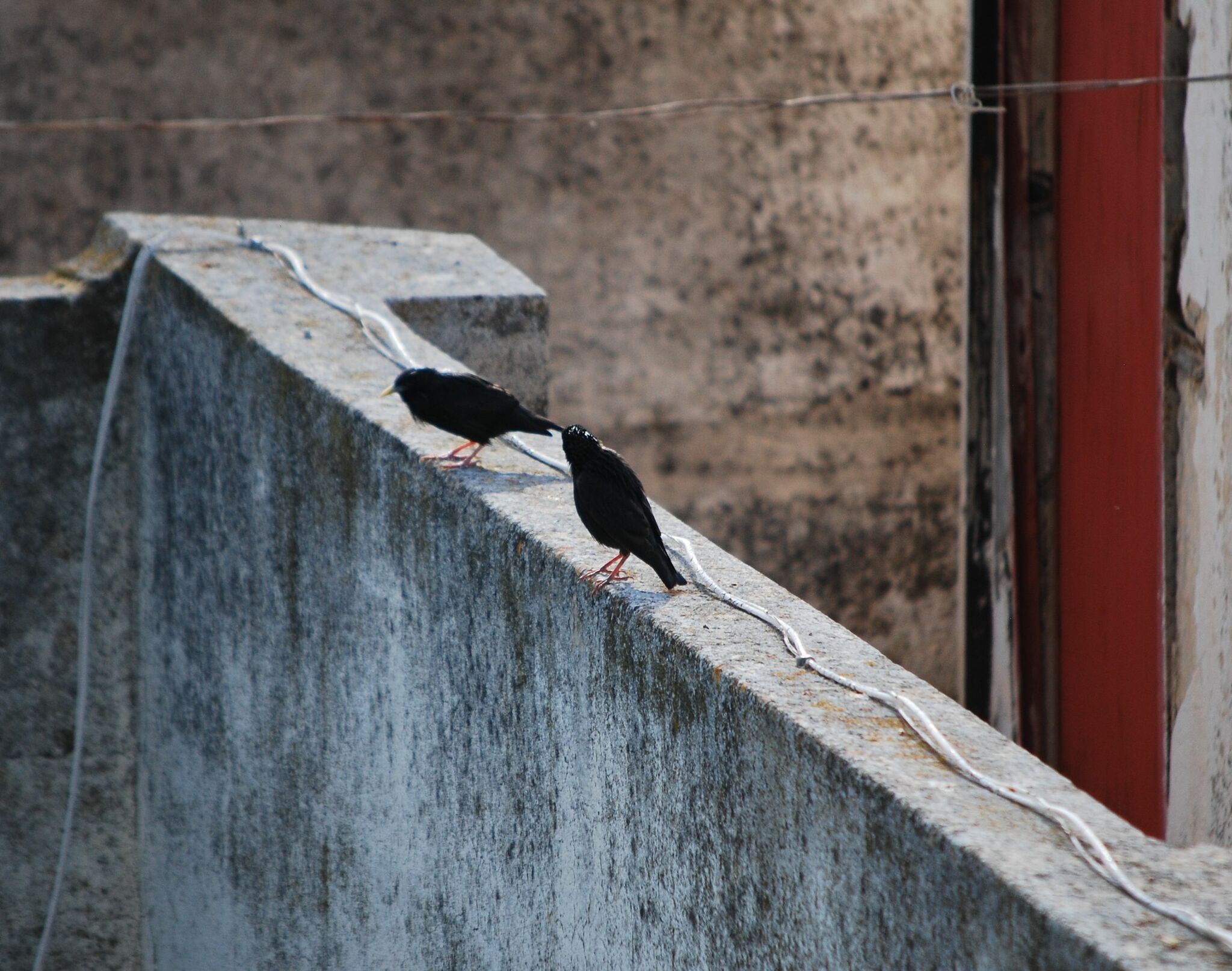
Sturnus unicolor
Identity and identification
Spotless Starling Sturnus unicolor belongs to Sturnidae. Dark glossy plumage includes relatively long throat feathers. It generally lacks Common Starling’s heavy spotting, but breeding Common Starlings can also lose many spots. Feather structure, voice and location must therefore be combined. It is placed in the order Passeriformes. The IUCN category carried in AviList 2026 is Least Concern (LC).
Habitat, food and behaviour
Farmland, pasture, orchards and towns provide habitat. It takes ground insects and larvae, adding fruit and seeds seasonally. Social birds form communal roosts and sing from exposed perches. Food proportions vary with season and resources.
Breeding and parental care
Nests occupy tree, rock and building cavities. Spain’s SEO/BirdLife account gives usually four or five eggs, incubation around 10–15 days and young flying at about 21–22 days, followed by further feeding. Two broods are possible. These breeding-range reference durations do not impose a Spanish calendar on the Maghreb.
Range and Arab occurrence
It occurs in the western Mediterranean, particularly Iberia, parts of the Maghreb and Mediterranean islands. North African occurrence makes it relevant to an Arab encyclopedia, but it is not another name for widespread Common Starling: the scientific identities are distinct.
Seasonality and observation
Mainly resident with local movements, it can be watched in November. Flocks may mix with wintering Common Starlings, requiring several individuals and angles to be documented. Lack of visible spots in a dark or distant photograph is insufficient.
Ecological role and conservation
It consumes agricultural invertebrates and disperses some fruit seeds, while sometimes visiting fruit crops. Cavities, varied farmland and reduced pesticides support populations. Local crop management should avoid destroying roosts or nests and harming mixed species.
References
SEO/BirdLife — Estornino negro, Sturnus unicolor.
Gil — III Atlas de las aves en época de reproducción en España (2022), Estornino negro.
AviList Core Team — AviList: The Global Avian Checklist, v2026 (20 October 2026).
Photo: Mirela — CC0 1.0.