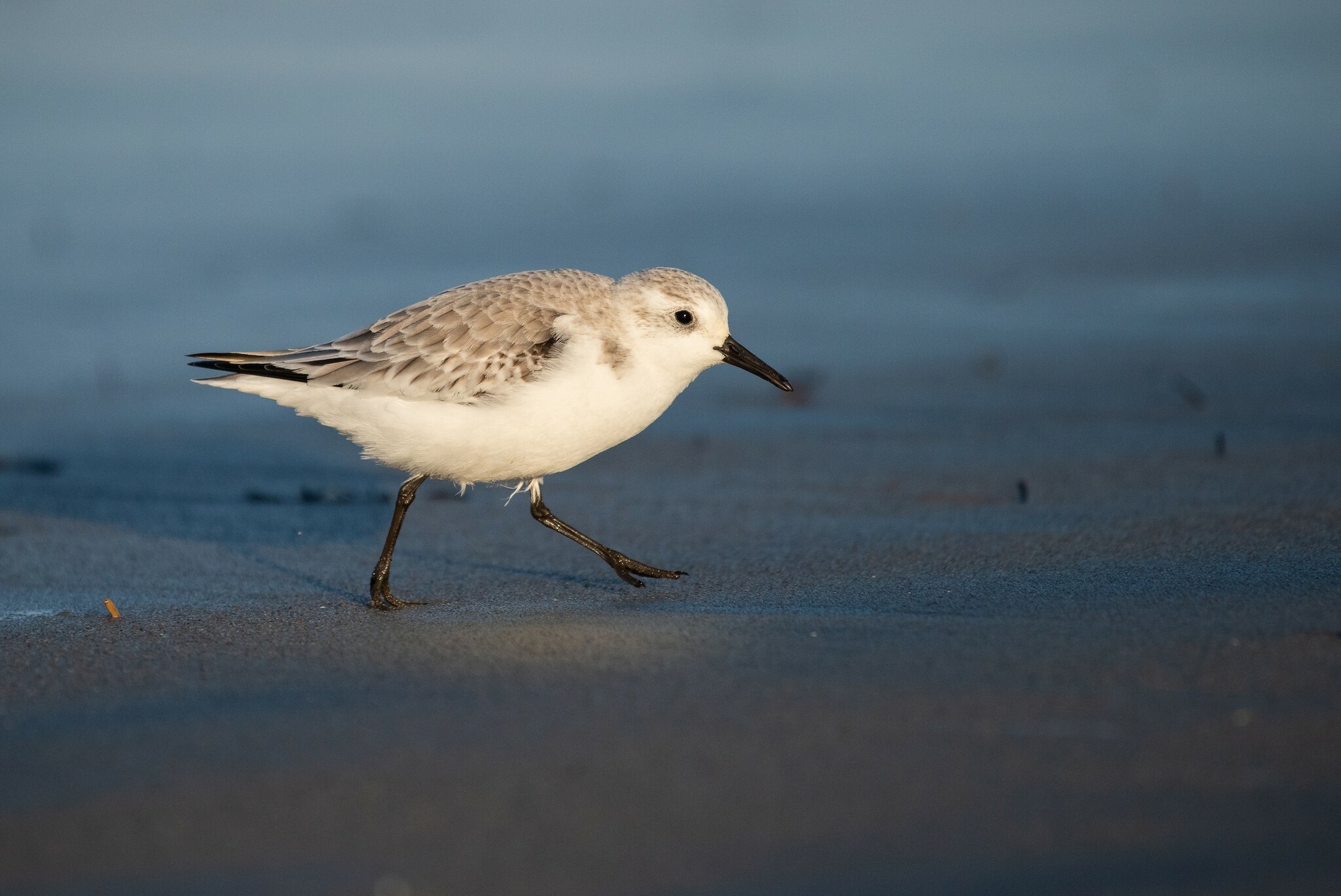
Calidris alba
Name and identity
Sanderling, Calidris alba, belongs to Scolopacidae within Charadriiformes. Lebanon’s 2026 guide uses al-durayja al-bayda; Kuwait’s reference gives al-madruwan. The local Kuwaiti name Irhaiz applies to several waders and cannot document the species on its own. AviList 2026 retains the scientific name.
A winter bird resembles a pale ball running over wet sand, following the retreating water before withdrawing from the next wave. The scene connects a warm Arab beach with a very different landscape: Arctic plains where it spends its short breeding season.
Plumage, age and identification
It is plump, with a relatively short straight black bill and black legs. Winter adults are pale grey above and white below with a darker shoulder area. Breeding plumage brings rusty tones and dark mottling to head, breast and back, while the belly remains white. Juveniles have more strongly black-and-white patterned upperparts than winter adults.
The sexes look similar, so plumage state and possible age are more useful than an unsupported sex assignment. The foot lacks the hind toe found in most sandpipers, but examining it never justifies disturbance. A broad white wing bar appears in flight. Compared with Dunlin, its bill is shorter and less curved and its winter appearance whiter; shape and behaviour complete the identification.
Habitat and food
Outside breeding it particularly uses sandy beaches, also visiting mudflats, saltpans and some inland water margins on passage. It takes worms, crustaceans, molluscs and other small prey at or below the sand surface; diet changes with habitat, and insects become important on northern breeding grounds.
Running beside the surf provides access to ground briefly exposed by retreating water. Birds may gather to rest when feeding space shrinks. Suitable coastline combines food with a quiet resting place; repeated chasing reduces the time available for foraging.
Breeding and life cycle
It nests in Arctic tundra in a simple ground scrape lined with plant material, usually laying three or four eggs. BTO gives typical incubation of 24–27 days and about 16–18 days to flight. Mating and parental arrangements vary: both parents may participate or one may care for the brood.
Downy chicks can move and pick up food, while still needing protection and warmth from the attending parent. Leaving the scrape precedes flight and does not mean independence. After breeding, birds move to temperate and tropical coasts; some non-breeders remain away from the tundra in summer. Such presence does not prove nesting where they are seen.
Arab occurrence and season
Its Arab occurrence includes North African countries, Egypt, Sudan, the Levant and Gulf states, extending to Djibouti, Somalia and Comoros. This breadth highlights the value of Arab coasts, but a country occurrence record alone establishes neither season nor abundance on every beach.
Lebanon’s 2026 guide describes scarce passage on sandy shores, mudflats, saltpans and wetland margins. Kuwait records common passage and winter visitation, with scarce summer occurrence; Oman’s database describes abundant passage and wintering. November observation is therefore especially appropriate along Gulf and Omani shores; common winter status there should not automatically be applied to Lebanon.
Conservation and watching
Its global status is Least Concern, LC, in the 2024 Red List assessment and AviList 2026. Habitat loss, oil pollution and disturbance remain important at individual sites. Protecting the wet feeding strip and connected resting places lets birds meet their needs without repeated forced flights.
Wait at a suitable distance rather than walking towards the flock, and do not stand between it and feeding ground. Record numbers, time and tide: changing water levels may explain movement between locations. Natural behaviour is more informative than a photograph obtained by forcing birds to flee.
References
AviList Core Team — AviList v2026, 20 October 2026.
Ramadan-Jaradi & Itani — Birds of Lebanon, second edition, UNDP, June 2026, p.157.
BTO — BirdFacts: Sanderling, biology.
Cornell Lab of Ornithology — All About Birds: Sanderling, identification and life history.
Kuwait Birds — Sanderling; Birds of Oman — species database.
BirdLife International — Calidris alba, IUCN Red List, 2024.
EURING/CMS — Eurasian-African Bird Migration Atlas, Sanderling, 2022.
Photo: Adam Jackson — CC0 1.0.