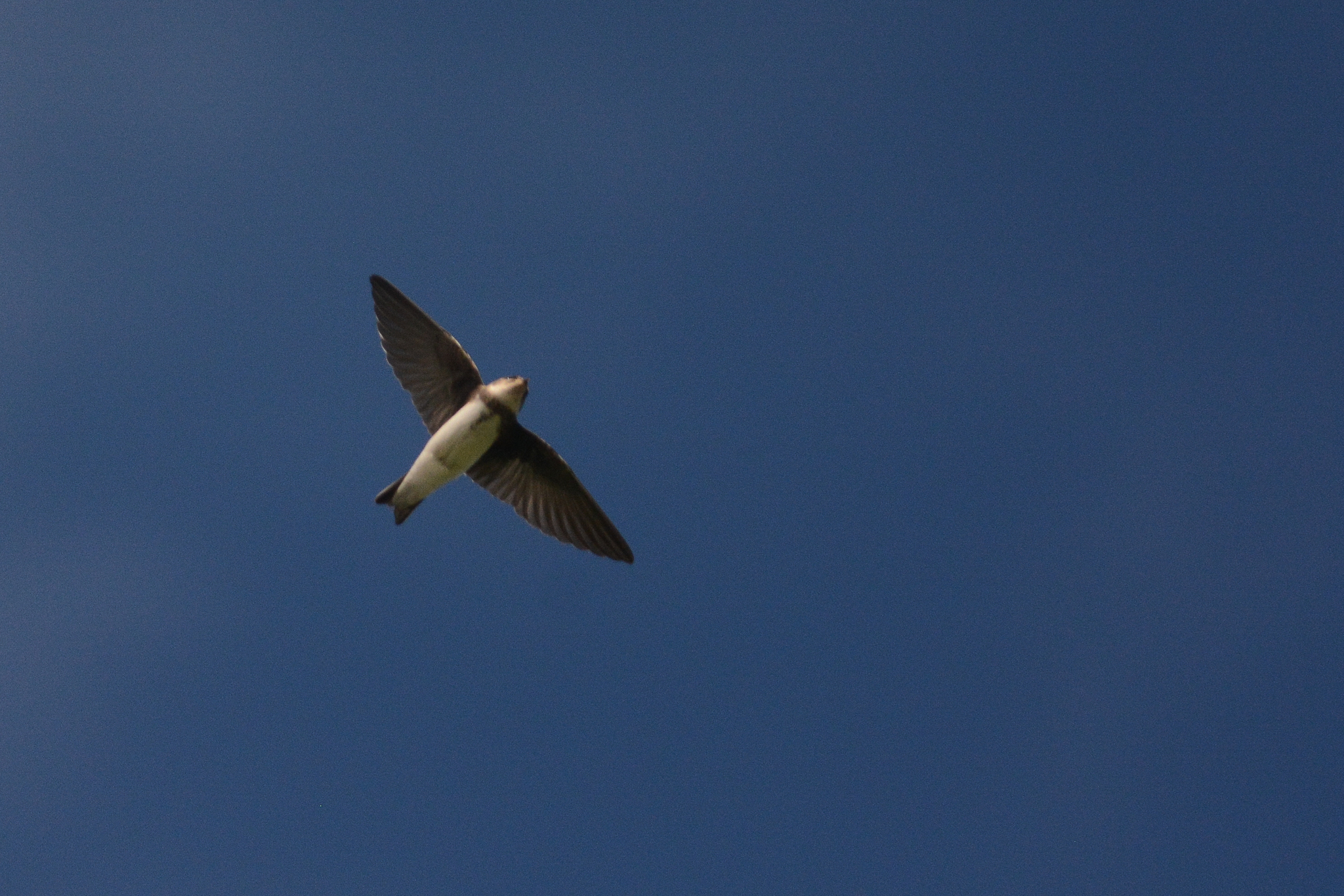
Riparia riparia
Identity and identification
Sand Martin Riparia riparia belongs to Hirundinidae. Small and brown above, it has white underparts crossed by a distinct brown breast band. This band, head shape and flight separate it from white-rumped House Martin. Closely related sand martins may require more detailed comparison. It is placed in the order Passeriformes. The IUCN category carried in AviList 2026 is Least Concern (LC).
Habitat, food and behaviour
It catches flying insects above water, fields and wet plains. Migrants gather at feeding and roosting sites, sometimes using reeds for sleep. Concentrations reflect food and resting opportunities rather than proving a nesting colony.
Breeding and parental care
A horizontal burrow is excavated into a sandy or earthen face, often in colonies. BTO gives four or five eggs, shared incubation around 14–15 days and young leaving at about 19–21 days. Two broods are possible. A stable bank and unobstructed entrance are essential.
Range and Arab occurrence
It breeds widely in temperate regions and winters farther south. Lebanon has common passage; possible nesting near the Assi remained unconfirmed in the 2020 checklist. Large migrant numbers must not be equated with residence or breeding.
Seasonality and observation
Lebanese passage extends through February–May and August–November. November falls within the end of autumn passage. Multiple views confirm the breast band; counts must avoid repeatedly counting circling birds.
Ecological role and conservation
Bank destruction while occupied, polluted water and insect declines are pressures. Stable nesting faces away from hazardous work help. Observe burrows from a distance: standing at entrances prevents parents from provisioning young.
References
Ramadan-Jaradi et al. — Updated checklist of the birds of Lebanon, Sandgrouse 42 (2020), 186–238.
British Trust for Ornithology — BirdFacts: Sand Martin.
AviList Core Team — AviList: The Global Avian Checklist, v2026 (20 October 2026).
Photo: Braden J. Judson — CC0 1.0.