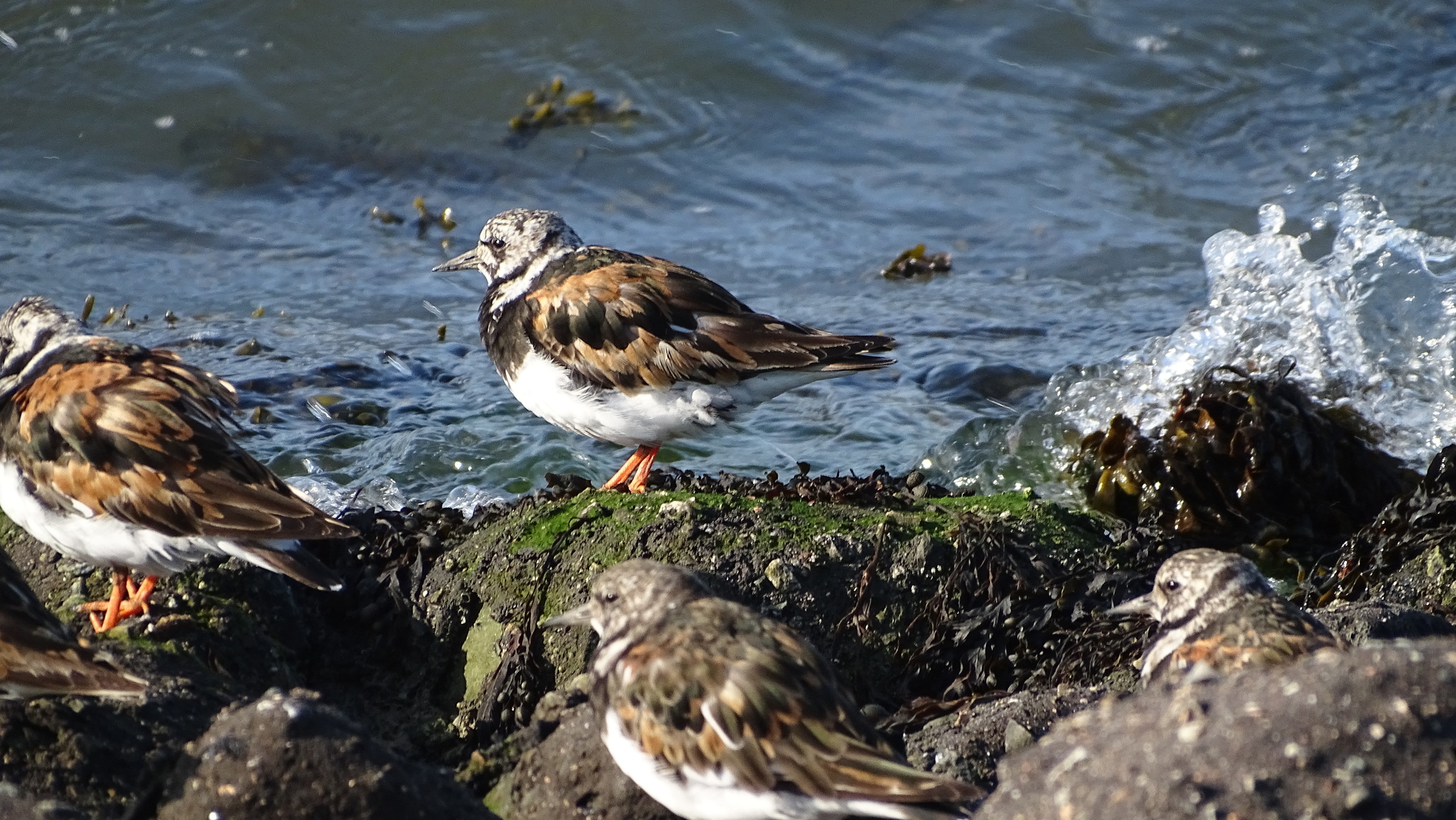
Arenaria interpres
Name and identity
Ruddy Turnstone, Arenaria interpres, belongs to Scolopacidae within Charadriiformes. Lebanon’s 2026 guide and Kuwait’s bird reference use the Arabic name Qunburat al-maa. Despite that name it is not a lark; the scientific name is the clearest reference for photographs and records. AviList 2026 retains it, and the French name is Tournepierre à collier.
Its character is most apparent on the shore: a short-legged bird working among pebbles and stranded seaweed, pushing a small object aside to expose what lies beneath. The English name combines its colourful summer appearance with this stone-turning habit.
Plumage and identification
It is compact, with orange legs and a short, sturdy bill slightly upturned at the tip. Breeding plumage combines chestnut, black and white, with bold face and breast markings. Females are generally less vivid than males, but sex assignment needs a clear view rather than a single colour in a distant photograph.
Winter upperparts become browner, while white underparts and the dark breast pattern remain. Juveniles have pale or rusty feather margins that make the back appear scaly. Flight reveals strong white markings on wings, back and rump, with a dark tail band. This combination separates it from nearby sandpipers and plovers; stone-turning behaviour alone does not establish identity.
Food and habitat
It visits rocky, shingle and sandy shores, mudflats and estuaries, sometimes stopping beside inland waters on migration. Moving stones, shells and seaweed exposes crustaceans, molluscs, insects and other invertebrates. Its varied diet changes with place and season, making natural strandline material part of feeding habitat rather than mere rubbish.
Outside nesting it gathers in groups, sometimes with other waders. Tides shape movement between food and rest. Birds need accessible feeding ground and quieter higher ground when water covers it. Their consumption of invertebrates places them within coastal food webs.
Breeding and development
It nests in open Arctic and subarctic country in a ground scrape lined with plant material. The usual clutch is four eggs; BTO records three to five and typical incubation of 22–24 days, mainly by the female with occasional male participation.
Downy chicks are mobile and gather food, with parents accompanying and protecting them. Leaving the nest site does not mean they can fly: the reference gives about 19–21 days to that stage. After breeding, birds move to warmer coasts; some non-breeders may remain in wintering regions through summer.
Arab occurrence and season
Arab coasts form part of its passage and non-breeding network. Lebanon’s 2026 guide describes scarce passage and winter visitation on shores and islands, rarely at inland lakes. Kuwait records common passage, uncommon wintering and scarce summer occurrence; Oman’s database describes abundant passage and winter visitation.
November is therefore suitable for watching on Arab shores, but expected numbers vary geographically. Occurrence on a Gulf beach does not imply equal abundance in the Levant, and summer presence alone does not prove nesting. Place, count and date make records useful for understanding local seasonality.
Conservation and watching
The 2024 Red List assessment classifies Ruddy Turnstone as Near Threatened, NT, with a decreasing trend; AviList 2026 repeats that category. Least Concern on some older pages is not the latest global status. Coastal habitat loss, oil pollution and disturbance affect feeding and resting sites.
For photography, wait outside the flock’s route, keep access to water open and keep dogs and vehicles away. If birds stop feeding or repeatedly take flight as you approach, increase the distance.
References
AviList Core Team — AviList v2026, 20 October 2026.
Ramadan-Jaradi & Itani — Birds of Lebanon, second edition, UNDP, June 2026, p.156.
BTO — BirdFacts: Turnstone, biology.
Cornell Lab of Ornithology — All About Birds: Ruddy Turnstone, identification and life history.
Kuwait Birds — Ruddy Turnstone; Birds of Oman — species database.
BirdLife International — Arenaria interpres, IUCN Red List, 2024.
Photo: Andra Waagmeester — CC0 1.0.