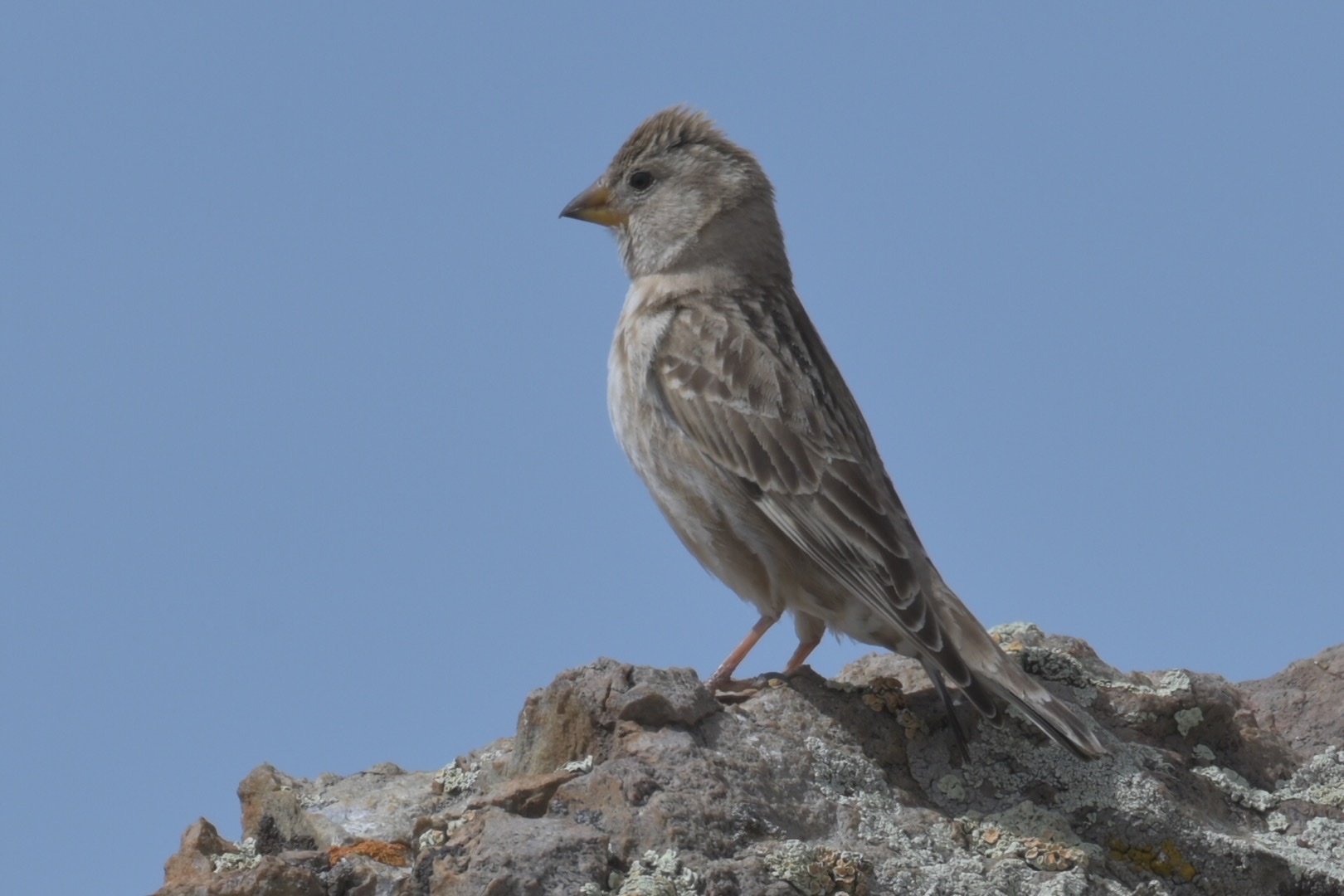
Petronia petronia
Identity and names
Rock Sparrow, Petronia petronia, is Moineau soulcie in French and belongs to Passeridae within Passeriformes. At about 14–16 cm long, it looks stocky and strong-billed. It is distinct from Pale Rockfinch Carpospiza brachydactyla and Yellow-throated Sparrow Gymnoris xanthocollis. Similar vernacular names, or yellow appearing on two different species, do not make them interchangeable. Including the scientific name is particularly useful when comparing photographs and regional records.
Identification
Brown and grey dominate, with streaking above and on the breast and flanks. The head is boldly patterned, including a broad pale eyebrow and paler central crown stripe. Adults possess a small yellow throat patch that may be concealed by feathers or viewing angle; failure to see it does not exclude the species. The sexes resemble each other, while juveniles lack the yellow patch. White tips to tail feathers show in flight and complement, rather than replace, the other identification features.
Habitat, food and behaviour
Stony slopes, short grass, dry farmland and mountain villages provide suitable surroundings, sometimes including old walls and buildings with cavities. Rocks alone are insufficient: birds also need food, accessible feeding surfaces and safe nesting and resting places. Seeds, grain and some fruit are eaten, with insects increasingly important during chick rearing. Birds frequently forage on the ground and become sociable outside breeding. Repeated calls may reveal a flock whose brown plumage blends into earth and stones.
Range and Arab occurrence
The range extends from southern Europe and North Africa east into Asia. Distribution accounts list resident occurrence in Morocco, Algeria and Tunisia, as well as parts of the Levant. Lebanon’s 2026 guide describes a common resident mountain breeder, nesting from early April to early August around 1,300–2,200 m and descending in winter. Iraq’s specialist checklist describes a local resident breeder in northern hills and mountains. None of this implies abundance across desert plains or throughout the Arabian Peninsula.
Breeding and development
Nests occupy rock crevices, wall holes or tree cavities, sometimes in older buildings. A usual clutch contains approximately 4–7 eggs, incubated by the female. References place incubation broadly within 11–15 days and nest departure around 18–22 days, varying among populations, conditions and definitions. Two broods may occur when the season permits. These ranges are more useful than a universal single-day figure, and never justify opening cavities to check development. Repeated adult visits do not warrant inserting a camera into an entrance.
November and responsible observation
In November, consider elevation as well as country. Increased numbers at a lower site may represent descent from nearby mountains rather than long-distance migration across borders. Watch slopes and adjoining fields from existing tracks and record approximate elevation, flock size, weather and feeding surfaces. Repeat visits to one site make changes easier to interpret than a lengthy pursuit of a moving flock. Do not flush birds to expose their white tail spots; wait for natural movements between feeding and resting places.
Conservation
Globally Least Concern, the species still benefits from protection against quarrying, damaged slopes and removal of vegetation or cavities. Suitable mountain landscapes combine open feeding ground with hiding and nesting places; losing either can matter even when the other remains. Repairs to occupied walls or buildings require attention to season and local law. Local abundance is neither permission to shoot birds or damage nests nor evidence that every population is secure.
References
AviList Core Team — AviList v2026; Oiseaux.net — Moineau soulcie; Oiseaux-Birds — Rock Sparrow; BirdLife International / IUCN — Petronia petronia assessment; UNDP / ABCL / Ministry of Environment — Birds of Lebanon, 2026, p. 390; Salim et al. — An annotated checklist of the birds of Iraq, Sandgrouse 34, 2012; African Bird Club — Rock Sparrow records, Morocco.
Photo: Лариса Артемьева