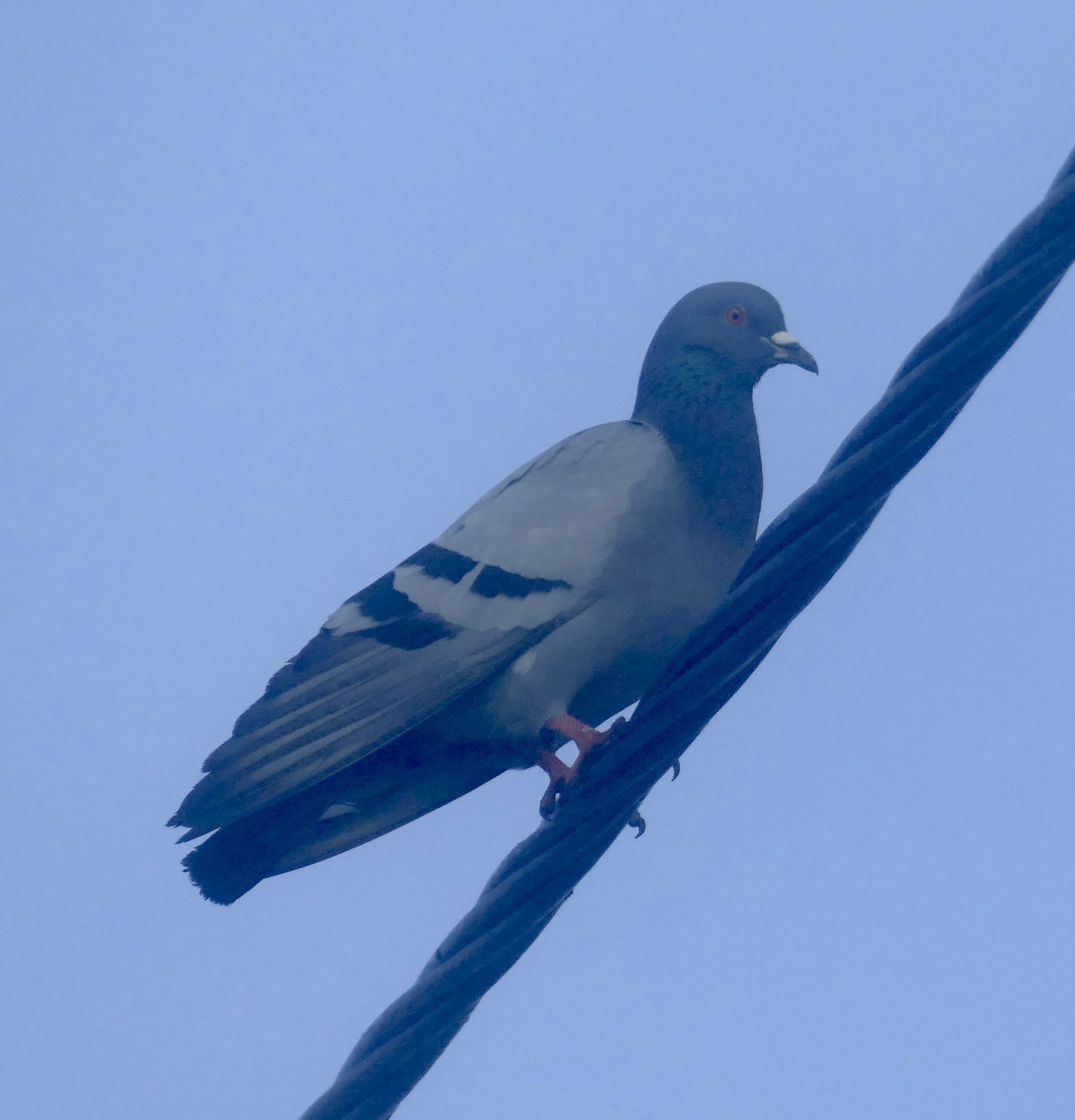
Columba livia
Identity and identification
Rock Dove Columba livia belongs to Columbidae and is the wild ancestor of domestic pigeons. Typical wild-type birds are grey with two black wing bars, a pale rump and green-purple neck gloss. Feral city pigeons can share this appearance, so colour alone cannot establish genetically wild ancestry. It is placed in the order Columbiformes. The IUCN category carried in AviList 2026 is Least Concern (LC).
Habitat, food and behaviour
Wild birds nest on coastal and inland cliffs and in caves, feeding on seeds and grain in open country. Domestic and feral forms exploit buildings and human food. Flocks travel to feeding and watering places; dependence on people varies among populations.
Breeding and parental care
Usually two eggs lie in a simple nest on a ledge or sheltered site. Both parents incubate for about 18–19 days and feed chicks crop milk, progressively adding plant food. Repeated broods are possible when conditions permit; urban productivity cannot be assumed for every wild cliff population.
Range and Arab occurrence
Its native wild range includes the Mediterranean, North Africa and Middle East. Lebanon’s checklist describes a cliff-nesting breeding resident. Feral pigeons are widespread around Arab cities. Distinguishing these categories matters when describing natural habitats or counting wild populations.
Seasonality and observation
Usually resident where rock sites and food persist, it can be observed in November. Habitat, behaviour and distance from settlements should accompany plumage notes, while mixed ancestry remains possible. A single photograph should not be labelled proof of genetically pure wild origin.
Ecological role and conservation
It consumes seeds and supplies prey for several raptors. Domestic introgression threatens original wild populations, alongside cliff disturbance and habitat loss. Urban pigeon management differs from protecting wild ancestry; avoiding indiscriminate feeding also improves conditions for urban flocks.
References
Ramadan-Jaradi et al. — Updated checklist of the birds of Lebanon, Sandgrouse 42 (2020), 186–238.
University of Michigan Museum of Zoology — Animal Diversity Web: Columba livia.
AviList Core Team — AviList: The Global Avian Checklist, v2026 (20 October 2026).
Photo: Jean-Paul Boerekamps — CC0 1.0.