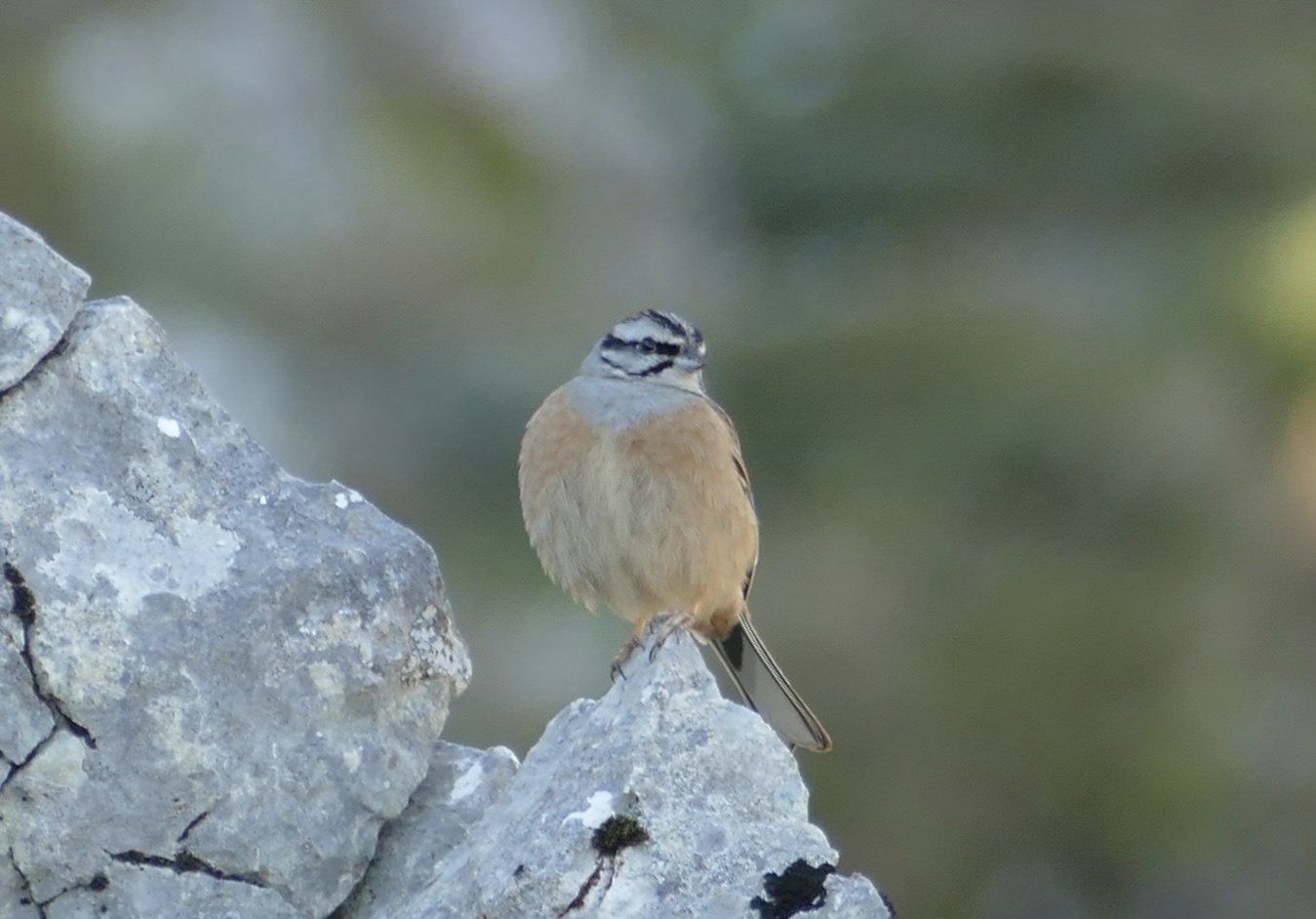
Emberiza cia
Identity and names
Rock Bunting, Emberiza cia, is a small passerine of the bunting family Emberizidae. Its French name is Bruant fou; Arabic references use درسة الصخور or درسة الصخر. These are names for the same species, which should not be confused with other buntings sharing rocky landscapes. The 2026 Lebanon guide gives a length of about 16 cm, wingspan around 26 cm and weight around 30 g. A short conical bill and fairly long tail contribute to its recognizable shape.
Identification
The adult male combines a pale grey head with strong black stripes, a streaked brown back and warm buff to chestnut underparts. The facial pattern matters as much as the body colour: look for the arrangement of dark lines above and through the eye and below the cheek. Females and juveniles are less contrasting, with a browner head and paler underparts. White on the outer tail is useful when visible. A faded head pattern should not be mistaken for proof of another species without examining the whole bird.
Habitat and food
Rocky slopes with scattered low vegetation provide a mixture of cover, perches and accessible ground. Open mountain scrub, stony grassland, sparse woodland margins and some terraced landscapes can be suitable. Food changes with season: insects and other small invertebrates are important during breeding, particularly for growing chicks, while grasses and other plants supply many of the seeds eaten outside that season. Birds feed on the ground or take seeds directly from plants. Retaining rough vegetation around rocks preserves feeding patches that a uniformly cleared slope would lose.
Range and Arab occurrence
The range extends from northwestern Africa through southern Europe and parts of western and central Asia towards the Himalayas. Resident populations occur in the Maghreb, including Morocco, Algeria and Tunisia. In Lebanon, the 2026 guide describes a common breeding resident of rocky mountains, especially near cedar-grove margins, with breeding mainly at 1,000–2,400 m and downward movement in winter. Kuwait presents a sharply different picture: the local reference classifies Rock Bunting as an extremely rare vagrant and non-breeder. A mountain resident in one country is therefore not necessarily a regular winter visitor throughout the Arab world.
Breeding and development
The female builds a cup nest on the ground, sheltered by vegetation or rock. Specialist references describe a usual clutch of 3–5 eggs and female incubation lasting roughly 13–15 days. Both parents feed the chicks. Young may leave the nest after about 9–13 days but still need parental care; departure is not immediate independence or necessarily strong sustained flight. The Lebanese guide places local breeding from late April to late July. Nesting schedules vary elsewhere, so this country-specific season should remain distinct from the species’ wider breeding calendar.
November and responsible observation
In November, lower slopes may become more relevant than the high summer nesting grounds. Outside breeding, birds can gather in small feeding groups; neither a group nor a single late-autumn record proves long-distance migration. Watch from a path or a stable viewpoint and note the ground vegetation, altitude and flock size. Avoid pushing birds across exposed terrain to obtain a flight photograph. A quiet pause often allows feeding to resume and gives time to examine the head stripes, bill and tail without chasing the group.
Conservation
The global conservation category is Least Concern, LC. This is not permission to overlook local habitat damage or indiscriminate shooting. The Lebanese guide identifies habitat loss and degradation, illegal hunting and warming among pressures. Conserving a varied mountain landscape means retaining seed-bearing vegetation, scattered shrubs and undisturbed nesting cover alongside the rocks. Records with dates, locations and behaviour are particularly valuable where the species is rare, because they distinguish a documented exceptional visitor from an unsupported claim of regular seasonal presence.
References
UNDP / ABCL / Ministry of Environment — Birds of Lebanon, 2026, p. 429; Oiseaux.net — Bruant fou; BTO — BirdFacts: Rock Bunting; KuwaitBirds — Rock Bunting; Avibase — Emberiza cia; Museo Nacional de Ciencias Naturales / CSIC — Enciclopedia Virtual de los Vertebrados Españoles: Emberiza cia; State of India’s Birds — Rock Bunting.
Photo: Jean-Paul Boerekamps